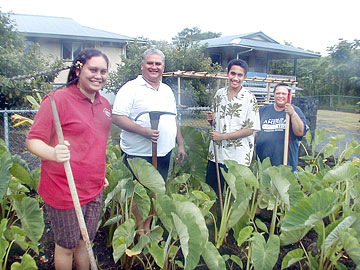
 ROD THOMPSON / RTHOMPSON@STARBULLETIN.COMThe Neves family takes a break from tending their front-yard taro patch in the Keaukaha Hawaiian Homes area of Hilo. From left are daughter Akala, father Paul, son Kinohi and mother Wanda. |
|
Neves family immersed in culture
The Neves family strengthens bonds through the Hawaiian language
HILO » Akala Neves spent her student years in Hawaiian language immersion on the Big Island, but that didn't prove to be a barrier when she attended Harvard University as a junior in high school.
Last June, Akala took an intensive course in neurobiology at Harvard Medical School. Naturally the course was in English. When she finished the neurobiology course, a professor urged her to become a doctor.
Parents Paul and Wanda Neves hoped for this type of success when they enrolled Akala in the Hawaiian-immersion Punana Leo preschool in 1992. For the Neveses, which include Akala, now 17, and Kinohi, 14, Hawaiian-immersion education has been a family undertaking.
Punana Leo parents were required to study Hawaiian like their children. They had to join in "hana makua," hands-on help with the program. The commitment continued at the K-12 Nawahiokalaniopu'u immersion school (Nawahi for short).
"I wanted them to speak the Hawaiian language," said Paul, a kumu hula.
But Wanda, a cruise ship security guard, added, "It was more like we just wanted to have a loving, good family."
For her, the motivation was simple. "I had a very terrible childhood," she said. That included alcoholism in the family and not enough food.
Paul's childhood was even more complex. The 13th child among 15 siblings born and raised in San Francisco, Paul was taught to have pride in being Hawaiian by both his Hawaiian mother and his Portuguese-American father.
When he was 14 and his family returned to Hawaii, Paul expected "paradise." The reality brought a shock.
"Why are Hawaiians so poorly dressed?" he wondered. "Why are they not doing so well in school?"
Growing to adulthood, Paul became a lay pastor in the local Catholic church. In 1989, he attended six months of training by the World Council of Churches in Geneva, Switzerland, learning how to make social changes based on Christian principles.
In Geneva, trainees from many nations all spoke English to some degree, and Paul was struck by their intelligence. None suffered intellectually because they spoke other languages too.
Returning home, he didn't wanted to "save" Hawaiian, but simply to use the language he saw all around in names and phrases.
In Hawaiian immersion, the Neves family also learned Hawaiian culture.
Every school day, students chant together outside, asking permission to enter. Little children learn not to giggle at something strange in a different culture.
A student who makes a major mistake, like cheating on a test, must stand before his family and the whole student body, apologizing and telling what he learned from the mistake.
Unlike his sister, Kinohi is shy, his father says. Kinohi agrees. But at a moment's notice, Kinohi can stand in front of a crowd of strangers and deliver a speech welcoming them to his school, because that is part of the culture the school teaches.
Nawahi is part of the state Department of Education. When officials visit the school, they ask Akala what class she teaches. Akala has to explain that she is a student, not a teacher.
Many think Hawaiian immersion means no English. Actually, from middle school on, many of Nawahi's textbooks are in English, including literature, Akala said. Students simply discuss the texts in Hawaiian.
"We're able to turn it on and off like hot and cold water," Akala said. "You're thinking in both languages."