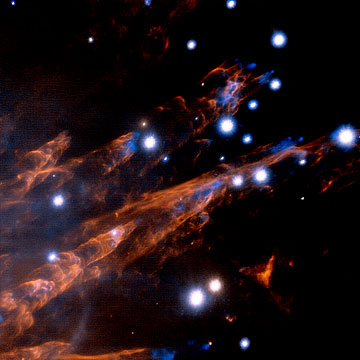
COURTESY GEMINI NORTH OBSERVATORY
This composite image taken at various infrared wavelengths shows the "Orion bullets" as blue features and represents the light emitted by hot iron gas. The light from the wakes, shown in orange, is from hydrogen gas. CLICK FOR LARGE
|
|
Scope captures cosmic gas 'bullets'
Gemini issues a clear image of blobs that hurtle through space
HILO » Enormous "bullets" of gas plowing through space like ships through water have been revealed in an image created by Gemini North Observatory on Mauna Kea using a special laser technique.
The exceptionally clear image was released yesterday by Gemini.
The clumps of gas look like mere specks on images from smaller telescopes, yet each one is about 10 times the size of our solar system.
Trailing each bullet is a wake of hot gas like the wake of a speedboat. Each wake is so big that a flash of light, starting at one end and moving at the speed of light, would need 10 weeks to reach the other end, Gemini officials said.
Astronomers believe the huge blobs of gas are a thousand years old, shot out of a nebula or cloud of gas where stars are forming.
This is all taking place in the Orion Nebula, the middle, seemingly starlike object in the sword hanging from Orion's belt in the constellation named for the ancient hunter. The nebula is almost next door, 1,500 light-years away.
The "Orion bullets" were first seen in 1989. Michael Burton at the University of New South Wales, Australia, was one of the first to suggest they were blobs of shooting gas.
"What I find stunning about the new image is the detail it shows, which was blurred out in any previous studies, revealing the structure of the bullets and their trailing wakes as they run into the surrounding molecular cloud," Burton said in a Gemini statement.
The Gemini staff was able to create the spectacular image, constructed by combining three images taken in different ranges of infrared light, because of its 26-foot main mirror, its use of "adaptive optics" and a new laser that makes the optics work.
Adaptive optics samples turbulence in the air that makes stars twinkle, then smoothes out the twinkle by lightning-fast changes in a special mirror.
But that works only because the degree of twinkle is detected by looking at a known star. In Gemini's case they create an artificial star with a new laser.
The laser is tuned to light up sodium 55 miles up in the atmosphere, left over when meteors burn up, Gemini spokesman Peter Michaud said.
Gemini installed the new laser almost a year ago, but adjustments are still being made, Michaud said.
The Orion Bullets image was produced in the process of making the adjustments.


