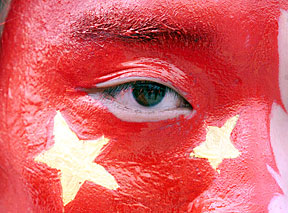
Will the real China please stand up?
It has been influenced by several political ideologies during its sometimes turbulent history
LOOK EAST
Bill Sharp
STARTING in the 1950s and running in reincarnated form until 2002, "To Tell the Truth" was a popular TV game show where panel members queried contestants to try to distinguish who really was the person introduced by the announcer. At the end of questioning, the real person had to stand up. Today, the world seems in as much of a quandary as the panelists often were, as it tries to decipher the "real" China. Is it Marxist, Leninist, Stalinist, Maoist or, as many declare, capitalist, just like the United States? Will the real China please stand up?
Marxist
As created by Karl Marx and Friedrich Engels, Marxism interprets historical evolution as a reflection of society's productive powers. Marx and Engels are concerned with social classes, especially the "proletariat," or those who provide labor but who do not own the means of production, and the "bourgeoisie," who own the means of production and employ the proletariat.
Marxists see society progressing in a linear fashion through four stages: feudalism, capitalism, socialism and communism. Progression is energized by focusing attention on cultural and philosophical shortcomings that prevent advancement to the next stage. As each hurdle is overcome, a new synthesis of thought is created. Society ultimately will reach the stage of communism where each gives according to his ability, to each according to his need. There will be no need for a coercive state bureaucratic apparatus, since everyone will be equal.
Contemporary China is generally free of the Marxist rhetoric that dominated in the past. There is no talk about class struggle or proceeding from one stage of history to the next. Use of Marxist symbolism and jargon is primarily reserved for opening ceremonies at such formal events as the National Party and National People's Congress.
Leninist
Marxism-Leninism combines Marxism with Russian revolutionary Vladimir Lenin's economic and political theories. Lenin emphasized the role of a Communist Party populated by professional revolutionaries and the dominant role of the state. Both the party and the state would act in the name of the proletariat to guarantee their well-being. Religion was to be strictly controlled since Lenin felt that it weakened the proletariat to the point where they were easily exploited.
Lenin brooked no deviation and had no compulsion about using the coercive powers of the Cheka (forerunner of the KGB) to ensure compliance. Economically, Lenin introduced the New Economic Policy (NEP) in 1921, which allowed farmers to sell surplus production after a tax in kind was paid to the state. As a result, agricultural production exploded.
Like Lenin, the Chinese believe in the supremacy of the party and strict control of religion. China is especially fearful that religion could serve as an avenue of hostile or unfriendly foreign influence that might challenge party dominance. Many Chinese leaders of earlier generations were educated in the Soviet Union and had closely studied its economic development. Thus China's post-Great Proletarian Cultural Revolution economic recovery and post-1978 economic development plans were in part politically legitimized by Lenin's use of economic incentives in the NEP.
Stalinist
"Stalinist" refers to a system of government that adheres to basic Marxist principles and the Leninist view of party and state pre-eminence. While Lenin employed coercion, Stalin employed terror and fear on a society-wide scale. His purges of the 1930s and decimation of agricultural peasants underline that fact. His unpopular collectivization of agriculture no doubt contributed to further peasant unrest.
Stalin ended Lenin's NEP and began a system of economic development based on five-year plans that featured greatly expanding heavy industry to strengthen the Soviet Union against the West. Stalin was a tyrant, but his defenders argue that without him the Soviet Union might not have emerged victorious in World War II.
Stalin's rule was punctuated by unrelenting self-deification. China's post-1978 economic development sought to increase steel production, but to a much greater degree it got jump-started by the promotion of light industry and consumer goods -- something Russia still lacks. China's agricultural production has grown more in line with the Lenin's NEP than with any aspect of Stalinism. Stalinist is a more appropriate description of North Korea, where deification and terror play key roles in sustaining the leadership.
Maoist
The essence of Maoism was formulated while Mao Zedong and the party were based in Yanan, in northern Shaanxi Province, during World War II. Mao understood the importance of economic development in making China strong, but he insisted that a fundamental transformation of Chinese people's political thought was needed first. Agricultural peasants represented the largest segment of Chinese society; therefore, Mao launched a peasant-based revolution. Mao further wished to stamp out Confucian influence because he felt that Confucian decorum -- how one should relate to another through a rigid system based on age and gender -- made Chinese meek.
Strongly influenced by Marxism, Mao was a proponent of permanent revolution. Theoretically, he emphasized the need for "struggle" or the need for those with bad (anti-revolutionary) class backgrounds to confront the contradictions in their behavior that prevented them from becoming more revolutionary. Mao's stature grew during the Yanan Period when he effected "mass line," which forged strong bonds between the party and the peasants and required party officials to produce policies that the peasants wanted.
Because he is the one that created the New China, Mao is held in high esteem by large numbers of Chinese who regularly visit his hometown, mausoleum and other places of revolutionary significance. Yet given his excesses during the Great Leap Forward and Great Proletarian Cultural Revolution (1966-1976) and the millions who died or were killed because of him, Chinese do not wish a return to the past. Save for a few scattered groups such as the Maoist Nepalese guerrillas, who seek to remodel Nepal in a Maoist fashion and who the Chinese government openly considers an embarrassment, Maoism lacks appeal.
Capitalist
I cringe when I hear or read bold claims that China is capitalistic, just like the United States. Left in near economic ruin due to the excesses of the Cultural Revolution, the Chinese government sought economic incentives to restart agricultural production. Private plots allowed farmers to grow a certain amount of crops for the state and then to sell their surplus on the free market. Clearly, the contemporary Chinese economy employs certain capitalistic conventions. It is mind-boggling to listen to lectures by senior Chinese Communist Party officials extolling the virtues of market forces. Yes, some smaller Chinese businesses might well be completely privatized, but China is far from being morphed into a replica of the United States.
State-owned enterprises are the bedrock of the economy and, while many have been partially privatized, the state still holds decisive, overriding control, said Yining Li, a professor and dean emeritus of the Guanhua School of Management at Beijing University, former member of the Chinese National People's Congress, and key author of Chinese privatization law, while recently visiting Hawaii Pacific University. Venture capitalism has contributed much to the United States, but it is in a very early stage in China. The party is the pre-eminent institution in China whose tentacles reach everywhere. Thus there is no American sense of laissez faire. The party's concern for maintaining pre-eminence impedes real judicial reform, wider use of elections, greater access to Internet news, complete privatization of state-owned enterprises or the creation of any other center of countervailing power.
SO, WILL the real China please stand up?
Minxin Pei, director of the China Program at the Carnegie Endowment for International Peace, writes in the March/April 2006 issue of Foreign Policy, that China might best be described as a "neo-Leninist state." Pei's view is based on the strong role of the party-guided state in controlling key sectors of the economy and blocking democratic development. When necessary, the state uses coercion to preserve its economic and political dominance. Somewhat reluctantly, Pei acknowledges that China has successfully used market forces to achieve great growth; however, he states that China's growth isn't as impressive as Japan's, South Korea's or Taiwan's.
In a 2005 statement, World Bank President Paul Wolfowitz said, "China, as we all know, has been the fastest-growing economy in Asia for the past 20 years and has lifted more than 400 million people above United States $1-a-day poverty levels in that time." Nevertheless, Pei maintains that the model has caused expenditures for health, education, housing and old age pensions to be cut, causing a particularly severe effect in the countryside; yet 30 percent of gross domestic product goes to bail out banks that continue to make politically connected loans. Moreover, the regime has fostered cronyism and built its support base on the military, technocrats, foreign capital, professionals and private entrepreneurs.
Whatever China's shortcomings, it has provided economic growth and stability -- two qualities that Americans take for granted and for which Chinese have long yearned. China's future is contingent on the party continuing to provide such while effectively addressing socio-economic disparities.
Bill Sharp is adjunct professor of East Asian International Relations at Hawaii Pacific University. Reach him at
wsharp@campus.hpu.edu