Hoku posts 1st loss as public firm
It plans to use Hawaii as a base for its first solar sales
Hoku Scientific Inc. announced yesterday its first losing quarter since going public, but also said that by midyear it could see its first revenue from its new solar-cell business.
Initially, that business will operate out of Hawaii, not Idaho, where the company plans to build a large-scale solar materials plant.
The Kapolei-based alternative energy company, which last week landed a $370 million polysilicon supply deal with
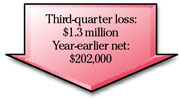
Sanyo Electric Co. Ltd., swung to a fiscal third-quarter loss of $1.3 million, or cents a share, from a net gain of $202,000, or 1 cent a share, a year ago. The loss primarily was due to a non-cash write-down of capital equipment and inventory of $785,000 used in the company's fuel-cell business.
Revenue fell 35.3 percent to $1.1 million from $1.7 million, with all the revenue continuing to be generated from contracts related to Hoku's fuel-cell technology business.
Dustin Shindo, chairman, president and chief executive of Hoku, said on a conference call yesterday the company received $2.8 million in solar cells last quarter purchased from Taiwan-based E-Ton Solar Tech Co. Ltd., and that he expects Hoku to generate its first solar module sales in Hawaii during the fiscal quarter ending in June. He said Hoku would outsource module production or acquire third-party modules, as necessary, until its own module production line is operating next quarter.
"We're positive about the Hawaii opportunity," Shindo said. "That's why we're placing our equipment here initially. But in terms of how big (the demand) would be, obviously that's uncertain."
Hoku Chief Financial Officer Darryl Nakamoto said Hoku is in discussions with "a variety of businesses" and that the company plans to sell solar modules to both residential and commercial customers.
"We purchased equipment for solar module manufacturing for up to 15 megawatts at our current facility," Nakamoto said. "If we outgrow capacity, we'll definitely expand to Pocatello." Hoku chose Pocatello, Idaho, earlier this month as the site of the company's new polysilicon plant.
Piper Jaffray & Co. analyst Jesse Pichel said investors need to look beyond the loss in the latest quarter because of Hoku's emergence in the booming solar market.
"The quarterly results are irrelevant to the investors because with the fuel-cell macro environment stagnant, solar is of primary concern," said Pichel, who has an "outperform" rating on the stock. "It appears that the company is on track to offer both Hoku solar modules by the end of '07 for the Hawaii market, in addition to a polysilicon feedstock plant (in Idaho by the end of 2008 with operation beginning in 2009)."
Hoku, which went public in August 2005 with the hope of capitalizing on the commercialization of fuel-cell technology, has been focusing its efforts recently on the growing market for polysilicon, which is used to make solar panels.
Investors have jumped on the Hoku bandwagon and pushed up the stock more than double since the start of this year. Hoku's shares, which rose 34 cents to $6.14 yesterday, are down 33.6 percent over the past 12 months but up 135.3 percent since Jan. 1. The stock is trading just slightly above its initial public offering price of $6.
Pichel said investor enthusiasm may be warranted but that proper caution needs to be exercised.
"We don't use 'speculative' with Hoku, but we say there's substantial execution risk involved with building a polysilicon plant," he said. "I don't know how the company would be doing better than it is now. It seems to be making all the right moves, but I believe their hiring of the right engineering firm and their contracting for some of the polysilicon equipment lessons the risk. Still, investors should not blindly buy the stock, as it is quite volatile."
Shindo said the company is pleased with the progress it has made over the past several months in its solar and polysilicon businesses and with the performance of Hoku MEA, its membrane electrode assemblies that are being incorporated in IdaTech LLC's fuel-cell systems in a U.S. Navy field demonstration at Pearl Harbor Naval Station. Hoku had $1.7 million in deferred revenue with the Navy as of Dec. 31.