ASSOCIATED PRESS
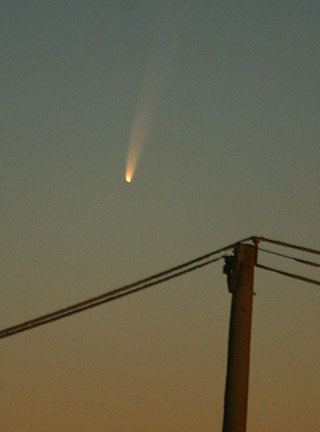
The Comet McNaught appeared across the sky in Barrow, Alaska, on Monday. The comet was discovered only six months ago. CLICK FOR LARGE
|
|
Isles get comet viewing opportunity
A comet discovered only six months ago and reported to be the brightest in 30 years might be seen here for the last time tonight, weather permitting.
Comet McNaught was closest to the sun Friday and is now rounding it to head farther out into the solar system again, said Carolyn Kaichi, Bishop Museum Planetarium manager.
"It's clearly visible as a comet with a tail," she said, adding that she saw it right after sunset Friday. But by tomorrow, it will be so close to the sun she believes it will no longer be visible.
The best time to look for it is right after sunset (6:10 p.m. today) until about 6:30 p.m., she said. "The window is really small."
The leeward side of the island or anywhere the setting sun can be seen is a good place to watch for the comet, she said.
It will be very low on the horizon, she said.
She recommends using binoculars but warns not to use them until the sun is completely set to avoid risking damage to the eyes.
"Otherwise it's a really nice sight."
Kaichi said she had reports that the comet is bright enough to see in the day but it means looking in the direction of the sun so people should use their hand to block out the sun.
She tried yesterday and couldn't see it, she said.
The comet is named for its discoverer, Australian astronomer Robert McNaught, who spotted the faint object Aug. 7 in a photograph taken at the Siding Spring Observatory in South Wales.
NASA astronomer Tony Phillips said Comet McNaught is the brightest comet visible from Earth in 30 years. It is six times brighter than Hale-Bopp in 1997, and 100 times brighter than Halley's Comet when it appeared in 1986, Phillips told the Associated Press.
"It may be bright," Kaichi said, "but it's not a good time to view it, which makes it less spectacular to most people."


