OFFICE OF HAWAIIAN AFFAIRS
CRAIG T. KOJIMA / CKOJIMA@STARBULLETIN.COM
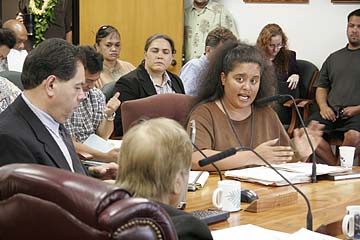
At an Oct. 5 meeting of the Office of Hawaiian Affairs, Leimaile Quitevis testified that the U.S. military was not adequately protecting Hawaiian artifacts.
|
|
OHA board election will fill 5 seats
The winners and the incumbents have serious tasks to face
Making the push for Hawaiian self-governance to supercede future legal entanglements will be a major mission for the Office of Hawaiian Affairs, which has five open spots among its board of trustees.
Three at-large seats and one seat each for Oahu and Maui are up for the general election this year, with 23 candidates overall.
Chief among the concerns for the new board is the ongoing threat of lawsuits challenging the agency's constitutionality, said Deputy Administrator Ron Mun.
The perceived vulnerability stems from a U.S. Supreme Court decision in 2000 that threw out Hawaiian-only elections for the board. After that decision, non-native Hawaiians could vote and run for the board.
"I think the second thing, of course, is the fact that we have to begin the plan for nationhood, despite the fact that Congress didn't pass the federal recognition bill," said board member Rowena Akana, who seeks re-election this year. "I don't believe that this is a dead issue."
Akana is referring to what is known as the Akaka Bill in Congress, after U.S. Sen. Daniel Akaka, which seeks federal recognition and the right for self-governance.
Akana said legal action against OHA is costly, and passage of some kind of federal recognition document would stave off future court cases against the agency.
"It's a long process, definitely not something that's going to happen overnight," Akana said.
Walter Heen, a retired appellate judge and former Democratic Party chairman, said because the bill was defeated at the federal level, it's important that the board focus on trying to organize sovereignty at the state level.
After the bill failed in Congress, OHA drafted a governance plan called the Hoolu Lahui Aloha, or "to raise a beloved nation." This would involve negotiating with the state government in transferring existing Hawaiian assets to a new governing body. The state would then take negotiations on the federal level.
Heen also said it's important for the board to reach out to the general community.
"It's a question of how OHA can best partner with programs to raise the levels of opportunity for native Hawaiians, and at the same time for the general community," Heen said.
IN THE OHA BOARD ROOM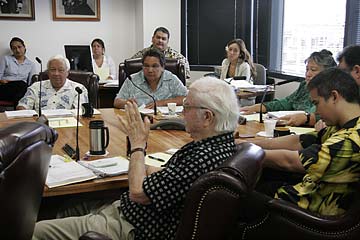
CRAIG T. KOJIMA / CKOJIMA@STARBULLETIN.COM
Office of Hawaiian Affairs members and participants listened to discussion at an Oct. 5 meeting.
|
|
Voters will choose between a wide variety of faces for the OHA board, including incumbents Akana, former Big Island Mayor Dante Carpenter, retired Judge Boyd Mossman, former Bishop Estate trustee Oswald Stender and John Waihee IV.
Also among the candidates is longtime sovereignty activist Dennis "Bumpy" Kanahele, leader of the Nation of Hawaii, and Roy Benham, a former teacher from Kamehameha Schools.
Mun said because of the wide variety of candidates, he advises voters to make sure to vote for all five available seats.
"The point is, you have to reside in the area to run for those island seats, but the voter is voting for all of them," Mun said.
Akana, a trustee since 1990, said voters also should be mindful of the candidates' community experience, and how it can translate to benefiting and growing the agency's $400 million trust.
"I believe people should know that voting for an OHA trustee is not like voting for a legislator or city council, where your specific duties are spelled out," Akana said. "The candidates have to have worked with the Hawaiian community for any length of time to understand who the Hawaiians are."