[ INSIDE HAWAII INC. ]
RICHARD WALKER / RWALKER@STARBULLETIN.COM
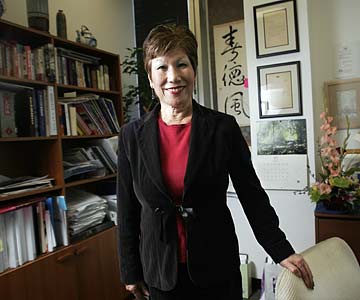
Masako "Nashi" Nashimoto-Luttrell, president and owner of Nashimoto & Associates, is receiving the governor's award for exemplary service to Hawaii's retail industry.
|
|
Nashimoto-Luttrell retails isle dreams
Question: Tell us about your company.
Answer: The client's level is the internationally known, which requires high professionalism and then communication skills. And then because most of them are located in New York or Los Angeles or California or Japan... the communication via conversations on the phone need a very skillful quality. New York, Hawaii have totally different cultures, also Tokyo, Hawaii have different cultures, so it has to be sensitive to cultural differences linguistically, has to be highly professional, understanding what they want, what they need -- and then I have to express what we can do, what we cannot do. In that way, I think we are unique. I am from Japan, born, raised and educated, and then started working for Japanese companies, then American companies, then Guam then Hawaii. So (it was) very difficult (to be) Japanese working in foreign countries without any major backup. I started by myself and then I carried on 25 years helping clients and also associates.
MASAKO 'NASHI' NASHIMOTO-LUTTRELL
» Recognition: The president and owner of Nashimoto & Associates is receiving the governor's award for exemplary service to Hawaii's retail industry. Originally from Japan, Nashi came to Hawaii in 1981. Her company, which does advertising, public relations and marketing for the Japanese market, has been around ever since, weathering the downturns in Hawaii's Japanese visitor market. The award was presented during a Retail Merchants of Hawaii luncheon on Friday.
» Clients: Chanel, Coach, Fendi, Cheesecake Factory, Christian Dior, MaxMara, and Shokudo Japanese Restaurant & Bar, among others.
» Reaction to award: "I don't think I really deserve it. I just did what I wanted to do. Advertising, public relations, marketing, that is my whole background, all my life."
|
Q: How did you weather the downturn in tourism after 9/11?
A: We had Sept. 11, and SARS badly hit my finances. My clients suffered, which means I suffered, too. Luckily I had three tiers, one is public relations, another is advertising, another is marketing. Advertising went down, but ... public relations to make for the loss of advertising exposure, that increased, as well as marketing. So that portion of the income came up. So, luckily, because of the three tiers, I was able to balance my income.
Q: What brought you to Hawaii?
A: Marriage. I was married in Japan, then lived in Guam three years, and then my late husband needed to move to a place where communication is much better than Guam. So that's why we moved to Hawaii. But this market is the right size to begin with to found a new business, because when I was working in Japan, all of the test markets (were) about 800,000 population. To begin with, this size is easy to work with. I decided logically to do that. I could have said to my husband, "No, I don't want to go to Hawaii," but it makes sense for me to me to begin with, unlike L.A. or New York. I had two small children and thought it was once of the nicest places to raise them, environmentally.
Q: I understand that you are co-founding a nonprofit tentatively called the Hawaii Senior Life Enrichment Association.
A: This is so exciting. The 2007 Japanese nationals who retire at age 60 ... will be about 2.2 million, and then in 2010, we are going to have 6.8 million who are going to retire at age 60. That is a phenomenal number, right? So I looked at that phenomenon and I was thinking about starting something to help people like retirees to bring more to an enriched life. But I'd like to connect that concept to Hawaii's economy. That's why I established Hawaii Senior Life Enrichment Association as a nonprofit organization and I'm one of three founders. We are now in the process of (developing) detailed programs to launch for the sake of the senior people who are interested in coming to Hawaii, but to do something they have never done before, such as the ukulele, or learning quilt or maybe a beginner type of surfing or the nature walk in Hawaii or learning a foreign language in Hawaii.
We just had a meeting and all of the top companies related to Japan were entirely supportive of this program and we were very encouraged. And we contacted the state Hawaii Tourism Authority and they seemed to be supportive too.
Q: Why not go after the youth market?
A: As you know, about 10 years ago people in Hawaii think that the Hawaii market is for youth and they are the ones who spend a lot of money for brand names and all that. But that should be changed.
Q: Japanese arrivals to Oahu are down 9 percent this year, which is pulling down overall Japanese spending. How is this being felt by Waikiki retailers?
A: Arrivals are down but per-person spending is up. The Hawaii Tourism Japan strategy is, instead of pursuing quantity numbers, they are trying to get higher-spending visitors, and that seems to be working.
Inside Hawaii Inc. is a weekly conversation with business and community leaders. Suggestions can be sent to
business@starbulletin.com


