ASSOCIATED PRESS
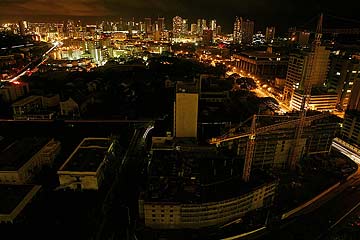
Much of Oahu was without electricity following a strong earthquake early yesterday. The Honolulu skyline was partially lit last night as seen from a rooftop. CLICK FOR LARGE
|
|
Tremors rattle isles
Two earthquakes in succession hit the Big Island the hardest | No fatalities and only minor injuries are reported statewide | Three counties lose power, forcing residents to make do
Two strong earthquakes shook Hawaii residents out of bed yesterday morning and triggered power failures in three counties.
The temblors, measuring 6.6 and 5.8, struck one after the other starting at 7:07 a.m. They had different epicenters under the ocean west of the Kona Coast of the Big Island. The first quake lasted 15-20 seconds. Several milder aftershocks followed throughout the day.
A brief history of moderate or strong earthquakes that have struck in Hawaii
Source: U.S. Geological Survey
March 28, 1868:
7.0, Ka'u district, a foreshock of the April 2 earthquake
April 2, 1868:
Ka'u district, Hawaii's largest earthquake, at 7.9, caused 77 deaths and knocked down homes made of stone, wood or straw; landslides buried homes, and a tsunami drowned dozens of the victims
Feb. 19, 1871:
6.8, Lanai
June 2, 1923:
7.0, south flank of Kilauea
Oct.6, 1929:
6.5, Holualoa
Jan. 22, 1938:
6.8, Maui
Aug. 21, 1951:
6.9, Kona
Nov. 29, 1975:
7.2, Kalapana; tsunami killed two people in Halape
Nov. 16, 1983:
6.7, Kaoiki
June 25, 1989:
6.1, off coast near Volcano
July 15, 2005
5.3, Paauilo
July 17, 2005
5.2, Naalehu
Yesterday:
6.6 (preliminary), west of Kohala
5.8 (preliminary), west of Kohala
|
The power failure on Oahu also canceled and delayed flights at Honolulu Airport, which operated on auxiliary power into the evening. Neighbor island airports also reported delays and cancellations, but most were back in operation by early afternoon.
There were no fatalities and only minor injuries were reported. Gov. Linda Lingle told reporters the most serious injury she had heard about was a broken arm.
The quakes generated a 3-inch tsunami that washed ashore on the west side of the Big Island, according to the Pacific Tsunami Warning Center.
The Department of Education planned to keep several Big Island schools closed today so they could be assessed for structural damage.
Kona Community Hospital was evacuated after ceilings collapsed and power was cut off, according to a hospital spokeswoman.
At least 10 acute-care patients were being evacuated across the island to a medical center in Hilo, said Terry Lewis, spokeswoman for the hospital. About 30 nursing-care patients were being moved temporarily to a nearby conference center, she said. But the hospital emergency room remained open.
Patients were also evacuated from North Kohala Hospital to another building on the grounds as a precaution.
Mayor Harry Kim estimated that as many as 3,000 people were evacuated from three hotels on the Big Island. Brad Kurokawa, Hawaii County deputy planning director, confirmed the hotels were damaged, but could not say how many people had left. They were being taken to a gymnasium until alternate accommodations could be found, he said.
LINGLE WAS staying at the Mauna Lani Resort in South Kohala, only a few miles from the epicenter, when the quakes struck.
"The jolt we felt was intense," Lingle said yesterday afternoon at a news conference in the state Civil Defense conference room in a former military bunker in Diamond Head Crater. "It threw everything around the room."
Lingle, who has experienced earthquakes in California, said she knew what to do when the first quake struck.
"I went under the door frame," the governor said.
Just after they straightened the room out, the second quake struck, Lingle said, sending the television in the room crashing to the ground a second time.
After leaving the hotel, Lingle went to the Kona police station to get briefed on the damage and then took to a National Guard helicopter to see the damage from the air before returning to Honolulu.
Lingle said at Kealakekua Bay a rockslide into the ocean was continuing hours after the initial quake. She said she saw boulders falling into a brownish sea.
She also witnessed patients being evacuated from Kona Community Hospital and loaded into yellow buses, although she said there was no evidence of damage to the outside of the structure.
AT THE STATE Civil Defense headquarters, Lt. Gov. Duke Aiona, acting on Lingle's behalf, signed an executive order declaring a statewide disaster and authorizing the use of the National Guard.
Lingle said Homeland Security Secretary Michael Chertoff called her and assured her that the federal government would expedite a request for a presidential emergency declaration.
A Federal Emergency Management Agency computer simulation of the quake estimated that as many as 170 bridges on the Big Island could have suffered damage in the temblors, said Bob Fenton, FEMA director of response for the region. More than 50 federal officials were en route to the Big Island to assess damage and begin recovery work, he said.
Guard spokesman Maj. Chuck Anthony said several helicopters on the Big Island were used to help assess damage, but no ground troops were called out. U.S. Sens. Daniel Akaka and Daniel Inouye were scheduled to fly over the Big Island today to survey the damage, according to a statement from Akaka's office.
State Department of Transportation Director Rod Haraga said rockslides closed Hana Highway on Maui and three highways on the Big Island. DOT engineers were to leave this morning to assess the damage and structural integrity of three bridges: a concrete bridge in Honokaa at the mile 35 marker on Highway 19, and two bridges on Akoni Pule Highway near Kawaihae.
Mamalahoa Highway was also closed because of rockslides, Haraga said.
Kawaihae Harbor was closed due to structural damage to the pier, said a Hawaii County spokeswoman. Officials were to inspect the pier and also a fuel line for leaks. There was no major damage at other harbors, Haraga said.
Jenny Duhaylonsod was on a Hawaiian Airlines flight that left Maui at 6:50 a.m., so she never felt the earthquakes.
She did not learn about the quakes until the plane landed.
"We were circling, and they said we were circling because it was raining hard," she said.
When they landed, it took 40 minutes before ground crews could bring a stairway to the aircraft so they could disembark, she said.
City spokesman Mark Matsunaga said the city's backup generator worked as expected at the Sand Island Sewage Treatment plant. But by yesterday afternoon, he said, "Everything was functioning normally."
The diesel-powered backup generator turned on after the power went out. There was a slight delay in starting the backup system; during that time, 1,200 gallons of untreated sewage spilled on the treatment facility ground.
Also at the Wahiawa sewage treatment plant, 15,500 gallons of partly treated sewage was discharged into the Lake Wilson Reservoir. Matsunaga said the sewage had been treated but had not received the final ultraviolet treatment.
IKAIKA MORI, a cashier at the Foodland on South Beretania Street, said he started work just as the earthquakes hit.
"We were running on our backup generators. The lifetime is about eight hours, and about eight hours after the earthquake, it gave out," Mori said.
Mori said his store had a line circling around the store. People were let in 10 at a time. Transactions were with cash or credit cards.
"They were really understanding. I made announcements with my loudspeaker, and they were very friendly and understanding," Mori said.
At the Safeway in Manoa, which closed around 4 p.m., Joe Burke and his son Jacob were among the lucky ones who were able to shop yesterday.
"I figured sandwiches," Burke said.
Burke said the day without power "wasn't inconvenient at all," but his young son thought differently.
"It is boring because the TV doesn't work, so you don't have anything to do," Jacob said.
Police stayed on overtime or volunteered to come in and direct traffic at major intersections in Honolulu. Drivers were urged to stay home, unless absolutely necessary, during the outage.
Electrical power was restored to the neighbor islands by early yesterday afternoon, but larger power plants that serve urban Honolulu took longer to restart. As evening fell yesterday, the smell of teriyaki meat grilling on outdoor barbecues drifted over neighborhoods where the electricity had not come on before dinner.
Star-Bulletin reporter Richard Borreca and the Associated Press contributed to this story.


