BOOKS
COURTESY IMAGE
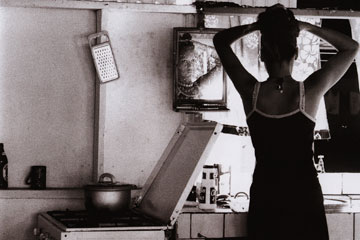
Despite the romantic images conjured by the West, contemporary French Polynesia is infused with modern culture. A young woman fixes her hair in Vaiava.
|
|
Authenticity
A new book of art, writings and photography reveals the true French Polynesia
It's easy for Hawaii residents to make fun of people who come here thinking that "Tiny Bubbles" is a traditional Hawaiian song, or that pineapples grow on trees, but how much do most of us know about Tahitian culture, or the difference between Tahiti and French Polynesia? Too little, certainly, and that makes this beautifully presented anthology of poetry, prose and artwork a welcome look at the indigenous arts scene growing there.
"Varua Tupu"
Edited by Frank Stewart, Kareva Mateata-Allain and Alexander Dale Mawyer
University of Hawaii Press
2006, $29.95
|
Terminology can be tricky. Visitors may be confused that the state of Hawaii includes an island also named Hawaii. Talk about going to Tahiti, and you're talking about a particular island in one of several groups of islands that make up French Polynesia. French people live there, as well as Polynesians, so when referring to "the French Polynesian artistic community," what does that mean? More importantly, what are these writers and artists doing?
"Varua Tupu" bridges the language barrier with a fascinating collection of fiction and nonfiction in translation that provides insights into the history and indigenous culture of people from the various island groups. A fictional account of the arrival of a group of missionaries -- yes, they went there, too! -- takes the perspective of someone in the crowd who listens patiently as the local ruler greets the newcomers with a genealogical chant that takes hours to complete.
The emphasis is on new indigenous literature and art of the islands, but several vintage photos evoke a sense of how things were a century ago. Contemporary photos offer a selected look at the present.
The artwork -- reproduced in full color on glossy paper -- is gorgeous, most of it inspired by the traditional pre-Christian culture of the islands. The cover shot of a tattooed boy attempting to charm a hermit crab is a sample of the delights within.
"Varua Tupu" is also a beautiful memorial to a Hawaii-born artist, Bobby Holcomb, who left Hawaii for French Polynesia in 1976 and remained there until his death in 1991. Holcomb embraced the people and culture of French Polynesia, and he has been much better known as an artist, sculptor, writer and recording artist there than in Hawaii.
Holcomb's work is prominently featured in the pages of this book, as are photos of the artist enjoying life in his adoptive home, and this book should increase awareness of his artistic legacy in the place of his roots -- Hawaii.
COURTESY IMAGE
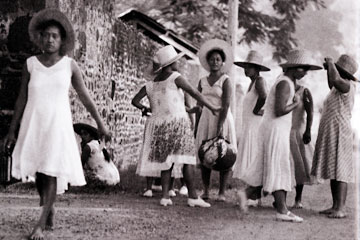
In a historical photo dated 1932, Polynesian women in Western attire wait for appointments at a hospital, above. The silver-salt print is by Roger Parry.
|
|
COURTESY IMAGE
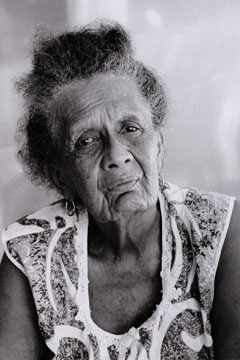
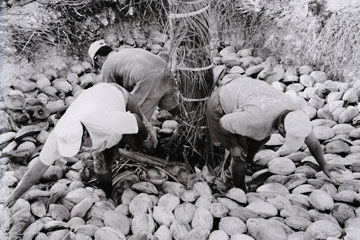
A soulful portrait from 2003 of an old woman in Makemo, Fakarava. The photo, including those below, are from the book "Tangata: A Polynesian Community" by Marie- Helene Villierme, which documents the lifestyle of the communities in the Tuamotu and Gambier Islands.
|
|
COURTESY IMAGE
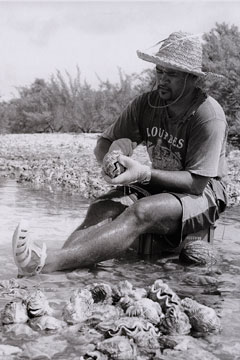
A man gathers clams in Tatakoto.
|
|
COURTESY IMAGE
Preparations of a limestone oven commence in Naupaka in 2004.
|
|