PET OHANA
SUCHI PSARAKOS / HAWAIIAN HUMANE SOCIETY
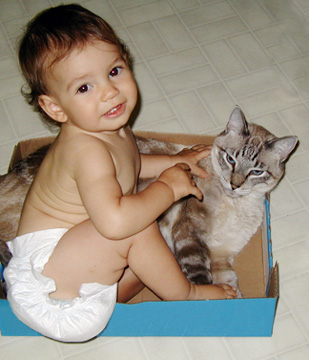
Eva loves showering her cat Oscar with affection every day, The two can have fun playing in a simple cardboard box cover.
|
|
Cats enjoy longer, healthier lives indoors
The Hawaiian Humane Society
June is Love-a-Cat month, a good time to teach an outdoor cat to live indoors.
Cats are inquisitive and enjoy exploring, but that doesn't mean they are only happy outdoors. Keeping cats inside is best. Domestic cats might find as much satisfaction prowling through your closet as they would anywhere outside.
Love-A-Cat Month
Celebrate in June:
Cat Tales: Submit your favorite cat story via www.hawaiianhumane.org and kitv.com. Winners will be announced on the KITV morning and evening news shows and promoted on both Web sites.
Adopt a cat: The Hawaiian Humane Society is offering cat food and a cat toy with every June adoption, in addition to sterilization, microchip identification and vaccination.
Visit the Cat House: Hours are 11 a.m. to 7 p.m. weekdays, 10 a.m. to 4 p.m. weekends and holidays. The shelter is at 2700 Waialae Ave.
Bless your pet
Celebrate your pets during the Pet Blessing Festival taking place at Hawaii Kotohira Jinsha -- Hawaii Dazaifu Tenmangu in observance of Pet Appreciation Week.
Reservations are not required. Bring your leashed or caged pets for a blessing any time between 10 a.m. and 2 p.m.
The shrine is at 1239 Olomea St., off Houghtailing. For more information, call 841-4755.
|
In an urban environment, cats allowed to roam outdoors face danger every day. Tangles with traffic; exposure to fleas, ticks, poison and disease; and the temptation to fight other animals all shorten their life expectancy. Outdoor cats also require more visits to the veterinarian and can cause problems in your neighborhood.
Most cats adapt easily to staying indoors, as the stress of dodging cars and the dog next door disappears. But some cats might need extra attention or training to make the transition.
If your cat has always been an outdoor cat, slowly reduce the amount of time spent outside. Your cat will adjust and in a few weeks should be converted completely to the great indoors.
Introduce the litter box: Start with litter box training immediately. Place the litter box in a quiet area and bring the cat to the area frequently. It usually doesn't take long for cats to grasp the concept, and then you can begin to keep it inside for longer periods.
Cat naps and "cat television": Provide a comfortable spot on a window ledge where your cat can watch birds and the action outside. A basket near a sunny window is an ideal place for a cat nap. You might be surprised by how much time your cat spends there. Cats sleep an average of 18 hours a day and appreciate a safe place to bask in the sun.
Bring the fun of the outdoors in: Create a play area that includes interesting places to crawl through, curl up and leap to and from. Try cutting holes in simple cardboard boxes, or make a perch where it can stretch to bat hanging toys. Add shallow shelves to a wall that leads up to a kitty loft. Grow a pot of fresh "kitty grass" that is safe for your cat to eat. To protect your furniture, always provide a scratching post. Make life indoors interesting, and that outdoor-urge will be a thing of the past.
Bond with a brush in hand: Increase the time you spend grooming your cat. Almost all cats love to be brushed, and both you and your cat will be pleased with its healthier coat. Check for fleas while brushing, and if you find some, use a treatment meant for cats (not dogs). Regularly and carefully trim your cat's claws with a special feline nail clipper. Ask your veterinarian for advice on effective grooming and flea control.
What about the lanai?: To give your cat a breath of fresh air, teach it to wear a cat walking jacket so you can walk it safely on a leash. Jackets and tips for using them are sold at the humane society. For unsupervised fun on the lanai, construct an outdoor playhouse. Make a "kitty door" in a window that leads to the enclosure. Remember that other neighborhood animals might still confront your cat at the playhouse. Though your cat is safe inside, it'll still be scared, so ease that stress by limiting the playtime.
You are your cat's best friend: Remember that outdoor-only cats have a life expectancy of just two years. The anxiety of the transition indoors is better than the danger of the streets. Keep your cat quietly comfortable while making the change. Provide companionship, exercise, play and affection. Your patience will be rewarded.
"Pet Ohana" runs the first and third Fridays of the month. The Hawaiian Humane Society is a nonprofit agency dedicated to preventing cruelty to animals. It is at 2700 Waialae Ave. Call 946-2187.