UH ingenuity finds new planet
UH team makes a discovery 600 light-years away
WAILUKU » A team including University of Hawaii astronomers using a telescope made out of store-bought camera lenses and a 50-year-old computer on Haleakala has discovered a planet 600 light-years away.
The discovery of the planet "XO-1b" in the Corona Borealis constellation was made using software developed in part by Hawaii astronomer Dr. James Heasley and Ken Janes of Boston University.
"It's really kind of cool. ... It's very exciting," Heasley said yesterday.
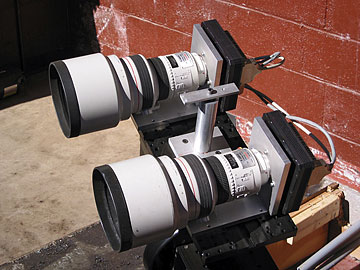
Heasley said scientists used relatively inexpensive equipment, including two 200-mm telephoto camera lenses, to scan the skies and a computer at the observatory originally designed to view satellites in the 1950s.
Heasley, a scientist with the university's Institute of Astronomy, said the computer software helped to detect slight dips in the intensity of the star's brightness, indicating an orbiting planet passing in front of the star.
"The discovery represents a few bytes out of nearly a terabyte of data: It's like trying to distill gold out of sea water," said astronomy team leader Peter McCullough, of the Space Telescope Science Institute in Baltimore.
The light from the star, called "XO-1," dips by approximately 2 percent when the planet XO-1b passes in front of it.
The observation also revealed that XO-1b is in a tight four-day orbit around its parent star and closer to its sun than Jupiter is in Earth's solar system.
HUBBLESITE.ORG
Astronomers used this inexpensive telescope to find an extrasolar planet 600 light-years from Earth. The scope is made with two 200-mm telephoto camera lenses.
|
|
The information was passed on to McCullough for further analysis and confirmation.
McCullough's team then turned to the McDonald Observatory in Texas, which used high-tech telescopes to verify it as a planet.
"It was a wonderful feeling because the team had worked for three years to find this one planet," McCullough said.
Heasley said scientists on the project have known about the planet for several months but waited until the discovery was confirmed before announcing it.
Heasley said while the planet XO-1b is probably uninhabitable for humans, there might be other nearby smaller and undetectable planets similar to Earth.
Heasley said scientists are only beginning to learn about the number of solar systems and the diversity of planets forming in the galaxy.
He said the approach used on Haleakala involved viewing a piece of sky over and over again and using a computer software program to sift through thousands of stars.
Heasley said the kind of equipment used at the current time allows scientists to find only larger-size planets.
"The kind of equipment we're using isn't sensitive enough to find the Earth kind of planet," he said.
Although astronomers have detected more than 180 extrasolar planets, XO-1b is only the 10th planet discovered using the transit method and the second planet found using telephoto lenses, the Space Telescope Science Institute said.
The first, dubbed TrES-1, was reported in 2004.


