|
Sidelines
Kalani Simpson
|
This Doerr’s still open
Memories of Ted and dreams of baseball remain vivid
HE still dreams about it, sometimes. Playing baseball. It's been more than 50 years since he left the majors, but the game won't let him go, especially at night. He dreams about playing -- once sent a bedside lamp flying when he thought he'd bobbled a grounder at second base.
He played for the Red Sox, 1937-1951, with time off for the war in between. He's in the Hall of Fame. He's 88 now, all this long behind him, a lifetime ago. And yet still, every once in a while, "I catch myself taking batting practice," Bobby Doerr says.
He's still in the game, in these dreams. As if he'd walked out of a magic cornfield, still with the Red Sox, still young.
"My whole life, since I was a kid, I wanted to be a ballplayer," Bobby Doerr says.
In life, if you're lucky, you come across one or two great friends.
Ted Williams was Bobby Doerr's great friend.
COURTESY BOBBY DOERR
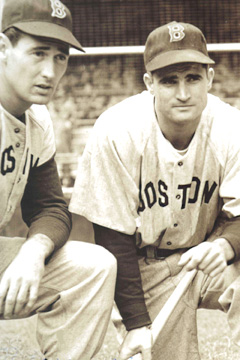
Former Boston Red Sox Bobby Doerr, who visited family in Hawaii recently, knew the soft side of Ted Williams, left.
|
|
BOBBY WAS KNOWN for being one of the nicest guys in the American League, and Ted's personality could sometimes be best summed up, politely, as "being Ted." It couldn't have been easy to be Ted Williams' friend. Maybe it just worked out perfectly that Bobby Doerr was the best man for the job.
Their bond was born on train trips, as the long hours were eased by the soothing rocking, the miles flying by beneath their wheels. Baseball lost much when it left the rails, Doerr says. There was something special about it, the secrets shared, cards played, lies told. Boundaries broke down, friendships were cemented. These were kids' sleep-overs for grown men.
He and Williams went to cowboy movies, told fishing tales, took long walks through the streets of whichever city they were in. These times were sacred, to Ted. Stolen moments when John Wayne could relax, let down his guard and just be. He was himself, on those walks, and safe. He always had the same answer, when a third wheel would want to join.
"You guys go ahead," Williams would say. He was not a man to easily let outsiders in.
Doerr remembers the first time he saw Williams, when Bobby was 18 and Ted not yet that old for another several months. Williams was there for a Pacific Coast League batting-practice tryout and he was a toothpick, "6-foot-3, 147 pounds," a raw, skinny kid. But he was already Ted Williams by then, something huge about him, you could feel it in the air. The hardened vets could see it after three swings of the bat.
Soon they were teammates in San Diego, then with the Sox. Then they were friends for life. Playing baseball, riding trains from town to town.
There was the night they were headed for Louisville, the farm team's hometown, the last stop on the Sox's journey from spring training to Fenway Park. Ted, in the way that Ted always did, had an idea: "Let's go to the bat factory in the morning and watch 'em make bats!" And as soon as he said it out loud it was like they were two kids who couldn't wait for Christmas Day.
They showed up early, waited on the front steps for a half-hour before the workers started to pour in. As soon as the doors opened Ted made a beeline for the back of the factory, to watch the lathe operator, to talk bats.
No, it was not always easy to be Ted Williams' friend. Just worth it, that's all. So much was on Williams, Doerr says, pressure, at all times, from all sides. There were moments -- "when he got on the high horse about something" -- that it seemed the pressure had to escape, let itself out of his body like sparks. But those explosions passed quickly. And those few who were close to him understood him, and accepted him. They loved him. They felt his sympathy, saw his heart. They knew who he was, explosions and all.
"Ted was about three individuals," Bobby Doerr says. "You had to know him. He's a Dr. Jekyll-Mr. Hyde, and then he was even something more stringent than the other two." No, it wasn't easy, but Doerr finishes the thought:
"And a real, wonderful compassionate person," he says. He was the ringleader. You couldn't help but be his friend.
THE THING TO remember about Ted Williams was that he fought embarrassment, "terribly," Doerr says. He was a perfectionist, so proud, almost unreasonably so. He needed to be great at everything; he was making up for something. He fought embarrassment by becoming the best in the world.
There were the times at Bobby's mom and dad's house, when Ted would come alive in their love, you could almost see him anointing himself an adopted son. He would sun himself in their affection, like a cat being scratched. You're the luckiest guy in the world, growing up in a house like this, he would tell Bobby.
"He never did have the love that we had at our home," Doerr says.
When they visited Ted's hometown he would talk about going home to a solo dinner consisting of a couple of scrambled eggs.
Embarrassment and perfectionism and outbursts that came from not always knowing how to channel his oversensitive, oversized heart.
"That's the way he was," Doerr says. "Spontaneous. Embarrassment. Something had to give."
One of the few things Ted Williams was unable to master, along with marriage, was golf. Doerr remembers one outing after retirement during which an enraged Ted would snap his wood shafts by slamming them down after every errant shot. CRACK!
"By the time we had gotten to the ninth hole," Doerr says, "he broke three woods."
Furious anger, swear words, broken clubs, just like that. Explosions. Again and again. Even a club he'd borrowed, and Ted was apologetic when they got back from their 18 holes. He was told not to worry. He'd given the former owner a story that was worth more than any wood.
Ted was reminded of a story himself, as he sat there in the clubhouse with Doerr after that round. He'd once done the same with clubs that came with those new graphite shafts. Tried to break them in frustration and instead was surprised with an unbroken club, an inflated knee. Limping, lesson learned, the next time he flung his iron instead, but -- bing-bong-BOING! -- it "cartwheeled" back and nailed him right in the side of the head.
As he told that story on himself, Ted Williams laughed. He threw his head back and roared.
THROUGH IT ALL the two men loved baseball. Occasionally, the game still visits Doerr in his dreams. Old losses still irk him, almost 60 years from the days they were played. Just because he was always unflappable doesn't mean that nothing ever flapped. The nicest man in baseball looks at guys like Mariano Rivera and is (politely) annoyed that management never went out and got the relief pitching that would have pushed the Sox over the top.
The Splendid Splinter would be proud. Probably always was.
You can see the two of them, if you let your mind wander for a minute, walking in the street talking, laughing on a train, Ted embracing Bobby's proud mom.
Now, one is 88 and keeps the other alive through stories. Stories of a friend who would give you everything, who helped kids when he made sure no one was looking, who showed his true soul to those he held dear. Doerr's heart is heavy, his face clouded, when talk turns to Ted's head and family squabbles and a freezer in Arizona. His pain is palpable. A friend shouldn't have to go out like that.
You can ask Doerr how they remained close through the years, how a baseball friendship turned into one that lasted for the rest of their lives, through retirements, and marriages, and moving and the passage of time, and finally, old age, when so often, old friendships just fade away. And he says things like, he, and Ted, and Johnny Pesky and Dom DiMaggio all came from California, had known each other since those PCL days. As if that sweeping statement could explain it all.
There is no simple answer, really. The simplest one might be this: In life, if you're lucky, you come across one or two great friends.
Ted Williams' great friend was Bobby Doerr.