IRAQI EXPATRIATES HELP HAWAII SOLDIERS TRAIN
GREGG K. KAKESAKO / GKAKESAKO@STARBULLETIN.COM
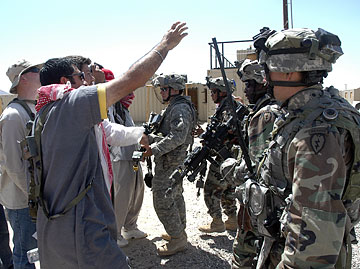
Members of the 25th Infantry's 3rd Brigade Combat Team stationed at Schofield Barracks recently trained in Fort Irwin, Calif., in preparation for deployment to Iraq. Soldiers faced daily confrontations with citizens of mock Iraqi villages where they lived during the past two weeks.
|
|
Soldiers thinking inside 'the box'
Exercises in the desert of California focus on the "human" environment
FORT IRWIN, Calif. » It's repeatedly said here at the National Training Center that the battle against insurgents in Iraq and Afghanistan has to focus on the "human" element.
"We are not going over there to take over the country," said Lt. Col. Drew Meyerowich of the 25th Infantry Division. "We are going there to help the Iraqi army and to help Iraqi people take care of themselves, and only when they are built up to a strength that they can do that, then we can leave."
From top to bottom at the National Training Center, cultural awareness is the mantra of the training for soldiers like the 25th Division's 3rd Brigade Combat Team, which trained there recently in preparation for an Iraq deployment this summer.
In a paper about the National Training Center, Brig. Gen. Robert Cone, commanding general, said the training allows leaders that "to exercise potential solutions to current problem sets, build teams, and gain experience in an environment with 'human terrain' similar to what they will experience in theater."
GREGG K. KAKESAKO / GKAKESAKO@STARBULLETIN.COM
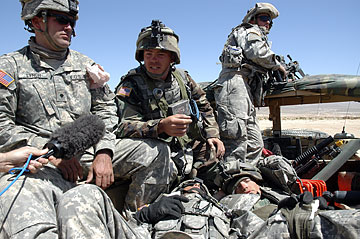
Pfc. Ben Blankenship, middle, believes the realistic training at the National Training Center has better prepared him for combat duty in Iraq with the 3rd Brigade Combat Team. Blankenship, a medic, was helping transport members of Charlie Company "wounded" by a suicide bomber during an attack on a checkpoint during training.
|
|
Training in "the box" -- an area in the Mojave Desert about the size of Rhode Island -- is so exhaustive and intense that trainers have been able to squeeze up to two weeks of activities into a single day, Cone has said.
It is a lesson that battalion commander Meyerowich hopes his young soldiers -- many of them just out of high school -- will take back to Schofield Barracks and keep with them when they leave for Iraq this summer.
Meyerowich, who assumed command of the 2nd Battalion, 27th Infantry Regiment, after it returned from Afghanistan last year, said these lessons of sensitivity and responsibility to the Iraqi culture are what he hopes that his 800 soldiers have learned over these past two weeks.
Meyerowich participated in the rescue effort in Somalia in 1993 -- made famous by the book and movie "Black Hawk Down."
"I think a lot of these young kids have to understand that culture for us to make long-term effects on the whole country. We are not going over there as occupiers. We are going over there to help build their army and to build their police force so they are strong enough to deal with the thugs and criminals who blow up buildings and strike fear into the hearts of the Iraqi people.
"That's what I want my soldiers to understand. It is not us taking care of Iraqi problems, but Iraqis taking care of Iraqi problems with our support."
Several Arab-Americans, who are hired by the Army to prepare soldiers for insurgent warfare, concur.
San Salih, who left Iraq when he was seven months old in 1980, said: "This is a whole new operation here. We try to train the soldiers that there is a better way than shooting your opponent. We try to emphasis that dialogue is very important."
GREGG K. KAKESAKO / GKAKESAKO@STARBULLETIN.COM
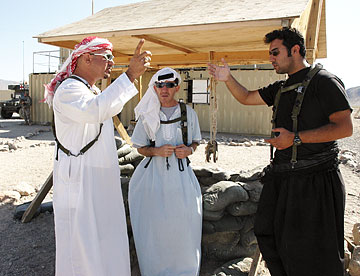
Tony Valentio, left, Salam Tobia and San Salih are among the 250 Iraqi expatriates hired by the Army to live the mock villages at the National Training Center and give soldiers a feel of what to expect in Iraq.
|
|
Salih is among the 250 Arab-Americans who live in the 12 mock Iraq village that are situated in "the box." In these villages, which were constructed three months after the U.S. invaded Iraq in 2003, soldiers from the 3rd Brigade Combat Team faced everything that they could run into in Iraq -- from homemade, suicide and roadside bombs to frequent insurgent attacks to assassinations of village elders and even the possibility of being kidnapped.
Baggam Kalasho, who was born in Mosul and left Iraq in 1997, said the three things U.S. soldiers have to understand is the culture, the language and the religions in Iraq.
"They have to understand the personality of the Iraqi people," said Kalasho, who has lived in San Diego for the past 20 years, "the way we talk with our hands and even the way we walk."
Salam Tobia, who lived in Iraq until 1986, said he sees his role as "a lifesaver."
"The soldiers get good training here," said Tobia, 49, "and a lot of experience. I am happy if it saves a life."
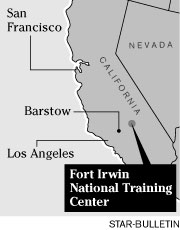
But how realistic is the training at this remote desert post 150 miles northeast of Los Angeles near Death Valley?
Sgt. Edgar Salas, who fought in Iraq with the 101st Airborne Division three years ago, said, "It gets really close to what is going to be there."
For Pfc. Ben Blankenship, a medic with Charlie Company who will be going into combat for the first time, anything that helps him prepare is good.
"I am not really nervous," said Blankenship, "but I would be a fool to say that I am not afraid. Fear is your best friend at times like these."