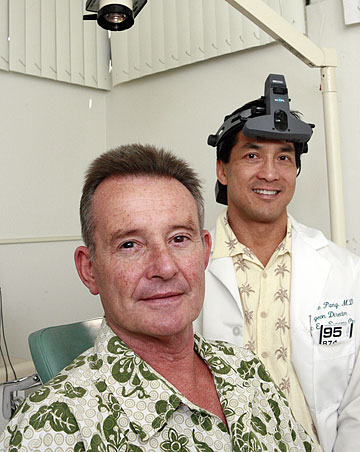
Exec gets sight back in damaged right eye
David Wilson learns it pays to get a second opinion, even after 24 years
Advertising and public relations executive David Wilson said he had given up hope of ever seeing with his right eye again.
And then he read a story in the Star-Bulletin.
The article, published June 10, 2004, was about a technique developed by retinal specialist M. Pierre Pang to reposition a lens slipping out of place after a cataract operation.
Wilson, 59, of McNeil Wilson Communications, Inc., said he went to Pang to see if he was a candidate for surgery.
Wilson had been blind in his right eye for 24 years because of an accident in 1980.
Pang said Wilson's case illustrates the importance of patients getting a second opinion when they have questions relating to their health.
He said Wilson is lucky that his wife, Carolyn Tanaka, told him they should get another opinion before allowing a doctor to remove his eye after the accident.
"His own cataract was dislocated from trauma," Pang said, adding that Wilson had been to other doctors over the years and nothing was done for his damaged eye.
"I could see how people didn't want to do anything. I, too, initially thought the eye was not salvageable," Pang said, describing it as "an awful case, with extensive retinal scarring and a very dense, dislocated black cataract."
He said he was reluctant to operate because of liability and the fear that he would do something that would end up having to remove the eye.
But electrophysiologic tests (an "EKG" of the eye), ultrasound studies and other measures were "pretty positive," Pang said. "I thought, 'Wow, potentially he has good vision.' "
That's because one pin-sized area near the optic nerve wasn't scarred, he said. It was the macula, "which accounts for the best vision you can obtain," he said.
"Surprisingly, the whole eye was scarred except for this one very small area. He must have been living a right life because this small area was intact."
Pang said he told Wilson the tests "looked very promising but it was a long shot."
The three-hour procedure was done Aug. 26, 2004, with dramatic results, Wilson said.
"Within weeks, I'm in my car, closing my left eye and reading numbers on (license) plates. It was just amazing."
Pang said Wilson's vision before the surgery was 20/200. He could count fingers, see hands moving and images but nothing else. He would have been legally blind if that was his seeing eye, Pang said.
Now his vision measures 20/25 and he's regained depth perception.
"That's the big one," Wilson said, "because I would park my vehicle and think I would be fully into the stall. Then I would jump out and see I was way out in back." He learned to align his car with the one parked next to him, he said. "You learn tricks."
It also "got dangerous" playing baseball with his son, he said. "As he got faster and stronger, the ball was hitting me on the head."
Wilson and Tanaka, whom he met in London, moved to Hawaii 26 years ago after he served 18 years in the Royal Navy.
His first job was to establish a factory for vehicle parts on Sand Island for an automobile insurance company, he said.
Workers were pulling trees out of the ground with a forklift and a rope when a branch broke and "whacked my head like a boomerang, right in the eye," he said.
In the emergency room at the Queen's Medical Center, he said the doctor who saw his eye said it was so damaged, "'Let's take it out; let's remove it right away.' I was devastated," Wilson said.
He wouldn't have asked for another opinion because that isn't done in Great Britain, where he was raised, he said. "People are kind of in awe of doctors."
However, his wife persisted and they got another opinion from Dr. Harvey Minatoya.
He said Minatoya told him, "It doesn't look good but you're not going to die if we don't remove it. Let's see what happens and if it is rapidly deteriorating, we'll have to remove it."
The right side of his face was crushed, Wilson said, and "Dr. Max Cooper put me back together again. It's amazing what he did."
He said his face healed and his eye stabilized but all he could see out of it was distorted light. The trauma also made the pupil of his right eye completely expand to the edges of the iris, he said. "To this day it gets a lot of light in there."
When he saw a shadow out of his injured eye in 1980, his ophthalmologist referred him to Dr. Worldster Lee for surgery for a detached retina. He said Lee told him things were in the works that might save his eye in the future.
Pang wasn't sure he had the solution but said Wilson wanted to go ahead with the procedure because he felt he had nothing to lose.
"During surgery, I was sweating," Pang said, describing the intricate process of totally dislocating the partially dislocated lens, removing the cataract with sound waves and going into the back of the eye to take out the rest of the dislocated cataract.
"That was even more difficult," he said.
He removed the jelly or vitreous inside the eye and had to sew in the new artificial lens because there was no support for it, he said.
"Not only has his vision been restored but he now reads better in this eye and now has depth perception," which requires both eyes, Pang said.
"Needless to say, his quality of life has dramatically improved and he is much more active, all because he had these two second opinions."
Pang said he encourages his patients to get a second opinion whenever they have questions and he gets a second opinion from a colleague if he isn't sure about something. "A doctor who says, 'Don't get a second opinion, I'm all you need,' those are the ones you have to worry about."
Wilson said he feels grateful to have met Pang. "When you go into something like this, you need to know ... that you've got a good shot at a successful procedure, and that's what he gave me."
Wilson went back to his Sand Island job briefly after the accident, then became involved with advertising and public relations. He met David McNeil and discovered they had a lot of ties: McNeil had served in the British Army while Wilson was in the Royal Navy; they had lived within 15 miles of each other in England, and their fathers both are Scotsmen.
The two formed McNeil Wilson Communications in December 1982. Seven years later they formed Laird Christianson Harris Advertising, Inc.