CRAIG T. KOJIMA / CKOJIMA@STARBULLETIN.COM
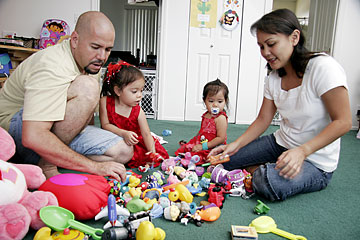
Scott and Darci Ludington play with their daughters, Auli'i, left, and Hi'ilei at their Hawaii Kai home. Darci Ludington was diagnosed with breast cancer while she was pregnant with Hi'ilei in 2004.
|
|
Pregnancy helps save mom from cancer
She was 28 and 7 months pregnant when diagnosed
»
Screening message working in Hawaii
When Darci Ludington was diagnosed with breast cancer two years ago, at age 28, she said her first thought was, "Who is going to be a mother to my girls?
"When I heard the 'c' word, 'cancer,' I thought I was going to die."
Ludington said her fight for survival gives special meaning to Mother's Day for her and her children. She feels it will be important for them when they grow older.
She was 7 1/2 months pregnant, lying in bed with her older daughter, Auli'i, now 3, when she felt a lump as she examined her right breast.
She thought it was a clogged milk duct, but her obstetrician was concerned and scheduled her for an ultrasound, which showed it was a fluid-filled cyst, she said.
A surgeon discovered it was a solid mass, she said. The next morning, on July 1, 2004, she was told the tumor was malignant.
Her choices were a mastectomy or lumpectomy, and she chose a mastectomy, "because I just thought if they take the whole breast, I wouldn't have a chance of reoccurrence in the same breast.
"And I was young at the time. I didn't want to live the rest of my life wondering if they took the whole tumor out."
In fact, Ludington said, she wanted both breasts removed, but her doctor was against that because of her age.
"I wasn't thinking about myself," she said. "I just wanted to be alive for my girls. My oldest girl was then only 18 months."
Her husband, Scott, a city bus driver, was with her at the doctor's appointment and supported whatever decision she made, she said. "What was important at that time was my life, not my breast."
Although she did self-exams, Ludington said she knew nothing about breast cancer "because I never thought it would happen to me, and if it did I thought I would be 60 or 70, because there was no history of cancer in my family."
However, her father was diagnosed with stomach cancer one year after her surgery, she said.
The mastectomy was done six days after she was told she had breast cancer, she said, "so there was not a lot of time for me to think."
It had to be done right away, because her pregnancy hormone was spurring the tumor's growth, she said. In two weeks, from the time she found it until it was removed, "it went probably from the size of a dime or penny to the size of half a dollar."
When she was wheeled into the surgery room at the Queen's Medical Center, Ludington said there were two teams of doctors -- the surgeons working on her breast and an OBGYN team monitoring her unborn baby.
The surgery took five hours -- longer than usual because of her pregnancy, she said. She was stable but "contracting a little bit," so she recovered in the maternity area, where her pregnancy could be monitored.
Delivery was induced about a month early, and Hi'ilei was born on Aug. 9 weighing 7 pounds, 5 ounces.
Ludington is a full-time mother and volunteer for the American Cancer Society. She's working on the Relay for Life at Magic Island in July and is certified as a Reach for Recovery volunteer.
When she called the recovery program after her diagnosis, she said the person closest in age to talk to her was 36. The woman had two children, and helped her cope with the mastectomy.
Ludington is grateful, because if it hadn't been for her pregnancy, her doctor said, the tumor might not have grown as fast and possibly would have spread before it was detected.
"That is why my youngster daughter is so special to me," she said. "She's like a life-saver. If it wasn't for her pregnancy, I may not be here today."
Screening message working in Hawaii
Efforts by many organizations to emphasize early detection and treatment of breast cancer are paying off, says Dr. Carolyn Gotay of the Cancer Research Center of Hawaii.
More cases will be diagnosed because women are living longer, but breast cancer rates are starting to decline a little, she said.
The American Cancer Society estimates 680 new female breast cancer cases in Hawaii this year.
The state averaged about 800 cases a year in 1995-2000, according to Hawaii Cancer Facts & Figures 2003-2004.
Breast cancer cases totaled 783 in 2001, 913 in 2002 and 904 in 2003, said Kevin Cassel, partnership program coordinator, Cancer Information Service Pacific Region. Figures are not yet available for 2004-2005.
The percentage of Hawaii women 40 and older who reported having a recent mammogram in 2001 was "very impressive," said Gotay, cancer center researcher and program director for clinical science.
"One thing that really surprised me, the highest percentage by ethnicity was Japanese women," she said. "The second-highest were native Hawaiian women. That was a change from five years ago, when they were definitely lower."
Hawaiian women have the highest breast cancer incidence and mortality rates of any ethnic group in the state.
JACKIE YOUNG, American Cancer Society chief staff officer for mission and an eight-year cancer survivor, said the society is doing a better job of reaching out to women about the importance of mammograms, particularly Asian Pacific women and women between the ages of 40 and 50.
She said she's always after her three daughters, ages 39, 47 and 50, to be screened for breast cancer.
Gotay and Young point to many positive changes related to breast cancer.
They include early detection, "more refined" treatments (instead of radical mastectomies), new drugs and drug trials and studies showing the importance of a good diet and exercise.
"There are a lot of risk factors we can reduce," such as obesity and smoking, Young said. "Let's get rid of those factors.
"We're in a good place now, where we're beginning to have breakthroughs. It is very exciting."


