DRAWN & QUARTERED
Music animates graphic tales of love
Music has a way of touching all our lives in one way or another.
The best songs can lift our spirits to new heights or make us reflect on depressing lows, remind us of love gained or reassure us after love lost. (And then there's the contemporary hip-hop/R&B scene ... heaven knows what kinds of messages are being conveyed through that.) If anything, the music heard today can help shape the memories of tomorrow.
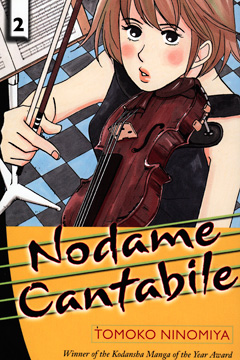
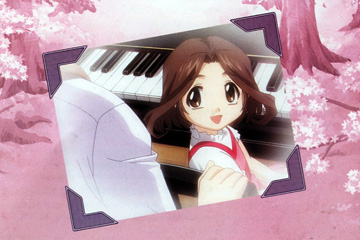
To that end, music plays a central role in two Japanese series: the anime "Piano: Melody of a Young Girl's Heart," available stateside from Right Stuf, and the manga "Nodame Cantabile," available from Del Rey. While the series go about telling their stories in different ways, both share a common thread of love -- for music as well as for one another.
The 10-episode series "Piano" is a quiet coming-of-age story about eighth-grader Miu Nomura. Miu has enjoyed playing the piano for much of her life, but she's a bit scared of her current teacher, Mr. Shirakawa. And for good reason: Shirakawa has a tendency to project an aura of disconnected aloofness, not saying much and often staring out the window during practices.
Complicating matters somewhat is Miu's unspoken yet evident crush on Takahashi, an upperclassman on the track team, as well as her best friend Yuuki's budding romance with fellow track team member Takizawa. Yuuki often tries to do whatever she can to help get Miu and Takahashi together, but Miu is too shy to take the next step.
Then there's the matter of Miu's family, which is arguably one of the more complete units seen in anime today, with a mom, dad and sister all playing prominent roles. Sure, dad Seiji is the typical workaholic Japanese salaryman, and sister Akiko is often abroad leading tour groups, but the family members' love for one another is always evident whenever they're together.
The early episodes are not so much about Miu's piano playing as they are about establishing and developing the relationships among the characters.
Once the piano comes into play, though, with Shirakawa's request that Miu play an original piece at the spring recital, the instrument seems to become an extension of Miu. While she cares deeply about other people, she's often too shy to express those feelings herself; through her playing, she finds that outlet, even if she doesn't realize it.
The leisurely pace of the series -- established with the opening theme song "... to you," a solo piano piece -- allows most of the plot threads to develop naturally. That said, though, it is a bit disappointing that one major event gets cut off at the end of the final episode just after it begins, and another mystery gets hurriedly resolved in the closing episodes.
Right Stuf offers an appealing array of DVD extras that helps to flesh out the series, including English production notes, five side stories, four visual monologues told from Miu's perspective and two live-action epilogues featuring Ayako Kawasumi and Tomoko Kawakani, the Japanese voice actresses for Miu and Yuuki, respectively.
While "Piano" plays a quiet melody with its story, the best comparison to make with "Nodame Cantabile" would be the cantabile musical style itself -- a smooth, lyrical, carefree way of performing compositions.
Not that the central character of this tale, Shinichi Chiaki, would appreciate this free-spirited fun.
As the son of a famous pianist, he has loads of talent, and he knows it. While he is in the piano course at Momongaoka Music Academy, Graduate School and University, he longs to join the conductor course and fulfill his destiny of becoming a great European conductor like his idol and inspiration, Sebastiano Viera. He believes his own hype to the point where he feels the other students -- and even some of his teachers -- are beneath him.
This, of course, means he'll have to eventually deal with each and every one of these detestable people, one way or another. Primary among them is Megumi "Nodame" Noda, a fellow music student and -- how convenient! -- Shinichi's next-door neighbor who has a mad crush on him. When she sees him passed out outside his apartment one night, she drags him into her apartment and lets him stay overnight.
Problem is, Shinichi never realizes this is happening. So when he wakes up the next morning amid Nodame's squalor, his head resting on a pile of books, he freaks out and stalks off. She is as messy and disorganized as he is neat and organized, and it messes with his sensibilities somehow. A subsequent visit to her apartment turns up a bowl of rice with a lovely growth of mold spores, a pot with some gunk that used to be cream stew more than a year ago, and even a pile of clothes topped off by a thriving mushroom.
But while most of Nodame's spontaneous, carefree lifestyle and her puppylike adoration of him irritates him to no end, one part of her always captivates him: her improvised piano cantabiles. And while it might seem like he's always pushing her away, it also seems as if he softens a bit as the story progresses.
It certainly helps that he softens up, too, with a supporting cast of characters that is just as quirky, if not more so, than Nodame. There's Ryutaro Mine, a violinist who longs to add a bit of rock splash and flash to his playing; Masumi Okuyama, a claustrophobic homosexual tympanist who's enamored with Shinichi; and Franz von Stresemann, a world-renowned conductor with a penchant for getting a little, ahem, friendly with the ladies.
This all has the potential to spiral out of control, but author Tomoko Ninomiya manages to keep the situations in check and believable, for the most part. Granted, there are a few clichés; in one story arc, Shinichi takes the reins of the ragtag orchestra that von Stresemann started and turns it into an impressive, cohesive unit, a sort of "Bad News Bears" story with musical instruments.
Overall, though, there's a blend of quirky whimsy and the desire to see how the relationship between Nodame and Shinichi develops that will make readers want to come back for more.
Del Rey has released five volumes to date; a sixth will be released in late July.