IN THE MILITARY
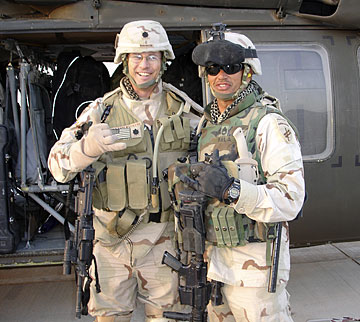
U.S ARMY PHOTO
Lt. Col. Curtis A. "Manny" Manchester, left, and Sgt. 1st Class Adrian Kela, both Hawaii Army reservists with the 322nd Civil Affairs Brigade from Fort Shafter returned from a mission in Balad.
|
|
Reservists leave Iraq legacy
Humanitarian projects help fight terrorism, Hawaii troops affirm
When 150 Pacific Army reservists depart from Iraq around Mother's Day, they will leave behind 5,000 wheelchairs but take with them a sense of accomplishment after a spending a year working with Iraqi government agencies and civilians.
The "Free Wheelchair Mission" was coordinated by Iraqi Ministry of Health and 5,000 chairs were given to various Iraqi hospitals, clinics and institutions, said Lt. Col. Curtis "Manny" Manchester during a telephone interview last week.
The mission was one of the many humanitarian assistance projects undertaken by the 322nd Civil Affairs Brigade, which is normally stationed at Fort Shafter. Although individual soldiers from the brigade participated in the 1991 Gulf War and were deployed to Bosnia, Bangladesh and East Timor in 1998, this was the 322nd's first deployment as a unit.
Manchester, a civil affairs and military operations instructor, said all of the reservists from Hawaii are in Baghdad. His civil affairs brigade was augmented by three battalions from mainland states. All of the brigade's casualties have been members of their affiliated battalions and none from the islands.
Manchester, 45, said the Hawaii reservists have been working with Iraqi government agencies over the past year.
"We both mentor them in governance, help them to gain the confidence of their people, and improve the security environment by gaining the trust of the Iraqi people," said Manchester, a 1980 Kalani High School graduate.
"It is not unusual to get tips on the location of caches of weapons, impending terrorist attacks, and the location of improvised explosive devises from communities where there have been effective humanitarian assistance projects."
"These projects both help to move the Iraqi government towards autonomy and help save the lives of coalition forces, Iraqi security forces, and innocent civilians," he said.
For the past two months Manchester has been an instructor at the Counter-Insurgency Center for Excellence at Taji, about a half-hour drive north of Baghdad.
His job is to teach civil-military operations to U.S. military commanders and their key staff when they first come to Iraq.
"Basically, I teach counterinsurgency," Manchester said. "That means how to fight insurgents. The emphasis now is on bridging and creating relationships with Iraqi civilians and Iraqi government agencies and about minimizing the effects of war on them so they will see improvements in their country."
Over the past five years, Manchester said he has been deployed 15 times, going twice to East Timor and other areas in Asia and the Pacific. In civilian life, he has been a long-time volunteer with the Honolulu Chapter of the American Red Cross, doing similar disaster assistance work on the mainland.
Before his current assignment, Manchester was in Tikrit, Saddam Hussein's home town, working on reconstruction projects, tracking and initiating potable water, sewage and water purification and water treatment projects.
Duty amid East Timor civil unrest and as a Red Cross volunteer on the mainland drives home the notion that "people are resilient," Manchester said. "As you drive through Iraqi towns, people wave at you. A lot of places where you go, and despite of what you hear, lots of people waved at us, smiled at us. Human nature's ability to survive and adapt is amazing."
As for the soldiers he works with, Manchester said, "the morale is high for those who go out on missions all the time, particularly civil affairs personnel, since they are out there working with people."


