COURTESY PHOTO
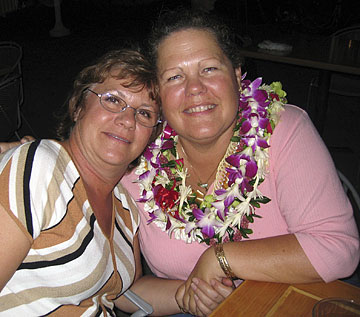
Rill Partlow, right, says she still likes to have fun with her friends, but the dancing has been curtailed.
|
|
Lou Gehrig's disease patient seeks ALS funds
The woman urges appeals to lawmakers in Congress for more research support
Rill Partlow can no longer work, cook, bathe herself, dress, drive or go SCUBA-diving, which she used to do at every opportunity.
The 48-year-old Kapolei woman was diagnosed last June with amyotrophic lateral sclerosis, a neuromuscular disorder known as ALS or Lou Gehrig's disease.
Partlow has difficulty talking because her speech is slurred but is seeking more support and funding for research ofthe disease through e-mails and letters to congressional representatives.
She has been selected to attend ALS Advocacy Day May 15-17 in Washington, D.C., and hopes to meet with Hawaii's four congressmen.
"May is ALS awareness month and I want to remind the people of Hawaii that many families here are struggling with this devastating disorder, for which the cause isn't understood, much less the cure," she said in an e-mail.
She is encouraging the public to learn more about the disease at a free ALS seminar presented by the Muscular Dystrophy Association from 9 a.m. to noon May 20 at the Queen's Conference Center.
Jennifer Li, health care service coordinator for the Muscular Dystrophy Association, said the MDA for more than 50 years "has honored Lou Gehrig's enduring spirit" and the courage of patients living with ALS.
The disease destroys nerve cells controlling muscles, weakening them until they are paralyzed. Deathusually occurs three to five years after diagnosis, she said.
"It never ceases to amaze me how many people are touched by ALS ... and we all want to learn more about it so we can help," Li said.
Of more than 500 families served by MDA in Hawaii, about 80 are registered with ALS, she said.
"However, we know there are more out there. With the ALS seminar, we hope we can reach out to these families with ALS and let them know MDA is here in Hawaii to help them."
Partlow said she began having symptoms in 2003 but wasn't diagnosed until June, 2005, after months of testing. There is no test for ALS so tests are done to eliminate other diseases.
"One of my dive buddies (and my chiropractor) insisted I go to the doctor," she said. "He thought I might be having stroke symptoms."
There is no treatment or cure for ALS and "funding for research is pitiful when compared to other diseases," Partlow said.
She has appealed to Congress to increase the federal budget for ALS from $41 million to roughly $110 million, the amount spent on multiple sclerosis.
"While ALS ravages the body, it generally leaves the mind intact, so patients are fully aware of what is happening to them," she said in her letter to Congressional members.
She said one patient, writing about his experience with the disease, said, "With keen mind and open eyes we watch ourselves die."
Partlow lives with an aunt close in age in a split level condo that isn't handicapped accessible. "It takes two people to get me up and down the stairs so I am stuck up here all the time," she wrote. "We can't afford to make the necessary structural changes."
Once very active, she uses a walker now in the house and a wheelchair outside. She said she misses SCUBA-diving and doing underwater photography most of all. People with ALS are living longer and more fulfilling lives, but the quest for a cure continues and we won't stop until ALS is eliminated," she said. She used to go dancing with friends and still goes out with them, "but the dancing has been curtailed."
She has a bachelor's degree in criminal justice and worked more than 25 years in retail management.
Partlow said the Muscular Dystrophy Association's services "have helped me and my friends in countless ways -- through the doctors at the MDA clinic, through support groups and help in obtaining or repairing equipment I need."
But ALS is under-funded compared to other diseases and the devastating impact it has on lives of those affected, she said.
For more information, call MDA's Honolulu office, 593-4554, or e-mail jli@mdausa.org.
Seminar on ALS will be held May 20
Terry L. Wise of Boston, former trial attorney who survived a suicide attempt after her husband died with Lou Gehrig's disease, will be keynote speaker at a free seminar on the disease May 20.
The Muscular Dystrophy Association is sponsoring the event from 9 a.m. to noon at the Queen's Conference Center to commemorate the 15th annual national ALS Awareness Month.
Artist Peggy Chun, who has amyotrophic lateral sclerosis (ALS), known as Lou Gehrig's disease, also will speak at the seminar using a communication device.
"I'm facing the great challenge of my life but thanks to my family's and MDA's support, I have the will to keep fighting for a cure," Chun said in an MDA news release.
Wise will discuss "Preserving Emotional Health: Hopeful Insights from a Caregiver's Perspective."
She was 35 when her husband died of ALS.
"During four years of intensive caregiving, she watched her husband slowly become trapped in a motionless, paralyzed body," Eli Lilly and Company's Welcome Back Awards program wrote in giving her a national mental health award last year.
She was noted for her book, "Waking Up: Climbing Through The Darkness," describing her suicide attempt and the process of recovering from depression.
An independent panel of national mental health leaders selected her for a 2005 Welcome Back Award for making a difference in educating people about depression. The national program is sponsored by Eli Lilly and Company.
Helen Altonn
|


