PHOTO COURTESY OF BILL WESTERHOFF
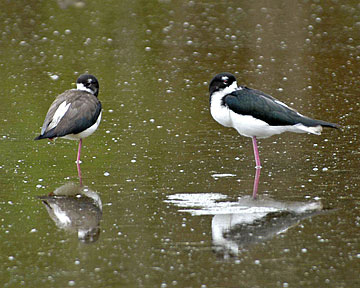
The Hawaiian stilt or ae'o, an endangered species, is beginning to return to the restored Maluaka wetland at Makena State Park.
|
|
South Maui wetlands project is a success
A partnership of groups helps bring back native wildlife and plant life
By Cheryl Ambrozic-Mooz
Special to the Star-Bulletin
MAKENA, Maui » State biologist Fern Duvall remembers three years ago when a wetland in south Maui had become so overgrown with kiawe trees and brush that he saw only two pairs of nesting Hawaiian stilts.
But with the restoration of the Maluaka Wetland through a partnership of government workers, nearby residents and volunteers, the birds have begun to return.
"I've already seen an increase in the stilt population," said Duvall, who counted 12 on a recent visit.
As new subdivisions expand along Maui's southern coastline, volunteers are working to clear and preserve what remains of the home of some of Hawaii's rare native wildlife.
One of the newest additions is the North Pu'u Olai Wetland Management Association, an association of property owners living near the Maluaka.
Federal biologist Terrell Erickson said more than half of south Maui's coastal wetlands have been lost to development in the past 40 years. Kihei had 199 wetland acres in 1965. That number shrunk to 83 acres in 2001 and still continues to drop.
At Maluaka, north of the Pu'u Ola'i cinder cone at Makena State Park, dense thickets of kiawe trees and brush had reduced the ground water levels, deteriorating the wetland habitat for birds, including the Hawaiian coot and Hawaiian duck, along with migrating species, scientists said.
The restoration project involved about three acres at Maluaka and required clearing the kiawe trees, then replanting the area with native vegetation.
Ho'olawa Farms owner Anna Palomino who was contracted to provide the new native plantings for the wetlands said her business produced more than 16,000 plants including 28 different plant varieties.
"It took approximately a year and a half to propagate all the plant materials," Palomino said.
Helicopters were used to take out heavy logs, and fencing was built to keep out alien animals such as deer, cats, dogs and the mongoose. The group laid a temporary irrigation system to help the new native plants.
Hawaiian leader and teacher, Kimokeo Kapahulehua of Halau Maui Nui O Kama embraced the project as a classroom environment. Kapahulehua led the cleanup and planting with the help of the Kihei Youth Center, Merimed Foundation, Maui Hero Project, Seabury Hall, Maui Economic Opportunity Youth Bank, Aloha House, Maui Youth and Family Services, and Americorp.
"This venue is a way to perpetuate, preserve and educate people of the importance of the Hawaiian ahupua'a system," Kapahulehua said.


