COURTESY NOAA
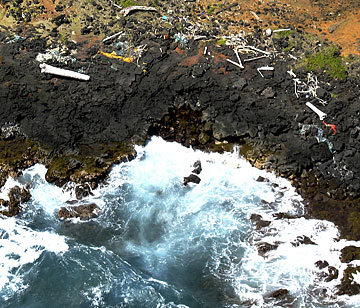
Ocean debris clutters a Hawaii shoreline in this undated photo from an aerial survey conducted by the National Oceanic and Atmospheric Administration.
|
|
Derelict nets surveyed
A new NOAA initiative pinpoints marine debris in 63 Big Isle locales
A new marine debris project got off to a good start last week, with a helicopter-based crew spotting 63 masses of junk in Big Island nearshore waters or on shorelines, a participant said yesterday.
"We saw derelict fishing gear in a number of locations, as well as other forms of debris," said Jake Asher, a team leader for the $300,000 National Oceanic and Atmospheric Administration project.
In five days of aerial surveys Feb. 13-17, Asher and his crew scanned the entire Big Island coast out to 400 meters. They noted 12 floating nets and four hung on reefs.
The rest had washed ashore, most notably at South Point, off the Kona Coast and near Pololu Valley on the North Kohala Coast, Asher said.
Tomorrow and Saturday, the three-person NOAA team expects to survey Kauai's coast. Then they will analyze where the debris is and how they and partner agencies can get to it and remove it with the remaining funds available.
The project is only funded for two islands for this fiscal year, said NOAA spokeswoman Wende Goo, but could be expanded to Maui and Oahu if it is successful.
Asher said some of the clumps of net were as wide as 10 to 20 feet across, but he declined to estimate how much they might weigh.
Cooperative debris removal efforts in the Northwestern Hawaiian Islands collected more than 540 tons of debris between 1996 and 2005, NOAA reported last year.
Asher worked for three years on crews that removed debris from the remote and biologically rich Northwestern Islands. One of the big motivators for that work was reducing the chance of endangered Hawaiian monk seals becoming entangled.
So far, the effort in the main Hawaiian Islands has not removed the stuff, but that prospect pleases Asher.
"It's nice to be able to do this closer to home," he said.
Asher said one surprise was that there still was plenty of debris on the Big Island's southern shores -- despite four major land-based cleanups this winter, funded by NOAA and coordinated by the Hawaii Wildlife Fund.
Location of the junk has been noted with global positioning system equipment.
"We'll prioritize the sites according to accessibility and hopefully in next several months, to go back and remove it," Asher said.
The Hawaii project is part of a nationwide effort that includes marine debris work in the Pacific Northwest (Alaska, Washington), the Gulf Coast (Louisiana, Mississippi) and Florida, according to information prepared by Goo.
"I am pleased to see NOAA's commitment to keeping Hawaii free from marine debris and its devastating consequences through projects like this," U.S. Sen. Daniel Inouye said in a written statement supporting the effort.


