CINDY ELLEN RUSSELL / CRUSSELL@STARBULLETIN.COM
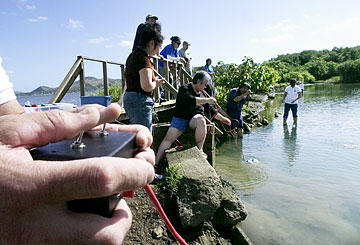
Teachers tried out remote-operated vehicles yesterday at Waikalua Loko fishpond in Kaneohe as part of a workshop with Massachusetts Institute of Technology Sea Grant researchers to help promote the sciences in public schools.
|
|
Robotics workshop thrills isle teachers
MIT researchers help promote a way to raise science interest
HAWAII teachers lit up like young Einsteins yesterday when remotely operated underwater vehicles they had built over the last two days zoomed around the muddy waters of Waikalua Loko fishpond on Kaneohe Bay.
Fifteen teachers built the devices in a workshop with visiting Massachusetts Institute of Technology Sea Grant researchers. Their ultimate goal, of course, is to get their students as excited as they are about building and using the "Sea Perch" gizmos as platforms for classroom science research.
Projects could include gathering water or algae samples or observing underwater life with remote cameras attached to the vehicles, said Vic Polidoro, one of the MIT researchers leading the workshop that started at Windward Community College Tuesday and ended at the ancient Hawaiian fishpond yesterday morning.
CINDY ELLEN RUSSELL / CRUSSELL@STARBULLETIN.COM
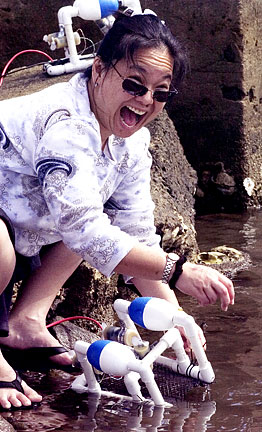
Resource teacher Alison Inouye had a good time yesterday as she tried out her remote-operated vehicle at the Waikalua Loko fishpond in Kaneohe. The ROV was made of PVC pipe and sported three motors, which propelled the hydrocraft and moved it up and down in the water.
|
|
"This thing has four switches, and each switch has six wires that have to be wired exactly right and soldered," said Liz Kumabe, a Sea Grant education specialist at Hanauma Bay, who constructed her ROV with King Intermediate School teacher Tina Chan.
"Neither of us have ever built anything like this," Kumabe said. "There were times when we wanted to quit, but we did it -- and it works."
The devices are toaster-size arrays of PVC pipe, with three small propellers and a couple of swimming-pool lane divider floats for buoyancy. Funny-looking but practical.
As MIT researchers perfected the design over the past few years, downsizing from real oceangoing vessels, Polidoro said. A $50 kit includes common items one can find at hardware and electronics stores.
With about $200 worth of tools and the MIT manual, anyone can construct an underwater robot to do their scientific bidding, Kumabe said.
A 30-foot-long cord snakes out of the ROV, ending in a control box with switches that teachers were having a blast with yesterday.
"Left and right propellers and you go forward or back. One forward and one back and you turn. And this one is for up and down," demonstrated Brian Okumura, a Waipahu Intermediate industrial arts teacher who had a short learning curve on vehicle operation.
One of the attributes of the machines is that students can take underwater measurements without having to snorkel. But Debbie Pollock, a marine science special resources teacher at Castle High, plans to have her students snorkel with their ROVs after they have built them.
Waipahu High science teacher Cliff Jenkins was beside himself with the potential of the vehicles for awakening the sleeping scientist or engineer living inside students.
"We're all natural engineers. If you've ever taken anything apart and put it together, you're an engineer," Jenkins said. "If you can figure this out, you can figure life out."


