PET OHANA
HAWAIIAN HUMANE SOCIETY
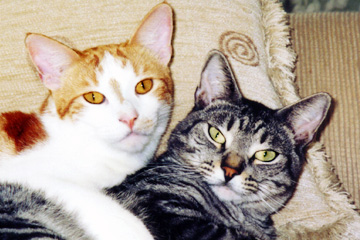
Unspayed cats can produce a litter of kittens three times each year. In seven years, one cat and her young can produce 420,000 kittens. Dan and Kathryn Kirley's cats Frito, left, and Kebe, were adopted sterilized from the Hawaiian Humane Society
|
|
Neutering controls population of freedom-loving cats
Hawaiian Humane Society
Cat owners can do something for their pets that makes the future brighter not just for their cats, but for all animals on Oahu. Sterilization is a simple procedure that extends the life of your cat and reduces overpopulation.
Participating vets
» Aina Haina Pet Hospital, 373-2111
» Blue Cross Animal Hospital, 593-2532
» Cat-Bird Vet Mobile Hospital, 623-5466
» Ewa Beach Animal Hospital, 689-1797
» Home Pet Service, 261-6000
» Island Veterinary Care, 944-0003
» Kailua Animal Clinic, 263-8863
» Kalihi Pet Clinic, 841-6313
» Kapalama Pet Hospital, 841-2861
» Kokua Pet Clinic, 843-8382
» Leeward Pet Clinic, 484-4460
» Makai Animal Clinic, 262-9621
» Mililani Town Center Pet Clinic, 625-6744
» Newtown Veterinary Clinic, 488-3667
» Ohana Veterinary Hospital, 845-1762
» Pearl City Veterinary Clinic, 456-2221
» The Cat Clinic, 732-8884
» The Pet Clinic, 946-5096
» The Pet Doctor, 733-8828
» Vca Family Animal Hospital, 484-9070
» Vca Kaneohe Animal Hospital, 236-2414
» Wahiawa Animal Hospital, 621-7000
» Waianae Veterinary Clinic, 696-4161
» Waipahu-Leeward Veterinary Clinic, 671-4095
|
Cats have the ability to reproduce frequently, doing what comes naturally. One un-neutered cat and her offspring can produce 420,000 kittens in just seven years.
Besides reducing the homeless cat population, the sterilization procedure has many positive effects.
Neutered males will not develop prostate disease, are less aggressive and less likely to roam, which means fewer fights and traffic dangers. Spraying and fighting will almost disappear in neutered male cats, making them better companions.
Spaying eliminates a female's risk of developing life-threatening mammary cancer and uterine infections, as well as the inconvenience of female heat cycles and troublesome suitors.
For male and female cats that spend time outdoors, it's also the law! Since 1995 a city-and-county ordinance requires all at-large cats over 6 months of age to be sterilized. Identification is required for all cats over 6 months of age on Oahu, whether kept indoors or allowed outside.
Started in 1986, Neuter Now, a cooperative effort of the city, 23 veterinarians and the Hawaiian Humane Society, allows household cats and dogs to be sterilized at a reduced rate.
The program has spayed or neutered 60,363 cats since 1993, 2,203 of them last year.
A Neuter Now certificate pays for the preliminary exam and surgery, which would otherwise cost $200 or more. The city funds the surgeries, the participating veterinarians perform them and the humane society administers Neuter Now at no cost.
Certificates cost $40 for a male cat, $50 for a female cat or male dog and $75 for a female dog. Sterilization certificates for cats can be purchased at the Hawaiian Humane Society, satellite city halls or by mail. If you are an EBT card holder, the certificates cost $20. If you are under age 18, a parent or guardian must sign the sterilization certificate.
To have an application mailed to you, call 356-2227; or, print the application form from the Web site www.hawaiianhumane.org (select Spay & Neuter Services).
The Humane Society also has a year-round sterilization program for homeless cats on Oahu. The Feral Cat Sterilization Program sterilized 2,861 cats in 2005.
This free program is for cat caregivers who manage colonies of stray or feral cats. Household cats do not qualify for this program.
To find out more, call 946-2187, ext. 6, or visit www.hawaiianhumane.org, (got to Other Programs & Services, Feral Cat Sterilization).