REVIEW
JAMM AQUINO / JAQUINO@STARBULLETIN.COM
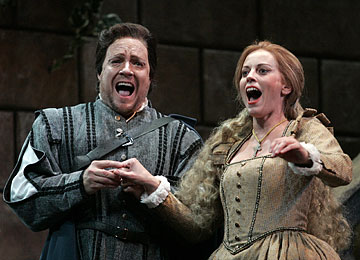
The Duke of Mantua is played by Jorge Lopez-Yanez, and Gilda, Rigoletto's daughter, is played by Nancy Allen Lundy in the Hawaii Opera Theatre's "Rigoletto."
|
|
‘Rigoletto’ lives up to perennial scrutiny
By Valeria Wenderoth
Special to the Star-Bulletin
Finally, we can do it again. We can absorb, laugh and cry at will. The Hawaii Opera Theatre season began Friday with Giuseppe Verdi's "Rigoletto," giving a faithful audience another chance to feel the ultimate Italian romantic emotions.
'Rigoletto'
When: 4 p.m. today and 7:30 p.m. Tuesday
Where: Blaisdell Concert Hall.
Tickets: $28 to $100
Call: 596-7858 or visit hawaiiopera.org.
|
This mixture of love, hate, purity and immorality has been one of the most popular operas in the world since its first performance 155 years ago. It includes a great set of arias, duets and quartets that never fail to stick to the listener's ear and mind, in the great Verdian tradition.
So we go wait for those memorable moments, to see if they can stir our emotions once again. And that is exactly why "Rigoletto" is so hard to perform. The main roles, the Duke, Rigoletto and Gilda, are always under extra scrutiny. Not only do we examine the agility and expression of their voices, but we also study their physical presence and acting qualities.
Jorge Lopez-Yanez as the Duke of Mantua, John Packard as Rigoletto and Nancy Allen Lundy as Gilda did the job. The supporting roles were very well cast. The sober set, designed by Peter Dean Beck, reflected the tragedy of the story -- especially smart was the set for the third act.
The orchestra, under Mark Flint's baton, performed pleasantly; the HOT chorus, directed by Beebe Freitas and Nola Nahulu, did a great job filling the music with a dark sound (the wind was great!). Finally, director William Florescu pulled together great talents in a remarkable production with refined mastery.
In "Rigoletto," arias and ensemble music follow each other smoothly, with brief transitions, sometimes changing the mood according to a character's predicament. Take the Duke. He introduces his character with "Questa o Quella" in the first act, establishing his Don Giovanni attitude toward women. Then he needs to convince Gilda of his love. But his limited philosophy eventually emerges in the last act, with his "La Donna è Mobile" and his statement that he "cheats on them first."
Lopez-Yanez fully entered the role, especially in the second and third acts, but his vocal strength and dexterity were clear from the start. His part is full of high notes (from A to B) and transitional notes requiring careful breathing and clarity in enunciation of the vowels. He did not disappoint. The audience, jolted to attention by the instrumental introduction of "La Donna," opened ears and hearts to the super-famous aria.
His most remarkable expression and pathos, however, surfaced in the duet with Gilda in the first act. Spontaneous and subtle, he had what it takes for a lyrical tenor. Allen Lundy seemed to inspire the best of his clarity and balance. As a matter of fact, she had the ability to make everything convincing.
Soprano Allen Lundy, who first played Gilda 10 years ago, delivered the coloratura passages with remarkable ease. She reached the high C easily, and her breath control allowed her to modulate her volume and control her phrasing with much taste.
The duets with Rigoletto were ravishing as she showed the spectrum of her emotions with depth, but also with the lightness required for this role. Although the orchestra was sometimes on the powerful side, the beauty of her grace could not be missed.
Of note was her cadenza at the end of "Caro Nome," after she expresses her love for Gualtier Maldé -- in reality the infamous Duke. Not written by Verdi, this cadenza is always challenging because the interpreter is on stage alone, with no accompaniment, vocally completely exposed.
Finally, the title role of Rigoletto. His character develops from a cynical and bitter jester to a loving father (super-protective, in the Verdian style) to a man obsessed with vengeance. Baritone John Packard and his rich voice stood out with his portrayal of the father figure. Scrupulously attentive to notes and dynamics, he delivered his lines with great control -- sometimes too much control. But he sang comfortably while depicting rage and in his tormented soliloquy.
Of note also were Jamie Offenbach as spooky Sparafucile and Jessie Raven as sexy Maddalena.
It was a production worthy of praise, and a wonderful beginning of the opera season.
Valeria Wenderoth has a Ph.D. in musicology from the University of Hawaii at Manoa, where she also teaches.