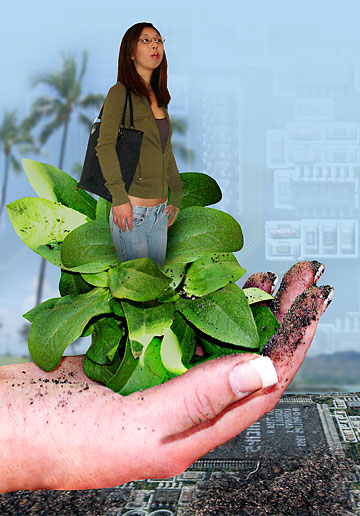
Growing local talent
Hawaii needs to grow more high-tech talent locally if it wants to keep its edge globally
By Mike Meyer
Special to the star-Bulletin
NOT LONG ago, I was in the chief executive's office of one of Hawaii's top technology companies, discussing the state of his business.
The good news, he said, was that business was great. The bad news was that he couldn't recruit enough local programmers to service his customers.
He explained that finding high-tech talent meant going to the mainland or elsewhere. He had even considered outsourcing his projects to Eastern Europe, China or India, where there were plenty in inexpensive programmers.
He said his first preference was to hire locally, but the scarcity of Hawaii talent meant he might even have to go offshore and hire a foreigner. The main problem with that, however, was getting an H1B visa, which he explained was a "big pain in the okole."
As David Heenan, former business school dean at the University of Hawaii, said in his latest book, "Flight Capital," in the good old days it was easy to skim the cream of foreign-born students and bring them to our shores. However, as people now are fond of saying, 9/11 changed everything. New homeland security measures make it extremely difficult to bring foreigners to Hawaii for hire.
Naturally, employers who need first-class tech workers here and on the mainland are hoping that the visa situation will change. However, that is clearly not a long-term solution. Nowadays, as Heenan vividly points out, foreigners who have attended top schools in this country are tending to go back to the countries of their birth rather than looking for jobs locally.
As the tech industry in India, China, Israel, Singapore and Ireland gathers momentum, foreign-born, high-tech workers are finding greener pastures in their homelands rather than traditional U.S. tech meccas such as Silicon Valley.
SO HOW CAN Hawaii's nascent IT and life sciences industries find the talent they need?
Kiman Wong, general manager of digital phone at Oceanic Time Warner Cable, declared, "We really need to grow our own. We're competing with not only the mainland, but with Asian and European countries that are cranking out top-notch technologists."
Wong is correct. In a recent New York Times column, Tom Friedman reported that the percentage of Americans graduating with bachelor's degrees in science and engineering is less than half of the comparable percentage in China and Japan. As Friedman said, "Anyone who thinks that all the Indian and Chinese techies are doing is answering call-center phones or solving tech problems for Dell customers is sadly mistaken. U.S. firms are moving serious research and development to India and China." Late last year, Intel announced a $1 billion investment in India that will go primarily into R&D.
There's no mystery why these companies are moving offshore. As Craig Barrett, CEO of Intel, said, when Intel sponsors a science fair, it attracts 50,000 American high school kids. In China, says Barrett, national science fairs bring in six million kids. By contrast our own science competition at Hitech Quest (www.hitechquest.com) a Hawaii nonprofit that I support, attracts perhaps 150 entries.
Granted, China has the population to appeal to millions. However, if Hawaii's new economic sectors -- IT and life sciences -- are going to grow, and our children to have the opportunity to find meaningful jobs, we need to educate more of our kids in science and math.
FORTUNATELY, private citizens and local companies can augment what the public schools aren't doing. One of the few proven means of improving education for our youth is project-based education that connects kids with both businesses and the community. For example, our organization, Hitech Quest, is composed of volunteers from companies such as CTA; Oceanic Time Warner; Booz Allen Hamilton; Microsoft and others that mentor high school and middle-school kids in technology. There are a range of other science and digital media/video competitions sponsored by businesses and organizations and a few such as Hawaiian Electric's summer intern program that actually puts students in working situations.
Local business stepping into the fray is a very positive development. However our educational system must also evolve. Based on what we're seeing abroad, we don't have time to waste.
As author Dave Heenan said, "in the Knowledge Economy, other countries aren't taking prisoners when it comes to educating young minds. Americans of every stripe should take heed. Simple solutions -- lengthening school days or years and demanding more homework -- may be the best medicine for our schools. But these straightforward solutions will require sacrifice by students spoiled by the 2:30 p.m. school bell, abbreviated school year and light homework loads."
Mike Meyer is president of CTA, a high-technology consulting firm based in Honolulu, and a founder of Hitech Quest, a Honolulu-based nonprofit dedicated to technology education for youth. He can be reached at mmeyer@cta.net