GALLERY
UNIVERSITY OF HAWAII ART GALLERY
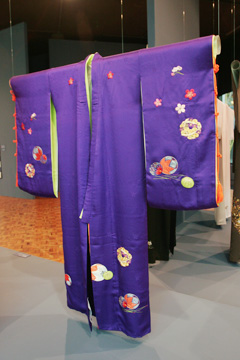
A child's kimono in vibrant purple silk displays Eiko Ushiyama's stitching of cherry blossom and temari balls.
|
|
Preserving a tradition of ‘lush beauty’
The high cost of contemporary society's premium on time and money doesn't affect just our leisure time and piggy banks. Perhaps even more costly are the prices we pay when our busy, expensive existences restrict our ability to preserve valuable cultural traditions.
On exhibit
"Painting with Threads: The Art of Japanese Embroidery"
Place: University of Hawaii-Manoa Art Gallery, UH Art Department
Time: 10:30 a.m. to 4 p.m. Mondays to Fridays and noon to 4 p.m. Sundays, through Feb. 17
Admission: Free
Call: 956-6888
Also: Demonstrations by guest stitchers, noon to 3 p..m. today and Feb. 12 at the gallery
|
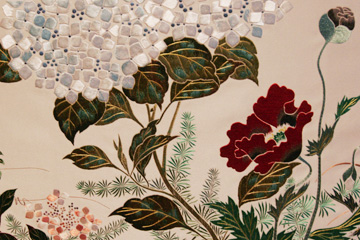
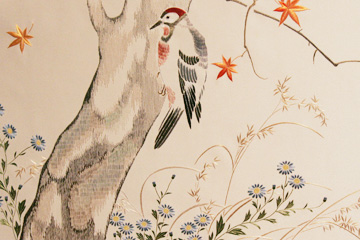
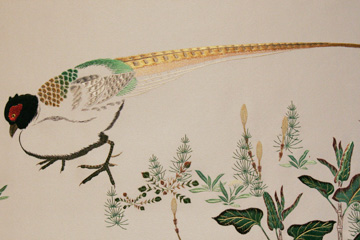
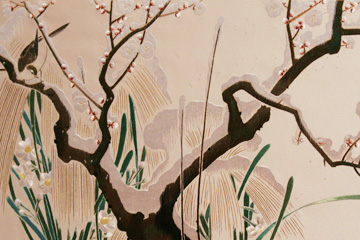
In Japan, the epitome of the fast-paced, consumer-driven society, for instance, the centuries-old art of Japanese embroidery is dying out. Before you say "who cares," take a look at the images on this page, meticulously handcrafted, stitch by traditional stitch, with gold and silver and silk threads and with needles made by hand. Such pieces are considered every bit as much works of fine art in Japan as paintings are in the Western world; in fact, Japanese embroidery utilizes the same Japanese archetypal motifs as those used by the country's painters and sculptures.
Yet for all their beauty and cultural relevance, most modern folk don't have the time and resources to make or purchase embroidery pieces. Works take at least six months to create and prices are astronomical, easily reaching tens or even hundreds of thousands of dollars.
Traditional materials, or rather, a lack of them, further endanger the art form. The handmade embroidery needles are currently supplied by one old woman in Japan, the last living person who knows how to make them, and certain types of traditional silk thread are no longer being produced. Traditional dyes also pose similar challenges.
UNIVERSITY OF HAWAII ART GALLERY
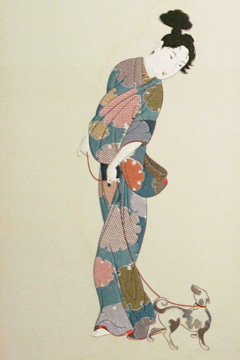
This image of a young woman, stitched onto a screen at a Kurenai-Kai Association workshop, recalls a famous screen from the 17th century. Kurenai-Kai is a Japanese embroidery association.
|
|
IN THE FACE of this gloom comes Willa Tanabe, chairperson of the University of Hawaii-Manoa's art department, and members of Japanese embroidery associations dedicated to preserving the art form. These groups are doing everything from teaching Japanese embroidery to raising silk worms. Tanabe gathered works from members, who range from Japanese housewives and artists to American hobbyists in Hawaii and Georgia.
The result is "Painting with Threads: The Art of Japanese Embroidery," which runs through Feb. 17 at the UH Art Gallery.
The show features vibrant silk kimono, wall hangings, silk scrolls and screens, quilts and "obi walls" filled with gorgeously adorned obi.
An added bonus to the exhibit is housed in a back section of the gallery, where the Hawaii association has provided a step-by--step display showing the various steps of creating an embroidered work.
If you pay the gallery a visit between noon and 3 p.m. today or Feb. 12, members will be on hand to demonstrate their craft.
UNIVERSITY OF HAWAII ART GALLERY
A set of four hand scrolls depicting the four seasons is exquisitely detailed.
|
|
UNIVERSITY OF HAWAII ART GALLERY
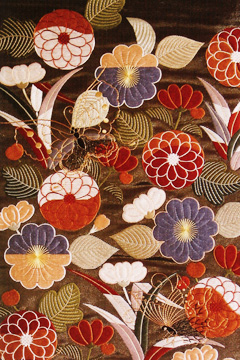
This obi by Keiko Nakamura features enlarged chrysanthemums and butterflies. The crowded composition reflects a style popular during the Momoyama period (1568-1615).
|
|