Police officers unhappy with chief
Morale is low and support is lacking, a union survey finds
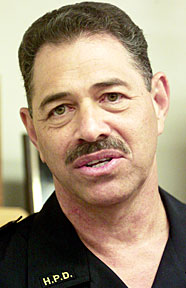
Honolulu police officers delivered a scathing assessment of police Chief Boisse Correa after his first full year, giving him low marks in several areas, including communication, fairness and support.
The police union survey results also revealed low morale, with two-thirds of respondents being dissatisfied. When officers were asked whether they wish they had a different chief, 78.3 percent said "always" or "almost always."
"The perception that the chief lacks appropriate leadership skills is widespread and demoralizing," wrote William Puette, director of the Center for Labor Education & Research at the University of Hawaii's West Oahu campus.
Puette analyzed the results of a November survey sent to 1,877 members of the State of Hawaii Organization of Police Officers. About 57 percent, or 1,068 officers, responded, considered a high rate of return for these kinds of surveys, union officials said. The SHOPO survey was released to the media yesterday.
The results consistently showed about two-thirds of respondents feel Correa does not show leadership qualities, Puette said.
The worst assessments were in communication, working with officers toward common goals, inspirational leadership, fairness and professional pride, areas where at least 70 percent of the respondents rated Correa negatively.
For example, when asked if "the chief supports line officers," 43.1 percent of respondents answered "almost never," and 22.4 percent answered "never."
"A surprisingly high percentage of respondents (51.5 percent) identified themselves as recipients of disciplinary action," Puette wrote. This suggests "discipline is being overused as a motivational and management device."
Other comments include:
» Morale is at an all-time low.
» The chief micro-manages the department.
» The chief draws resources away from ordinary police duties to build up a Homeland Security Unit for political reasons.
» There are not enough line officers to ensure public safety.
Correa issued a written statement questioning the validity of the results, contending no measures were taken to prevent multiple responses and that several statements were ambiguous.
"If morale were as low as the survey claims, I would expect to see a high number of officers leaving, an increase in complaints and other changes," he wrote.
He defended the job he has done by saying the department's vacancy rate is the lowest in more than a decade, complaints from the public are down, the number of officers disciplined is consistent with previous years and crime is down from last year.
Correa said police chiefs frequently make decisions not everyone agrees with.
"However difficult those decisions may be, I will never compromise my integrity or the department's integrity for the sake of my popularity," he said.
The survey results come on the heels of a glowing review issued Thursday by the Honolulu Police Commission, which ranked Correa as exceeding or exemplary in leadership qualities, managerial skills and communication with the commission.
After a cursory review of the survey results, Mayor Mufi Hannemann said, "Because it comes from the rank and file, it should be given serious consideration. While the chief communicates well with his management team, it seems there might be some problems with communications with the rank and file."
FAILING GRADES
In a State of Hawaii Organization of Police Officers survey, 1,068 Honolulu officers gave their responses to various statements about Chief Boisse Correa. Here is a sampling of the results:
» The chief communicates accurately and precisely with line officers: 5.2 percent said always or almost always; 17.1 percent said some of the time; 76.1 percent said almost never or never.
» I wish we had a different chief: 78.3 percent, always or almost always; 13.1 percent, some of the time; and 7.1 percent, almost never or never.
» The chief lives up to his word: 7.5 percent, always or almost always; 27.8 percent, some of the time; 61 percent, almost never or never.
Note: Where respondents chose not to answer a question, the totals do not add up to 100 percent.
Source: SHOPO
|