Addicts' families get advice and support
Hina Mauka's Families in Crisis program helps people face tough issues
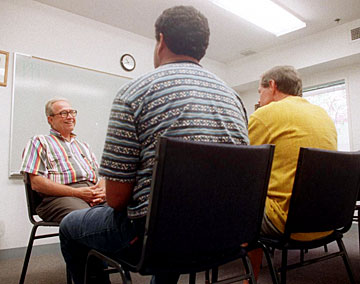
THEY WERE strangers, gathered together in fear and frustration because they didn't know what to do about family members addicted to drugs.
Meeting in Aina Haina, the group included seven parents, a husband, two sisters with their mothers and a family friend.
Alcohol was involved in three cases; crystal methamphetamine or "ice" dominated the others.
Five or six people regularly attend Hina Mauka's weekly Families in Crisis classes at the Church of the Holy Nativity but on this night only two had been there before, said facilitator Jill Pargoe.
The others had turned to the family program as a lifeline after reading about it in the Nov. 16 MidWeek. "It's hard to find where to go," said a distraught parent.
The Hina Mauka program provides education and support for families and friends of people addicted to drugs, Pargoe said, stressing that it isn't group therapy or a 12-step program.
Participants asked not to be identified because of shame and embarrassment as they shared emotional stories about addicted family members.
"As people cope better, they are less embarrassed," said Pargoe, a drug counselor at Hina Mauka's adult outpatient clinic in Waipahu. "They know it's not their fault."
The first family program began in 1996 after Hina Mauka opened a residential drug treatment facility in Kaneohe, said M.P. "Andy" Anderson, chief operating officer.
"We were getting lots of calls from people wanting treatment but they were always family members calling."
Other family programs were established at Hina Mauka clinics in Waipahu, on Maui and Kauai.
Two years ago, during a lot of publicity about the ice crisis, the Rotary Club of Honolulu wanted to help families of addicts and learned of Hina Mauka's Kaneohe program, Anderson said.
The club joined with the Harold K.L. Castle Foundation to fund a pilot program that began in February in Aina Haina. The East Honolulu Rotary Club and the foundation are funding a similar program at Palolo Valley Homes and Rotary's goal is to expand the program islandwide.
Anderson said the 90-minute family sessions are to let people know what they can do as a family "to get themselves healthy and not be intimidated by the person with addiction and not to react but simply learn how to take care of themselves and do what they need to do.
"Sometimes, when a family does that, the addict is baffled by it and sometimes ends up seeking treatment."
Many families don't know what addiction is, Anderson added. "They think it's stress."
Parents said they're torn: They don't want to enable their children's drug habit, yet they want them to be safe so they give them money and let them take showers or stay in their home.
"I know the different things I should be doing," said the mother of an ice-addicted son. "But it never ends. You just break down and say, 'Here's $20.'"
Pargoe distributed and discussed information about addiction as a "disease process." It's not a curable disease but it's manageable, she said, comparing it to diabetes. "A person addicted has to choose to manage it."
A doctor said his wife became an alcoholic a year ago although she "was not even a social drinker for five years.
"She is living in a parallel universe. She thinks everyone else has a problem, especially me ... I'm here to survive, to help my daughter and myself."
In a voice breaking with emotion, a mother described how her daughter lost her job and apartment and is now homeless. She hadn't seen or heard from her in two weeks.
Her daughter had been living with the family after going to a rehabilitation program but it didn't work, the mother said. "I think we were enabling ... but we were glad she was alive.
"It's terrible having her out there. It's also terrible having her with us."
The sister of a woman addicted to ice and now in jail said her sister was stealing from the family and "put them through a lot."
She said her mother, sitting beside her, couldn't kick her sister out so her father did. "Mom still feels bad but she enabled my sister. Mom has Parkinson's disease. She's willing to sacrifice for her daughter -- her health even."
Now, they're debating whether to let her sister back in the house when she's out of jail, the woman said. "That's why we're here, for understanding. We almost have to do a tough love approach."
She mentioned the case of a Waipahu man accused of attacking his parents with a hatchet on Nov. 19, killing the father, after asking his father for money to buy drugs.
A 15-year Al-Anon member said her late husband was an alcoholic and so is her son, who is in a Hina Mauka outpatient program.
"For the first time, he said he can't do it himself," she said. "I'm proud of him ... I want to go in there and fix it and I can't fix it."
Pargoe said it's normal for family members to "nag, lecture and preach" but this "ends up being a waste of time and very, very frustrating.
"Everyone feels hurt because it gets personal. They're (addicts) lying and stealing. Their goal is to use (drugs) and your goal is the opposite. You can't reason with them. As we keep trying to make them quit and they keep using, a struggle is going on and you're not in control."
Family members "get addicted to helping," Pargoe said. "They start adjusting to the behavior of the addict over time and put up with more stuff. It's part of the process, cleaning up their wreckage, walking on eggshells."
This takes a toll on the family with loss of sleep, stress and physical ailments, she said.
"Big time," commented a father.
"Figure out what you do have control over," advised Pargoe. "You have control over your environment and how you react to them. You're so immersed trying to care for them, you don't take care of yourself.
"The hard part is we love them; we keep trying to help them and sometimes it goes the other way ... If we keep rescuing them, they may never learn to rescue themselves."
But kicking a drug abuser out of the home isn't always the answer, Pargoe said. "You've got to think how you feel about this and if it's right in here," she said, gesturing to her heart.
A woman who attended other family meetings said she's trying to get information and "enough guts to be able to stand up to my (alcoholic) son."
She said she let him live in her home because otherwise, "he'd sponge on someone else." But she moved to another place so her granddaughter could visit her, she said.
The father of a 25-year-old son who has been on and off ice and in jail said he drove almost two hours from Kunia to attend the meeting "to try to get resources, help and support."
"At first, it was a big shame type thing," he said of his son's addiction. Practicing "tough love," he told his son he wouldn't bail him out of jail, so his son called his grandparents. "We're trying to educate them," the father said.
He said he enjoyed visiting his son when he was in jail because he was "clear-headed and coherent" but once he was out things changed.
A court ordered his son into a good rehabilitation program but he seems to be relapsing, the father said, noting that he had pawned a $1,000 classical instrument.
"A lot of addicts relapse," Pargoe said. "It's part of the recovery process ... It's not something they can learn right away. Pain is part of the addiction process. It is necessary for them to break through denial.
"Sadly, recovery rate is low," she said. "I see clients who keep rotating. Not everyone stays sober, only a small percentage. They come back. I see the same faces."
Classes at 6 sites on Oahu, Kauai and Maui
Family members and friends of someone addicted to alcohol or other drugs can learn ways to deal with the addiction in Hina Mauka's Families in Crisis Program.
Classes are open to anyone regardless whether the addicted person is enrolled in a Hina Mauka program. They are offered as follows:
» Kaneohe: 6 p.m. to 7:30 p.m. Mondays; 7 p.m. to 8:30 p.m., Thursdays, 45-845 Pookela St. Call 236-2600.
» Waipahu: 7:30 p.m. to 8:30 p.m. Thursdays, 94-216 Farrington Highway, B2-306. Call 671-6900, ext. 26.
» Aina Haina: 6 p.m. to 7:30 p.m. Tuesdays, Glantz Hall, Church of the Holy Nativity, 5286 Kalanianaole Highway. Call 447-5227.
» Palolo Valley Homes: 7 p.m. to 8:30 p.m. Wednesdays, 2170 Ahe St. Call 236-2600.
» Kauai: 6 p.m. to 7:30 p.m. Tuesdays, 2970 Haleko Road, #103, Lihue. Call 245-8883.
» Maui: 6 p.m. to 7:30 p.m., Wednesdays, 1276 Lower Main St., Ste. A1, Wailuku. Call 242-9733.
|
STAR-BULLETIN / 1996
Andy Anderson, counseling clients, is Hina Mauka's chief operating officer. He's been with the program since 1996.
|
|
Statewide treatment program began with 1 man
THOUSANDS of residents with substance abuse problems, families and teens have benefited from an alcoholic businessman who "got sober" in the mid-1960s and wanted to help others.
Hina Mauka's grassroots start by Bill O'Rourke was recalled by managing director Alan Johnson in an account marking the program's 40 years of prevention, treatment and recovery services.
O'Rourke had been in Hawaii State Hospital several times because alcoholism was a crime in the 1960s and habitual offenders were sent there, Johnson said.
After he became sober, O'Rourke volunteered at the hospital "to bring the message of hope to those in need," Johnson said.
Other volunteers joined in his efforts and carried on the mission after his death in 1972, looking for ways to help people with addiction, said M.P. "Andy" Anderson, Hina Mauka's chief operating officer. "There wasn't much in the way of treatment."
In 1969, the Legislature passed a bill decriminalizing alcoholism, which led to a Salvation Army detoxification unit and "legislative intent and money for programs," Anderson said.
Hina Mauka, which in English means "leaning on the mountain," operated out of the State Hospital until the hospital was renovated in 1988. The outpatient drug treatment program then moved to Kailua and began raising money for a residential facility that opened in Kaneohe in September 1995.
Anderson and Johnson have been with the program since 1996, overseeing its growth into the largest provider of drug treatment services in Hawaii.
Through all of its programs, Hina Mauka is assisting 2,500 to 3,000 people a year, including families and teens, Anderson said. This year, the program will see about 600 to 800 kids at sites for adolescents, he said.
Hina Mauka expects to help more people with a Kokua Fund kicked off with the first installment of a five-year $50,000 grant from the First Hawaiian Bank Foundation. The fund will assist people financially who show they're serious about overcoming drug or alcohol addiction and can't afford treatment.
The residential facility at 45-845 Pookela St. in Kaneohe has 48 beds and often has waiting lists, Anderson said. Many people attend outpatient programs there and a family support group, he said.
Hina Mauka also provides:
» Adult outpatient services at six sites.
» Substance abuse treatment to teens at 17 middle and high schools under a Teen CARE program.
» A therapeutic drug treatment program at the Women's Community Correctional Center.
» Families in Crisis Programs at six sites, including two operated with Rotary Clubs and the Harold K.L. Castle Foundation.
Hina Mauka is located on all islands but contracts for services on the Big Island, Anderson said. Statewide, it does all drug testing and collection of urine and assessments of Child Protective Services families, he said.
The program will provide therapy for people with both drug and psychiatric disorders under a new contract with the state Health Department's Adult Mental Health Division, Anderson said.
Hina Mauka's new vision, Johnson said, is "to bring treatment and recovery philosophies into housing and vocational rehabilitation" and to start an outpatient program for professionals.
Donations to the Kokua Fund can be mailed to Hina Mauka, 45-845 Pookela St., Kaneohe, HI 96744.


