SMALL, RURAL SCHOOLS FACE FUNDING CRUNCH
JAMM AQUINO / JAQUINO@STARBULLETIN.COM
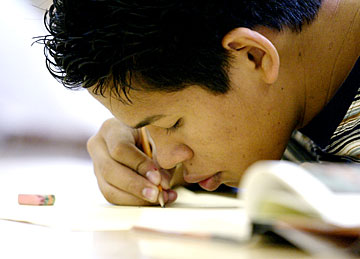
Ninth-grader Elijah Rabang works on a sketch of a tiger in Margaret Hoy's art class at Kohala High School. Since its inception in the early 1930s, the school has been an integral part of its Big Island community, but impending budget shifts within the Department of Education could severely reduce classes and activities.
|
|
Left out of the equation
Schools like Kohala High School on the Big Island will be squeezed by a new budget formula favoring large enrollment
HAWI, Hawaii » Like many schools in remote corners of the islands, Kohala High School has a connection with its community that a Honolulu principal can only imagine.
When its staff joined in a three-week statewide teacher strike in 2001, area residents hunted down and butchered some of the wild cattle that roam the nearby Kohala Mountains to help feed them.
School staff routinely volunteer after hours to run campus activities and clubs. And with the nearest malls and movie theaters more than an hour's drive away in Kona, school sports are the only organized entertainment along this remote, green coastline.
"It's the heart and soul of this whole area," said senior Nicole Pasalo. "I can't imagine the school not being here."
But there is bitterness in Kohala these days.
Under a new funding formula that heavily affects small, remote schools, Kohala High's budget would drop by $711,000, or 35 percent, over the next four years, just one example of a funding shift causing concern in rural communities across the islands.
"It's like this big black cloud over the whole community," said Vicky Kometani, whose daughter is a Kohala sophomore. "But what astounds me is it's so Honolulu-centric. There has been no thought given to how this affects rural areas."
The "weighted student formula," required under state law to be in place next year, awards money to schools on a per-student basis. Schools get more funds for students considered more challenging to teach, like the poor or those still learning English. Millions of dollars will shift mostly to big urban schools with many such kids, at the expense of smaller schools.
On paper, it would seem fair to cut 278-student Kohala High's budget. Per-student funding is now around $8,000 a year, nearly twice the average rate.
Yet it's still barely enough, according to the principal, Sunny Bratt.
The per-student figure is skewed, she says, because she needs the same basic programs and positions -- from registrar to librarian to custodian -- as other schools, but for a smaller student population. Then there are the higher costs of operating in a remote location.
JAMM AQUINO / JAQUINO@STARBULLETIN.COM
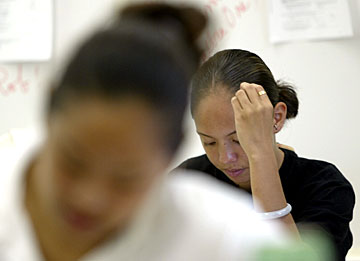
Eleventh-graders Chelsey Yamamoto, right, and Nicole Pasalo concentrate while working on a math problem in instructor Chris Brown's Algebra II class.
|
|
JAMM AQUINO / JAQUINO@STARBULLETIN.COM
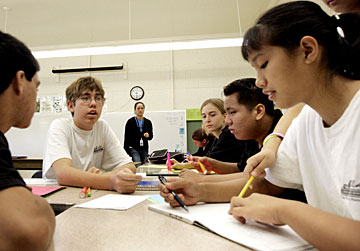
Instructor Jessica Brown, daughter of Chris Brown, who has taught at Kohala for 34 years, center, watches as ninth-graders Makani Black, Kekai Coakley, Eloise Standard, Gavin Miura, and Sara Lo make a list of 10 healthy and non-healthy foods during health class.
|
|
JAMM AQUINO / JAQUINO@STARBULLETIN.COM
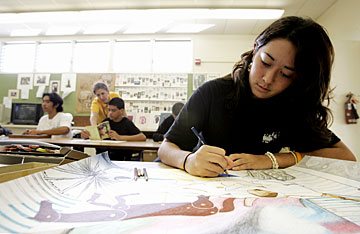
Eleventh-grader Mari Nickl works on her still-life project as art instructor Margaret Hoy, in yellow, assists ninth-grader Makani Black. Most faculty members at the school juggle different tasks, and Hoy, aside from being an instructor, is the department head of fine arts, music, physical education, guidance and health.
|
|

JAMM AQUINO / JAQUINO@STARBULLETIN.COM
Tenth-grader Kekoa Jacob concentrates while working on his linoleum piece he enthusiastically calls "Kekoa's Project."
|
|
"The only solution is to scale back staff and programs. But don't kids here deserve the same opportunities as others?" she asks.
There is scant evidence of higher than normal funding on this quiet campus 500 feet above the sea, where several employees perform double or even triple duty.
The school librarian is also the technology coordinator, teaches driver's education, and runs an online learning program. The registrar also teaches a class helping kids plan for college, and helps with various other administrative tasks. Some teachers teach across disciplines, or handle both regular and special education.
Despite a recent renovation, the facilities are as modest and underequipped as any state school, and some teachers complain that they often pay out of their own pockets for materials.
"We need new Bunsen burners!" one girl shouts instantly when a science class is asked about the state of its lab.
Another issues a plea for new safety goggles.
"You can't even see out of the ones we have. They're all old and blurry," she says.
Others complain the barely sufficient programs sometimes leave them scrambling to get the classes they want.
"It can be really frustrating, but you just have to deal with it," said Mai Fujii, a senior whose third-year Japanese class was not offered due to a low sign-up rate. She'll now have to take an extra year of Japanese in college.
Yet the school's own report card is respectable.
JAMM AQUINO / JAQUINO@STARBULLETIN.COM
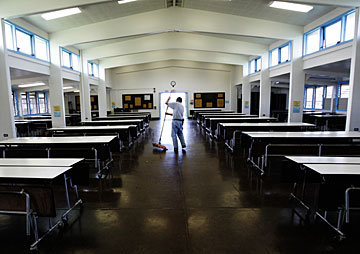
Cuts to Kohala High School's funding will affect not only students and teachers, but groundskeepers, assistants, custodians, and, ultimately, the entire community. Thomas Kaitoku, head custodian at Kohala High School for 7 1/2 years, sweeps up the cafeteria after lunch.
|
|
It's in good standing under the No Child Left Behind law, based on student test scores.
The graduation rate hovers around 95 percent annually, and more than 60 percent of graduates typically go on to post-secondary education, 28 percent on some sort of scholarship, Bratt says.
Last year, 41 percent received special Board of Education diplomas, which carry higher requirements but also more weight with college admissions officers.
Despite already juggling to provide a complete curriculum, Bratt said the formula would eventually lead to the loss of six of her 18 full-time regular-education teachers, crippling her arts, music and vocational programs.
Several other staff positions also would have to go, likely leading to more double-duty for the survivors.
She's even thinking about bringing in free-range goats to replace a groundskeeper position.
"They're not just trimming the icing off the cake," said Kometani. "(The cuts) would pull the foundation out from under what is a pretty well-run school."
Randy Moore, the Department of Education's point person on implementing the formula, said he has advised principals to imagine they have no staff at all and to rebuild their school from the ground up within the new budget.
"Some principals tell me, 'Hey, I never thought of it that way,'" he said, adding that others are unable to think outside the box.
"To cut staff members who have a name and a face and history with the school ... no one does that with great relish," he said.
However, Bratt said the cuts mean an erosion of academic programs. The department has suggested that she offer just one foreign language instead of the current two, and that students not shoot for the Board of Education diploma.
"I can't stand for that. In a rural area, students have fewer opportunities to stand out in the eyes of a university, and we need to provide all we can to help them," she said.
Factoring in nearby Kohala Intermediate School's $509,000 budget cut, Kohala faces a $1.2 million school funding loss, and the whole community is worried, said Shiro Takata, owner of Takata's general store, another local social hub.
JAMM AQUINO / JAQUINO@STARBULLETIN.COM
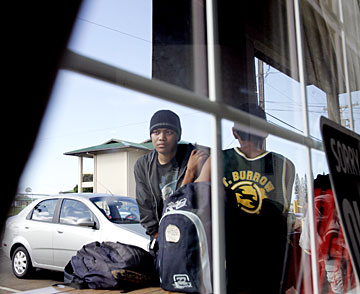
With no nearby movie theater or malls, Kohala High School students like Landry Matsu and Mana Viernes spend a lot of time at the Kohala Diner or at a beach they call "Lighthouse."
|
|
"The state is doing what they feel is right, but it doesn't fit for everybody," he said. "Places like this are always treated like the unwanted stepchild."
One of the weighted student formula's underlying principles -- barely mentioned by state officials -- is that, over time, "bad" schools "die" as students transfer to better-performing schools, taking their funding with them.
But while that may work in urban areas, it poses difficulties for the neighbor islands with their spread-out schools.
"When the nearest other school is 50 or 60 miles away, tell me where those kids are going to go," Kometani asked. "Where are kids on Lanai going to go? Where are kids in Kau or Hana going to go? They can't just go down the street to the next school like you can in Honolulu."
With eight out of 10 high schools on the Big Island facing cuts, there may also be few transfer options for teachers who lose their positions.
Concerned by such impacts, the board in October approved a slow phase-in of the program over four years, with just 10 percent of the funds shifting next year. Board members say they plan to take a closer look at the formula.
"The question now is whether we need to tweak the formula, because some of us feel there is something basically wrong with it. We're going to take a good hard look at that," said board member Karen Knudsen.
The slow phase-in bought Bratt some time. The first year of cuts will be manageable, she said, and she's hoping Kohala High will be spared the ax.
"We've all got our fingers crossed," she said.


