President comes home empty handed
BUSH'S ASIA TRIP
JUST AS national security adviser Stephen J. Hadley allowed to journalists, President Bush's Nov. 16-21 trip to Asia held little expectation of any major breakthroughs. America's strongest bilateral relationship with an Asian country is with Japan, to which the growing Koizumi-Bush relationship has added much. Bush's mention of how their fathers had both fought in the Pacific during World War II and now their two sons stood as leaders of the two most economically powerful countries in the globe lent a warm, fuzzy quality to the close U.S.-Japanese relationship. Nevertheless, the two-year Japanese ban against importing U.S. beef was not rescinded, despite Bush's efforts.
In a Kyoto speech, Bush lauded President Harry Truman's enlightened policies during the post-World War II U.S. occupation of Japan. Bush contended such policies brought Japan into the family of democratic nations and helped to propel Japan into the ranks of wealthy, developed nations. As a result, Japan was a model for the rest of Asia to follow.
ASSOCIATED PRESS
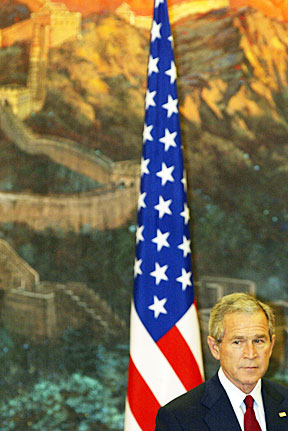
President Bush listened to Chinese President Hu Jintao as they met with the press Nov. 20 at the Great Hall of the People in Beijing. Bush called on China to expand religious, political and social freedoms and urged steps to reduce Beijing's huge trade surplus with the United States.
|
|
Certainly there are lessons to learn from occupation policies; however, mention of Truman and discussion of the occupation are politically risky and extremely sensitive topics in Japan. After all, it was during Truman's presidency that the United States dropped nuclear bombs on Hiroshima and Nagasaki. The occupation was the only time that Japan has been occupied by a foreign power. The Japanese themselves feel ill at ease discussing it. Just at a time when China holds itself as a model for others to follow, Beijing could not have been pleased with Bush's remarks, either.
In fact, Sino-Japanese relations are at perhaps their lowest level since the countries re-established formal diplomatic relations in 1972. A key reason for this state of affairs is the Japanese cabinet's strong support for Taiwan, a Japanese colony until the end of World War II. Bush's trumpeting, while in Japan, Taiwan's democratic evolution and thriving economy could hardly have gone over well with the Beijing leadership, although he did reconfirm America's "one China" policy.
The first international leader to visit President Bush after he was first elected was former South Korean President and Nobel Prize winner Kim Dae-jung. The meeting did not go well, with political neophyte Bush lecturing Kim about dealing with North Korea. Unlike Bush, Kim believed that the way to deal with the North was to interact with it. Kim' successor, President Roh Moo-hyun, and Bush do not maintain a close relationship, largely owing to South Korean and American differences on how to approach North Korea and the growing quest for national identity among younger Koreans. Like his predecessor, Roh prefers a more patient, less aggressive approach than does the United States.
However, both the United States and South Korea do want to see the denuclearization of North Korea. Bush went to Korea to attend the Asian Pacific Economic Cooperation summit of 21 world leaders with the goal of achieving trade liberalization. Hosted by President Roh, the summit yielded no economic advantage for the United States. No sooner had both presidents promised to improve bilateral relations than the South Korean government announced a proposal to withdraw one-third of its 3,200 troops from Iraq, the last thing Bush wanted from any coalition partner.
IMMEDIATELY upon arrival in Beijing, Bush proceeded to the Gangwashi Church for services. Such imagery undoubtedly would work well with Bush's core political constituency back in the United States, but it was certainly not the right way to build relations with a country deeply skeptical of Western religions, even though he was in a government-sanctioned church. Given America's traditional advocacy of human rights, the Chinese government has usually released a few incarcerated human rights activists before the visit of a U.S. president or other high-level U.S. representative. However, this was not the case during Bush's November visit to China. In fact, 30 protesters who wanted to meet with the president were arrested. Many observers conclude that President Hu Jintao, a former head of the Central Party School and first secretary of the politically discontent Tibet Autonomous Region, is cracking down on any form of political dissent.
To address America's exploding trade deficit with China, estimated to run $200 billion for 2005, U.S. policy has sought to persuade China to float the yuan (the Chinese unit of currency), with only limited results. The United States has sought enforcement of intellectual property rights concerning the piracy of movies and software. Trade officials presented the Chinese government with a list of 25 factories that reproduced U.S.-made DVDs. The Chinese government has yet to implement any corrective measures.
Much was made of China's decision to purchase 70 Boeing jets at a price tag of $4 billion. However, China needed to make some gesture of attempting to reduce the trade deficit, and China manufactures part of Boeing's fuselages. Shortly afterward, China announced its interest in buying a large order of aircraft from France's Airbus.
Bush's 12-hour stay in Mongolia was to express appreciation to the Mongolian government for sending 140 Mongolian troops to Iraq. Moreover, it was recognition of Mongolia's democratization and difficult transformation to a market economy.
While not reaping any tangible results, some view the trip as an attempt to restore American influence and soft power lost in Northeast Asia by reminding the world of Japan's, South Korea's and Taiwan's democratic freedoms and material comfort. All were achieved with U.S. economic assistance and security guarantees. And perhaps one day Mongolia will similarly benefit.
About the author:
Bill Sharp is adjunct professor of East Asian International Relations at Hawaii Pacific University. With this column, his reports on Asia will become a regular feature of the Sunday Insight pages.
|
|