Rise in tourism and a tight inventory give hotels a rosy October
STATEWIDE hotel occupancy climbed to its highest October level in 15 years as strong domestic arrivals and renovations in Waikiki put a premium on available rooms.
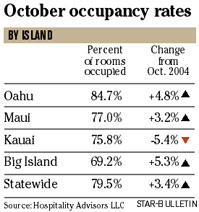
In what is typically its off season, the lodging industry's occupancy rose 2.6 percentage points over last year to 79.5 percent, according to a report released yesterday by Hospitality Advisors LLC. It was the strongest October since occupancy hit 80.9 percent in 1990.
The average daily room rate also increased significantly, rising 12.4 percent, to $159.67 from $142.07 a year earlier.
"Aqua (Hotels & Resorts), in general, always has high occupancy," said Guy Underkoffler, vice president of operations for the five-property Waikiki chain of condo and boutique hotels. "This year, I think the closure of Lewers Street and some prominent hotels in Waikiki has lessened inventory, which increases demand for rooms."
Outrigger Hotels & Resorts, which controls most of Lewers Street, has closed down the area to develop its $460 million Waikiki Beach Walk project, which includes hotel conversions to time-shares and a nautical-themed complex of shops, restaurants and entertainment. That has resulted in the loss of 1,200 to 1,500 rooms, according to David Carey, president and chief executive officer of Outrigger.
On Kuhio Avenue the Ohana Waikiki Surf, which has 404 rooms, is being renovated into a Wyland-themed hotel by marine artist Robert Wyland.
Partly as a result of the reduced inventory, statewide hotel room revenue jumped 16.2 percent, to $126.98 from $109.31.
Record visitor arrivals for October also boosted occupancy, with the 5.1 percent year-over-year increase in arrivals largely fueled by a 7 percent gain in domestic visitors.
Bank of Hawaii chief economist Paul Brewbaker said the occupancy numbers are encouraging.
"It says a lot about the seasonal off-peak months filling in," he said. "Of course, if the peak months are sold out, your whole growth strategy is based on those off-peak months filling in. That's a good sign, but eventually you run out of headroom even with that strategy."
Joseph Toy, president of Hospitality Advisors, said a shift in the meetings, convention and incentive market from busier times to the off-peak season also contributed to the strong month.
"It's been really similar to past busy years where we've seen demand more evenly distributed through the entire year," Toy said.
Carey said hurricanes that have affected the Caribbean, Florida and Mexico have swayed visitors to Hawaii, and the euro-dollar relationship also has helped.
"Hawaii is in a good place in the market right now," he said.
Brewbaker said occupancy levels will continue to grow in the off-peak months until additional hotel rooms are added. However, he said the tourism industry and the state have largely reached a consensus that there should not be any material increase to the total number of visitors.
"So we can enjoy the growth as it continues to speak to a strong domestic market," Brewbaker said. "It does mean, however, that there's less room to grow for a resurgent international market."
Waikiki had the strongest occupancy in the state as the level rose to 85.9 percent from 81.7 percent a year earlier. Oahu's occupancy level increased to 84.7 percent from 80.8 percent.
On the neighbor islands, Maui's occupancy climbed to 77 percent from 74.6 percent, and the Big Island grew to 69.2 percent from 65.7 percent. Kauai, however, fell to 75.8 percent from 80.1 percent.