STAR-BULLETIN / MARCH 2000
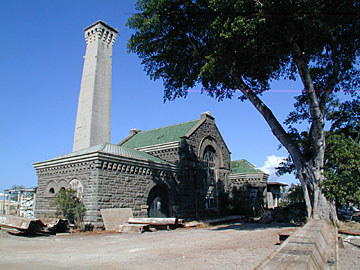
Built in 1900, the Ala Moana Pump Station was placed on the National Register of Historic Places in 1978. It ceased to be used as a pumping station in 1955 and has fallen into disrepair.
|
|
Pump station gets ideas for renewal
A public workshop solicits suggestions for the old Kakaako facility
Make the area around the Ala Moana Pump Station a green and inviting gateway to Kakaako makai.
Restore its historic blue stone building for use as a museum, gathering place or tourist information stop.
Only add other buildings around it carefully, making sure they're not high-rises and overwhelming.
These were some of the suggestions that 30 people made at a public workshop on the future of the 3.7 acres that hold the historic building at the corner of Keawe Street and Ala Moana.
Several called the former Honolulu sewage pumping facility "a jewel" of Kakaako makai, the former landfill and industrial area under redevelopment under the guidance of the Hawaii Community Development Authority.
Built in 1900, the blue stone building was placed on the National Register of Historic Places in 1978. It ceased to be used as a pumping station in 1955 and has fallen into disrepair.
"I think whatever you do, save that site and make it useful and wonderful," said Frank Haas, marketing director for the Hawaii Tourism Authority and a member of Historic Hawaii Foundation and Hawaii Capital Cultural District boards.
Clifford Planning LLC will add yesterday's suggestions to a report it is preparing for the Hawaii Community Development Authority, the state agency that oversees redevelopment of Kakaako and Kalaeloa. That report should be ready in February, said Janine Clifford, president of the company.
The HCDA has received proposals over the years to convert the pump station to a restaurant, microbrewery, open air market, and more. Even the state Office of Hawaiian Affairs considered moving its offices there but decided against it.
Clifford said her company's report will be used by the development authority to give guidelines to potential developers of the state-owned land.
David Cheever, interim executive director of the Historic Hawaii Foundation, asked that the development authority enter into legal agreement that the building could never be torn down.
Ray Whitworth, who described himself as part-Hawaiian and part-Polish, wondered if a former underground reservoir could be converted into a public meeting place.
The space is about 18 feet deep and 150 feet square, said Deepak Neupane, a HCDA project manager.
Whatever is done at the pump house won't be cheap. Ten years ago, it was estimated that the minimum cost of renovating the three historic buildings would be $2 million, Clifford said.
Current development authority rules would allow construction of up to 45-foot high buildings near the pump station and up to 200-foot-tall buildings on the makai side of the parcel. If building was approved to these heights, "the pump station would end up in this little hole with buildings all around it," Clifford said.
Jim Grogan, of the American Society of Mechanical Engineers, hopes to see a Hawaii engineering and technology museum on the site. In addition to civil engineering feats like the sewage pumping station itself, some highlights could include pineapple and sugar processing equipment or military radar, he said.
Artist Maile Sakamoto suggested including art-related ventures. "Arts will never be a million dollar thing and cannot compete with development, but they cannot be ignored," she said.
"I know this area used to be a dump," said Marilyn Michaels, who lives in Kakaako. "But this is a historic opportunity to make it into something else."
Nancie Caraway urged that there not be "wholesale, massive, overscale development" throughout Kakaako makai, the area that includes the new University of Hawaii medical school and is the planned site of a cancer research center and Hawaiian cultural center.
Lainie Tamashiro emphasized that she doesn't want to see the makai portion of Kakaako be covered with high-rise condominiums as is planned for the mauka portion. It should be an area of green and open spaces, she said.
Over the past year, volunteers have removed non-historic structures and fixtures and old paint at the site and done grounds work. A fund-raiser last month raised more than $11,000 for additional improvements.


