STAR-BULLETIN / FEBRUARY 2001
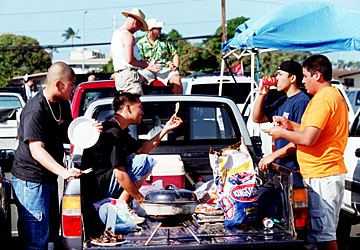
Tailgaters like these partying at Aloha Stadium might have to do so in the future without alcohol.
|
|
Proposed ban of alcohol only outside stadium is unusual
Few, if any, schools just prohibit drinking during tailgate parties
A year after Ohio State football fans rioted after a 14-9 victory over rival Michigan in 2002, the university and the city of Columbus began a crackdown on alcohol use during tailgate parties.
That apparently has been successful in reducing violence, arrests and the cost of police enforcement on football Saturdays.
While bad behavior at University of Hawaii football games is nowhere near a riot situation, Ohio State's experience and that of other schools might provide some insight into how a proposed ban on alcohol outside Aloha Stadium could be implemented.
A public hearing could be scheduled as early as next month on the stadium authority's proposed rule changes to ban alcohol in the parking lot during regular-season UH football games.
Information on how other stadiums deal with alcohol at college football games is hard to come by.
While the NCAA, the American Council on Education, Mothers Against Drunk Driving, and even the American Tailgaters Association and other national groups have general policies against underage drinking and excessive alcohol use in stadiums, they do not track what stadiums are doing about it.
Through Internet searches and phone interviews, the Star-Bulletin has found:
» While it is a growing trend for colleges to ban beer and alcohol sales and advertising inside stadiums during football games, it appears only a few have started enforcing or have instituted new bans on consuming alcohol outside stadiums.
Hawaii's proposal -- to ban alcohol outside the stadium and allow it inside the stadium -- is unusual and might be unique.
» Enforcement of alcohol bans during tailgating varies with some schools looking the other way, others pushing education, and others citing and arresting violators.
» A number of schools, such as Yale University, have instituted new policies to combat underage drinking and drinking games, especially during tailgates. But they have not banned alcohol use before and after the games.
» Some schools, such as Louisiana Tech in the Western Athletic Conference, are in "dry" cities or counties where alcohol has not been permitted for decades. These schools have developed, for the most part, alcohol-free tailgating traditions.
BECAUSE OF THE growing concern over binge drinking among college students, some schools have instituted new policies restricting alcohol on campus. However, some schools, like Michigan State University, specifically exempted tailgating from the new policies.
In the WAC, three schools -- Louisiana Tech, Boise State and the University of Idaho -- have policies restricting the sale and use of alcohol outside their campus stadiums.
Louisiana Tech's no-alcohol policy stems from its location in a dry city, Rushton, La., where you couldn't even buy a glass of wine in a restaurant until the law was changed a couple of years ago, said Corre Stegall, Louisiana Tech's vice president for university advancement.
"Our campus is substance-free," she said. "Our people have accepted that. ... It's just been a part of the culture of our university."
In the tailgate area of the 30,000-seat stadium, the university sets up a tent with free soda and ice cream for alumni. "People just flock to that," she said.
Stegall said there probably is alcohol at some tailgates. "I can't tell you what people are doing in their trucks or RVs," she said. "But are there kegs? No. There are not any open containers that anyone can see."
Both Boise State and the University of Idaho fall under the jurisdiction of the Idaho State Board of Education, which prohibits the sale and consumption of alcohol on university-owned, -leased or -operated facilities, said Frank Zang, Boise State's director of communications and marketing.
But last year, the board changed the policy to allow alcohol to be sold and consumed within designated areas at Bronco Stadium and the Kibbie Dome at the University of Idaho. That created corporate areas, where beer and wine can be sold or served to invited guests.
"It's in a controlled environment and very limited," Zang said.
Aloha Stadium spokesman Patrick Leonard said a task force of stadium authority members who investigated the proposed alcohol ban looked at creating a fenced-off area where patrons could buy and drink alcohol in a controlled setting, but did not include the idea in its recommendations.
Koa Anuenue, the UH athletic boosters club, and some visiting teams host pre-game parties inside the stadium before UH games, Leonard said. Because the parties are within the stadium, alcohol can still be served there under the new proposed rules, he added.
SGT. STAN NICCOLLS of the Boise Police Department said enforcement of the no-alcohol policy in the stadium parking lot and surrounding areas is more of an educational nature than involving the issuing of actual citations.
"If it's discreet and you can't tell what it is, we don't come around and sniff your cups and we don't go into your motor home," Niccolls said.
If a violation is obvious, the beer will be confiscated, he said.
Yesterday, police passed out leaflets reminding fans about the alcohol ban in preparation for this season's big game against interstate rival Idaho.
Niccolls said enforcement will be stepped up for that game.
Generally, Niccolls said there have not been many serious problems with alcohol.
It took a riot to get Ohio State to enforce existing laws about drinking outside the stadium.
After a victory over the University of Michigan in November 2002, students and fans overturned cars and set them on fire, smashed store windows and generally ran amok until police got the situation under control at about 4 a.m.
Following the riot, the university and the city of Columbus decided to enforce existing open container and drinking laws. Drinking was already prohibited inside the stadium.
Two years after the crackdown, the Columbus Police Department said it is now able to reduce its spending on police overtime because there are fewer arrests and fewer problems after games.
"We were bringing extra personnel to control riots (on game day) anyway," said Lt. Brent Mull of the Columbus Police Department.
Overtime costs for the Michigan game riot in 2002 came to $928,575, Mull said.
So the cost to the city of enforcing existing alcohol laws was not much different than what was already being spent, he said.
When police first began enforcing the law, officers warned violators, then if officers went back on the same day and there were still open containers, they were cited.
"Two to three weeks into the season there were no warnings," Mull said.
At the first game of the 2003 season against Washington, police issued 75 citations, 60 for open containers. But by the end of the season, only 20 citations were issued, 10 for open containers.
"It's gone smooth this year," Mull said, and police overtime costs are declining.
RICK AMWEG, the assistant chief of police for Ohio State University, said the university is spending an extra $20,000 to $25,000 a game on alcohol enforcement.
University police patrol the stadium and most of the parking lots where tailgating occurs.
Ohio Stadium on campus seats 101,568 fans, and an additional 20,000 to 50,000 fans spend the game in the parking lots, Amweg said. After the game, many fans head for private homes and bars in the city.
Amweg said enforcement of alcohol laws is aimed at behavior, rather than seeking out people who are drinking.
"We're looking for people being obnoxious and unruly," he said. "If you happen to be holding a red plastic cup that has beer inside, we can still go ahead and enforce that, and we have," he said. "But it's not a cut-and-dried yes or no answer (as to whether that person will be cited)."
Buckeye Sports Information Director Steve Snapp said the alcohol crackdown did not deter anyone from attending the games.
"Our ticket sales don't ever decline in football, nor does the alumni support," Snapp said in an e-mail to the Star-Bulletin.
But elsewhere in Ohio, at Division 1-AA Youngstown State University, attendance dropped in 2003 when the school announced it, too, would enforce the state's open container law, according to news articles.
Although some speculated that a losing record was more to blame than the alcohol policy, the state Legislature passed a law in 2004 that allowed nonprofit groups to sell beer before games in designated tailgate lots.
And this season, a winning record and tailgating with cold beer is back at Stambaugh Stadium, the home of the Penguins.


