Hawaii International Film Festival’s documentary nominees
Five films are up for the festival's Golden Maile prize for Best Documentary, to be awarded Oct. 28

COURTESY OF HIFF
"Sisters in Law" follows prosecutor Vera Ngassa and magistrate Beatrice Ntub as they work in a Muslim town in Cameroon. The documentary is co-directed by Kim Longinotto, left.
|
|
Tough lawyers defy patriarchal village
|
"Sisters in Law"
In colloquial English, with subtitles
Screens at 12:15 p.m. Sunday and 6:15 p.m. Tuesday at Dole Cannery
2 1/2 stars
|
The lady lawyers of Cameroon could out-Judy Judge Judy. In fact, if Judge Judy were to end up on their bad side -- she should just get out of the way.
Prosecutor Vera Ngassa and magistrate Beatrice Ntub are sisters in law, not related by marriage, but rather sisters in the law of the land.
This plain-spoken documentary follows four cases through the court system in the small town of Kumba -- a Muslim community that has not held a man accountable for spousal abuse in 17 years.
"It's true that I beat her," one husband admits. "I bought her medicine for it."
Attitudes are so ingrained here that you wonder how Ngassa and Ntub ever became lawyers. Young girls are paired off with older men as soon as they reach puberty, then immediately start bearing children.
"I was too small, I was too young," one woman says. She couldn't even judge whether her marriage was any good. "I didn't know what feeling happy was."
The cases involve two women beaten by their husbands, a young girl raped by a neighbor and a 6-year-old abused by her aunt.
The "sisters" have a take-no-prisoners approach as they brow-beat the abused girl's aunt and verbally emasculate all the Bad Men.
In many cases, the victims must defy their own families to come forward, but Ngassa props them up. "Even if a man supplies all the oxygen you breathe, he still has no right to beat you."
"Sisters in Law" is purely a fly-on-the-wall documentary, with surprisingly frank access to court proceedings, the police station, even family councils.
Directors Florence Ayisi and Kim Longinotto offer no embellishment in the form of narration or interviews. This will make the film difficult for some viewers to follow, as it offers little guide to the characters or the story. You just have to pay attention.
Each case creates its own "Law and Order"-type drama, however, making the whole curiously addicting.
BACK TO TOP
|
COURTESY HIFF
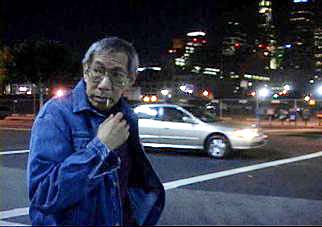
A documentary by director Curtis Choy, left, follows the experiences of Frank Chin, above, as the founder of San Francisco's Asian-American Theatre Workshop.
|
|
Film praises trailblazer without ignoring faults
|
"What's Wrong with Frank Chin?"
Screens at 7:30 p.m. Saturday and 3 p.m. Oct. 29 at Dole Cannery
4 stars
|
With a title like "What's Wrong with Frank Chin?," Curtis Choy's "novel documentary" may win over an audience of more than just a handful of literary and activist types.
The work turns out to be a respectful homage to Asian-American literature's original angry young man. While striving for balance, Choy makes a case for what's right with Frank Chin, even while detailing his run-ins with actors, producers, publishers and fellow writers throughout a career in which he's never achieved the mainstream renown of those he despises.
As a young writer at the University of Hawaii at Manoa, I had my own encounter with Chin, the author of such works as "Bulletproof Buddhists and Other Essays," "Donald Duk," "Gunga Din Highway," "The Chinaman Pacific & Frisco R.R. Co." and "Born in the USA: A Story of Japanese America, 1889-1947," when he visited our campus in the early 1980s. I was too naive to tremble with fear at the thought of interviewing the Chinese-American bad boy with the Fu Manchu mustache.
I listened to him spit out his desk-pounding tirades about Asian-American stereotypes and Hollywood's emasculation of Asian men. What I remember most was the conviction and vitriol of a man certain of his rightness, establishment's wrongness and frustration with others' blindness or indifference to his truth.
I reported the message but didn't embrace it, attributing our differences to geography and gender. Maybe things were different for him in San Francisco, but I had grown up in Hawaii as part of an Asian-American majority. What did I know of discrimination? I was an Asian-American female, a double model minority in an era of equal opportunity.
I look back and wonder why he didn't reach across the table and shake me awake. It must have been hard for him to be perceived as forever railing at invisible demons. But my reaction was typical and I imagine many of my generation are just beginning to realize Chin is getting the last laugh.
As he says in the documentary, on teaching a course in Asian-American Studies in the late 1960s: "I wasn't prepared for Asian-American Studies. Students were taking it as a Mickey Mouse course, easy grades. They had no idea of where they were in Asian-America, except they were above it. They were, each and every one of them -- this was common -- the first Asian of their kind to be accepted as white among whites. They call this assimilation."
When students asked, "What's wrong with acceptance?," Chin's response was "On whose terms?"
At the time, no books dealt with Asian-American history or culture, so Chin started oral-history projects, speaking to old actors and immigrants about their experiences. With writer Shawn Wong and San Francisco State College Asian-American Studies chairman Jeffery Chan, Chin searched for earlier Asian-American writing and what they found became the basis for the seminal anthology "Aiiieeeee! An Anthology of Asian American Writers" and its successor "The Big Aiiieeeee! An Anthology of Chinese American and Japanese American Literature."
Choy's documentary follows Chin's experiences as the founder of San Francisco's Asian-American Theatre Workshop, an experiment that did not end well when the group's aims diverged from his vision.
One of the most entertaining segments involves a long-running feud between Chin and Maxine Hong Kingston, author of "The Woman Warrior," whom Chin describes, along with Amy Tan, as being "Pocahontas yellows" delivering a "mixed-up East-West soul struggle" in works that "falsify Chinese culture." Never mind that little thing called literary license.
When Choy poses the question of whether such writers are sell-outs, Chin initially sounds as if he is trying to be diplomatic, before reverting to his belligerent tone. "I don't think writers are selling out," he says. "All writers really believe what they're doing is right. It's just that they're stupid."
"That's Frank," explained Frank Abe, one of the original members of Chin's Asian American Theatre Workshop. "He draws clean lines. It's black and white, yes or no."
Another interesting aspect to Chin's work is his little-known role in recognizing the "Day of Remembrance" for Pearl Harbor and his pursuit of redress for Japanese-Americans who lost civil liberties and property during World War II. Chin organized one of the first rallies for the cause in Seattle, explaining to Abe in urging him to go north: "The Japanese-Americans are making their move. They're going for redress but they don't know how to do it. If you lose redress you lose your history; if you lose your history you can kiss Japanese-American art goodbye."
If the status of Asian-Americans has improved over the past 30 years, we have Chin to thank for some of the initial volleys. Through his theatrical and printed works, he opened himself up to society's slings and arrows, while opening eyes to continuing inequities.
Consider Choy's work a belated thank-you.
BACK TO TOP
|
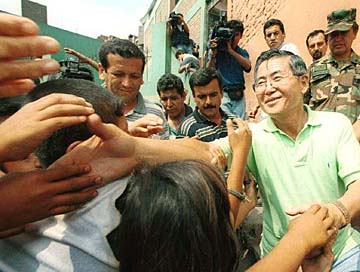
"The Fall of Fujimori" (United States)
Directed by Ellen Perry
Screens at 6:15 p.m. Sunday and 3 p.m. Monday at Regal Dole Cannery Theatres
Peruvian president Alberto Fujimori, the son of Japanese immigrants, came to power by promising radical measures to clean up the country. Ellen Perry's work shows how he led an oppressive war on terror in the name of democracy. This timely and chilling study of opportunism and rationalization will look eerily familiar to those who keep up with United States politics today.
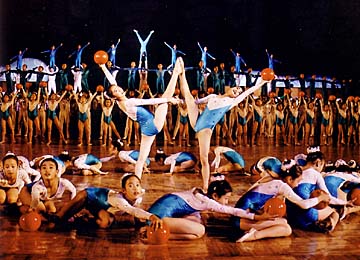
"A State of Mind" (North Korea)
Directed by Dan Gordon
Screens at 6:30 p.m. Friday and 3:30 p.m. Oct. 27 at Regal Dole Cannery Theatres
Dan Gordon's film follows two teenage gymnasts, Pak Hyon-sun and Kim Song-yun, preparing to perform at the Mass Games. This great honor involves the assigning of jobs, apartments and food rations to their families, revealing a rare outside glimpse into the mentality and lifestyles of North Koreans.
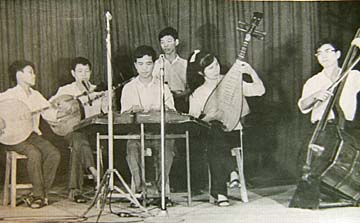
"Vietnam Symphony" (Australia, Vietnam)
Directed by Tom Zubrycki
Screens at 7:30 p.m. Sunday and 3 p.m. Oct. 27 at Regal Dole Cannery Theatres
Such is the power of art that even in times of war, people will try to salvage the markers of civilization. During the Vietnam War, students and teachers of the National Conservatory of Music were forced to flee Hanoi for the safety of a small, rural village. With the help of villagers, they built an underground campus with a maze of tunnels leading from auditorium to classrooms. Even as the war raged around them, they lived, studied and played music underground for five years.