STAR-BULLETIN / NOVEMBER 2004
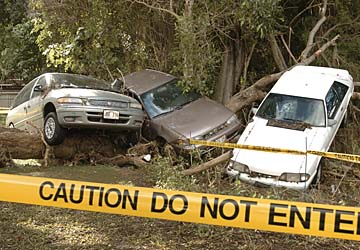
These cars were damaged last Halloween Eve when floodwaters devastated the area near Manoa Marketplace.
|
|
Response to Manoa flood compared to Katrina's
Frustrated residents say they still live in fear and that relief has been inadequate
Manoa residents still recovering from last year's Halloween Eve flood blasted city, state and federal officials last night for how they responded to the disaster and for not doing enough to prevent a recurrence.
"Like (Hurricane) Katrina, the city government, the state government and the federal government messed up," said George Nekota, who lives behind Noelani Elementary and has not yet completed restoration work on his home. "Same thing on a smaller scale."
More than 50 people gathered last night for a Manoa Neighborhood Board meeting at the elementary school, which sustained extensive damage in the flood. Many said they still worried about the safety of the waterways behind their homes and are still working to repair flood-damaged homes.
Others said they had not received enough disaster assistance and could not afford the low-interest Federal Emergency Management Agency loans on their fixed incomes.
State Civil Defense Director Ed Teixeira defended his agency's response, saying Manoa residents received all the aid they were eligible for and that the community received the quickest recovery response available.
"I don't think I can say anything tonight that's going to lighten your burden, but I can at least come here and tell you we care," Teixeira said, adding that he is expecting $2.5 million to $3 million from FEMA for flood control projects later this year.
"We're working as hard as we can with the systems and programs we have available," he said.
On the night of Oct. 30, a heavy downpour filled clogged streams and led to the flood, which caused more than $80 million in damage to Manoa, including parts of the University of Hawaii campus.
Teixeira said there are still serious flooding concerns in Manoa.
That is what scares resident John Hayama, whose backyard stream embankment has steadily eroded since last year's flood.
"We're looking for a solution to stop the erosion," he said. "It's a very frustrating situation."
He also said he has received little help from city, state and federal agencies, and is worried about the safety of his home's foundation.
"What we're faced with is government agencies that tell us why we can't," Hayama said.
Corrine Shigemoto, whose mother-in-law nearly drowned in her flooded basement a year ago, said she wants to focus on the potential loss of life a second flood could mean.
"I live right behind Noelani Elementary," she said, holding back tears. "If this had happened on a school day, I don't even want to think about how horrible it could have been."
Nekota said he is also worried a second Manoa flood could cause casualties.
And he said he is frustrated with talk of studies, especially the seven-year Ala Wai Canal Project by the U.S. Army Corps of Engineers.
"What will they do with the study?" he asked, shaking his fist in the air. "They're not going to do anything."
Derek Chow, senior project manager of the Corps of Engineers' study, said the report is aimed at finding a long-term solution.
The $100 million study, which started in 2003, will be completed in about three years. By 2010, construction is expected to start. Flood-control concepts that the study is analyzing include dredging the waterway, constructing flood walls and stabilizing banks.
"The problems that we're experiencing along these streams are problems we put ourselves into," Chow told attendees. "We as a society have built up houses, we've built businesses along these streams and flood plains. What we need to do now do is find ways that we can reduce or mitigate those problems."


