CRYSTAL KUA / CKUA@STARBULLETIN.COM
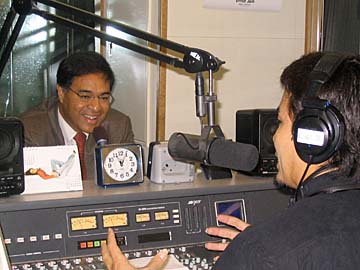
Mayor Mufi Hannemann taped an interview yesterday with Tokyo radio deejay Vance K., a Hilo native living in Japan.
|
|
Japan’s smart card intrigues Hannemann
The mayor gathers information in Tokyo on transit fare tech
TOKYO » A day could come when Honolulu commuters use a single electronic card to pay for rides on the bus, a proposed ferry and rail system.
Or, instead of a card, the transit pass could be stored on a cellular phone, and all the rider would need to do is wave the phone over a sensor.
Two technology giants of Japan -- electronics whiz Sony Corp. and mobile-phone giant NTT DoCoMo -- showed Mayor Mufi Hannemann and other city officials that the technology already exists, and they want a shot at demonstrating how it could work in Honolulu.
The mayor told officials from both companies that the city is interested in resurrecting plans for smart-card technology, but first it must overcome two obstacles: cost and the perception of whether it can work here.
"We had to stop the smart-card system that we had in TheBus -- I inherited (it) when I became mayor. It was filled with problems. So we canceled it, and so we are in a period now where we're going to reassess it," Hannemann told Sony executives yesterday at its electronics headquarters. "We know it's the wave of future, but the way we were doing it, it was creating more problems than creating opportunities."
Sony introduced city officials to FeliCa, its smart-card technology that touts ease of use and security features.
The card can be used to purchase train tickets, groceries and other consumer goods and also as a form of identification.
The technology could be taken a step further by integrating FeliCa technology by putting it into NTT DoCoMo phones so that all the information to access transit systems and other uses is stored in the phone.
Hannemann told Sony officials how he tried to use the city's smart card that was in limited use on TheBus earlier this year. The card did not work, and so a bus driver waved him through without paying.
"A lot of people would keep the card knowing that it didn't work, and that way they would get a free bus ride," he said. "We were missing a lot of revenue."
Hannemann, City Councilman Rod Tam and others with the mayor said they were impressed with the technology and could see how it would work with the city's plans to begin commuter ferry transportation and rail transit.
But they cautioned that there are kinks to be worked out if the city moves forward with it.
"I think we gave a suggestion of how they could penetrate the U.S. market, and at the same time they shared with us technology that once again we have a wonderful opportunity to take advantage of," Hannemann said later in the day. "We need smart cards. We're grappling with how to revive it and bring it back."
Paul Yonamine, Hannemann's volunteer senior adviser, said that because the mayor had to stop a "dysfunctional" smart-card system, it might be difficult to persuade the City Council to buy in.
"So if he goes to City Council now and says, 'I need capital costs to put in a new system,' it's very difficult right now, and I think the public would say, 'Another system?'" Yonamine said.
Yonamine said there could be "creative ways" the city could work with them to introduce the technology to the United States via Honolulu without a substantial cost to the city.
Hannemann also said he can see the technology working his plans to develop wireless Internet accessibility across the island.
Later in the evening, Hawaii tourism officials hosted a "Wow Honolulu" dinner last night for dozens of Japanese travel in-dustry representatives, where Hannemann picked up a microphone to promote Hawaii with song.
The mayor sang "I Fell in Love with Honolulu" and his version of "Honolulu I Am Coming Back Again" and later led a round of "Hawaii Aloha" when Councilmen Todd Apo and Donovan Dela Cruz joined him onstage. The two councilmen met up with Hannemann's group after attending a conference in Singapore.
Also attending the dinner were former sumo star Akebono (Chad Rowan) and former island disc jockey Kamasami Kong, now a radio personality in Japan.


