
Sticky mochi binds
family together
Rare is the Hawaii clan that still
pounds rice into New Year’s cakes
For 32 years, Edith Kuwana has gathered with family on the first Sunday after Christmas to pound rice into mochi.
This year, the 92-year-old watched the festivities from a shady spot in her back yard while her children, grandchildren and great-grandchildren did the heavy work.
"It's nice to have everybody coming together," Kuwana said as her daughters stuffed mochi with azuki and lima bean.
Nearby, a rhythmic pounding of wooden mallets could be heard striking steamed rice in a stone "usu," or mochi-pounding bowl. Dozens gathered around to take turns pounding the rice, which took about 15 minutes to turn into mochi.
The mochi-making tradition -- which brought together four generations of Kuwana's family yesterday -- was started by her late husband, who had hoped to teach his children about their Japanese heritage. Such gatherings are becoming more scarce locally and in Japan as many turn to grocery stores for traditional New Year's mochi.
"I think it's important to keep the culture alive," said Misha Tajima, Kuwana's granddaughter. The 32-year-old said she has been pounding mochi every December for as long as she can remember, and she is confident her family tradition will continue for decades to come.
"It's a day to look forward to," she added.
About 50 people came from all over Oahu and the mainland to attend the day of mochi-making -- and eating -- at the family's home in Hawaii Kai.
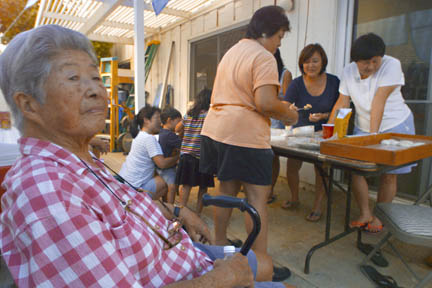
Four generations of the Komenaka family and friends gather annually at the home of Diane Komenaka to pound steamed rice into sweet mochi. Matriarch Edith Kuwana, 92, watches over the process she revived as a family tradition.
Komenaka's mother, Diane, steered clear of the pounding. Instead, she helped mold the mochi into small balls, covered them with rice flour and stuffed them with beans. The finished mochi were placed in parchment-lined boxes for family members to take home.
In about four hours, some 50 pounds of steamed rice was pounded into mochi. A pound of rice makes about 10 mochi -- which were then stuffed or left plain.
When Komenaka was younger, many Hawaii families would gather before New Year's Day to make mochi. But now her family is a rarity.
"We want to keep it up," she said, adding that it is important to include children in the event. "It's another generation entering the tradition."
The youngest to join in the pounding yesterday was 2-year-old Emiko, who timidly admitted she had not yet acquired a taste for mochi. Her 7-month-old sister had rave reviews, though, for azuki beans.
At 63, Mike Tajima is proud to say he has been pounding New Year's mochi since he was a young boy. These days, he is in charge of a more tasking job: adding water and turning the mochi between mallet swings. He said he has never been hit by a mallet, but there were a few close calls.
"It's about the timing," he said, noting that aggressive pounders are the most dangerous.
Tajima has to be cautious, too, with amateur pounders, who can miscalculate their swings. And, he added with a laugh, the family's mallets have to be replaced every year because people crack them on the bowl.
Komenaka also pointed out that the family's mochi-pounding is hardly professional.
Some mochi are extra small, and some very large. The cakes, ideally snow white, have small brown grains running here and there. And one batch of rice was a little harder than it should have been before it was pounded, while some of the mochi was a bit too sticky.
But that does not keep the family from coming together yearly.
"It's another reason," she said, "to come home for the holidays."
[News] [Business] [Features] [Sports] [Editorial] [Do It Electric!]
[Classified Ads] [Search] [Subscribe] [Info] [Letter to Editor]
[Feedback]
