
|
Voyage brings humility,
discovery
The Voyage
With high hearts the brothers sailed. Over a quiet sea they went, pushed by a steady wind, thinking of adventure and conquest. Then the wind changed and blew gustily. Great waves rushed toward their canoe as if to sink it. But skillful paddlers sent it to mount the waves, and the young men's hearts beat high as they battled the ocean. They ate and drank sparingly, for they knew their journey must be long. With anxiety they saw their food supply grow small.
Long and long they sailed, guided by stars or sun. How vast this ocean was! They longed to see a cloud that rested on the ocean, to see a floating log or land birds flying overhead. There were no signs of land. And now the men were weak with hunger. The eldest brother took Kaumai in his arms. "O my son," he murmured.
"Why do you weep?" asked Kaumai.
"For you, my son. For me, it matters not that water and food are nearly gone. I have lived many years and can face death. But you are young! Oh Kaumai, that you must die of thirst and hunger -- that thought is hard to bear!"
"But I'm not dying, Father. 'Aukele has a sacred leaf. We only touch it to our lips and it satisfies both thirst and hunger. Look at me, O my father! Do you not see that I am strong and well?"
The father opened tired eyes and saw health and strength in this well-loved son. "It is good," he whispered and closed his eyes with a contented sigh.
The boy looked at him anxiously and began to weep.
"What ails you, Kaumai?" 'Aukele asked. "Why do you weep?"
"For my father. For my uncles. 'Aukele, they are dying! Only you and I are fed."
"They hate me," 'Aukele answered. "Your father tried to kill me." Kaumai said nothing but wailed bitterly.
Then 'Aukele spoke slowly. "They are my brothers." He was silent, thinking. "They shall be fed." He shared the sacred leaf, and strength returned to all.
On and on sailed the double canoe. Then one day 'Aukele said, "Tomorrow we shall find land." When morning came they saw cloud-covered mountains and by noon had reached an island. It proved to be small and uninhabited, but there was room to stretch legs tired from days and nights at sea.
"This is not the land we seek," the brothers said. "We must be conquerors of some great island." After four days of rest they took supplies of food and water and journeyed on.
Again 'Aukele told them, "Tomorrow we shall see land. This is the land my grandmother told me of -- a land of danger. Let me take charge of the canoe."
His brothers stared at him in great surprise. "If you wanted to take charge you should have built your own canoe," the eldest said.
"But there is danger here," 'Aukele repeated, "danger to us all. My grandmother told me how we might be saved."
"Oh, you are very wise and strong!" the eldest answered, sneering. "But we too are strong and brave."
"In sports or battle," 'Aukele told him, "but here is danger not to be met by skill in fighting. I beg you let me take command that we may all be saved!"
The eldest brother tried to hide his anger because of Kaumai. He spoke in a low voice. "You -- keep -- still!"
Throughout the night they sailed while anger and fear lay on the canoe. Morning showed an island just ahead. As the canoe entered a bay the sun rose and shone upon great white birds winging their way to meet the voyagers. "They are sacred birds," 'Aukele whispered. "They will ask why we have come. O brothers, say that we are sightseers!" The eldest brother turned on 'Aukele a look that longed to kill. 'Aukele said no more.
The great birds circled over the canoe. "Why have you come?" they shouted.
"To make war!" the eldest answered boldly. "This is a war canoe, for we have come to conquer!" The birds flew off and the young men laughed. 'Aukele turned toward them with a long, sad look, then, throwing his calabash into the sea, leapt after it. He swam toward land, pushing the bowl. On shore he saw a woman shaking a kahili. When he looked behind he could see only the quiet bay sparkling in sunlight. There was no canoe, no nephew and no brothers. All had been destroyed! With heavy heart the young man swam toward shore pushing his calabash.
he reached a beach at last. He crawled toward a tree dragging the sacred bowl. In the shadow of the tree he slept.
The island on which 'Aukele lay belonged to a powerful goddess named Namaka. She lived there with her brothers and a few attendants. When her birds brought the boastful words, "... a war canoe," she shook her kahili and turned canoe and men to ashes.
Very soon the barking of her watchdog told Namaka that one from the canoe had escaped. Her power was turned against 'Aukele, but he also had great power through the gifts of his grandmother.
After a bitter struggle, Namaka sent for the young man. "Neither of us can prevail against the other," she said. "Let us be friends. Let us be wife and husband."
Love grew between the two who had been enemies. After a time Namaka made 'Aukele high chief and shared her powers with him -- all but one. "Has our sister given you the power to fly?" her brothers asked him.
"To fly? Has my wife the power to fly?"
"Yes. That power she withholds from you. She fears that if you learn to fly you will leave, and she has great love for you."
'Aukele did not answer, and the young men watched him curiously. "We can teach you to fly," they said at last and saw an eager light wake in his eyes. "Come with us to our house."
The young men were wise and patient teachers. Soon 'Aukele could fly up to a shelf, perch there and then fly down. "Good!" said the brothers. "Now fly up to the peak of this high roof."
Up flew 'Aukele and caught the ridgepole. For a moment he clung there, then fell with a thud. "I forgot to fly!" he said, laughing a little.
"Namaka may have heard that thud," a brother whispered. "Do not spoil the secret. Quick, 'Aukele! Go on with the boxing lesson you began some days ago." So when the chiefess came two of the young men were boxing.
"What are they doing?" she asked curiously.
"Learning to box."
"What is that?"
"Watch!" 'Aukele told her.
While Namaka watched, one brother staggered and fell. "That was the thud I heard," the chiefess said, satisfied.
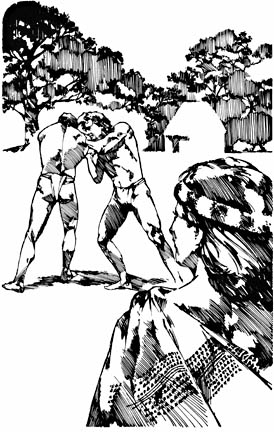
"Now fly!" the brothers told 'Aukele. "Fly to the high peak of the roof." This time the young man missed the ridgepole altogether and there was another thud. "She is sure to come again," one whispered. "Wrestle with me."
So when Namaka came she found two wrestling and stayed to watch. "I thought perhaps you were teaching my husband to fly," she said. Just at that moment 'Aukele threw her brother with a thud. Again the chiefess went off satisfied.
On his third try 'Aukele reached the ridgepole, clung a moment, then flew lightly down. "Good!" his teachers cried, delighted. "Now come outside."
'Aukele flew to the housetop, then up into the night sky. "It is glorious!" he said.
"Now you can tell Namaka. She will not be angry about the flying when she finds you do not leave her." This was true. Husband and wife remained together. Their love was great and, in his happiness, 'Aukele forgot both home and brothers.

Click for online
calendars and events.
