
Hawaii’s
Back yard
Cheryl Chee Tsutsumi
Annual ‘liberation’ part
of resort’s program to help
preserve turtlesOn the Fourth of July, Mauna Lani Resort might not light fireworks, but you can always expect an explosion of fun and excitement.
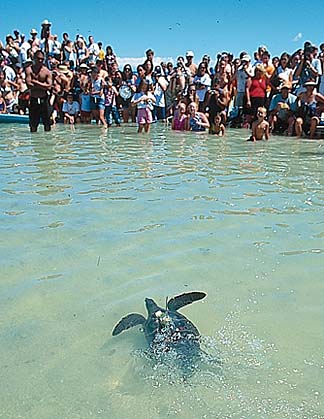
Each Independence Day, during a festive morning celebration, this luxurious Big Island resort "liberates" juvenile honu (green sea turtles), a threatened species, that have been raised in its saltwater ponds.
Turtle Independence Day
Place: Mauna Lani Resort, Kohala Coast, Big IslandTime: 8:30 to 11:30 a.m. today
Admission: Free. Food will be available for purchase.
Call: Susan Bredo, 808-885-6622
E-mail: sbredo@maunalani.com or dakaka@maunalani.com
Web site: www.maunalaniculture.org
The resort launched the Turtle Ambassador Program in 1989, in cooperation with Oahu's Sea Life Park and George Balazs, a turtle researcher with the National Marine Fisheries Service. Every year, a few dozen to a few hundred sea turtles are hatched at Sea Life Park. Most of them are identified with National Marine Fisheries Service tags and released into the ocean during the first 24 hours of their lives, but some are sent to qualified facilities like Mauna Lani's as part of a unique education project.
Mauna Lani receives five to 20 honu at a time for its Turtle Ambassador Program (the resort has nurtured more than 100 honu since 1989). The turtles usually range in age from 3 months to a year, and Mauna Lani's staff cares for them until they are big and healthy enough to be released into the ocean.
Generally, to be released, the turtles must have a carapace length of at least a foot, a size they attain when they're about 2 to 3 years old. Their release is the highlight of Mauna Lani's Turtle Independence Day, which marks its 15th anniversary today with the release of 15 turtles.
Exuding the lively atmosphere of a carnival, the event will begin at 8:30 a.m. with musical entertainment, games, face painting, balloon animals and canoe rides for the kids. Favorite picnic fare will be available for sale, including hot dogs, hamburgers, cotton candy, malasadas, shave ice and root beer floats.
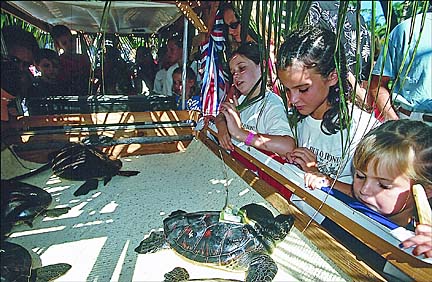
Baby honu are cared for as part of Mauna Lani Resort's Turtle Ambassador Program and nurtured until they are big enough to survive in the wild.
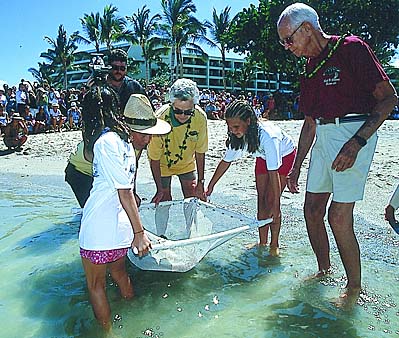
At 9:30 a.m. the turtles will be carried to shore, where a special chant and "honu hula" by John Kaimikaua's Halau Hula O Kukunaokala will take place prior to their release in front of hundreds of flag-waving well-wishers.
"Some turtles zoom seaward," says Pii Laeha, manager of Mauna Lani Resort's saltwater ponds.
"Others cruise the area before heading out to offshore waters."
Hundreds of schoolchildren annually learn about the honu on tours of the resort's ponds. "The turtles require special care," points out Laeha.
"There are many things to worry about. Do they have enough to eat? Are they sick? Is their water clean? You worry about them getting stuck in the rocks. With the turtles, you run into the same concerns and problems as you do when raising your children; they need lots of tender loving care."
A few turtles are selected as subjects in a satellite tracking project conducted by Balazs. Transmitters relay the turtles' location and other data to him at the NMFS's Pacific Islands Fisheries Science Center in Honolulu. Balazs notes, "The main scientific purpose of putting satellite transmitters on the turtles is to study their pelagic ecology -- where they travel and how they live with relation to ocean currents and other features such as temperature and winds."
During thorough pre-release examinations, Balazs and veterinarian Dr. Bob Morris determine which turtles are fit for release; the strongest and healthiest are chosen to wear the transmitters. They vary in age and weight, so information about them at different stages can be obtained. Last year, four turtles bearing satellite tags were released -- one from the shore and three in waters five miles off Mauna Lani.
Every Fourth of July is Turtle Independence Day at the resort, when turtles who are at least a foot long await their ocean send-off.
IN ANCIENT TIMES, according to Danny Akaka, Mauna Lani Resort's director of cultural affairs, ponds called "pa honu" were built to raise honu as a food source primarily for the alii (royal) class. A pa honu was located at Kawaihae, currently the site of the deep draft harbor.
"Honu also played a significant cultural role in that they were regarded as aumakua (personal guardians) by some Hawaiian families," Akaka says. "Families who believed the turtle to be their aumakua could not eat or use any part of it for any purpose; otherwise, it was said misfortune may befall them for not respecting the family guardian."
Akaka says Mauna Lani's Turtle Ambassador Program has provided a wonderful opportunity for staffers to talk to visitors about the honu as a symbol of longevity and voyaging, its cultural significance in Hawaii and its plight in today's world.
"It doesn't take much to sell people on the fact that the relationship between man and turtle is akin to the relationship between man and nature, and that man's existence depends on how well he treats nature," Akaka says. "If turtles cease to exist, what of man's existence? Will man's shortsightedness, negligence and abuse place him next on the endangered species list?"
A school group from Puna, where fishermen sometimes were caught illegally harvesting turtles from the sea, was among those visiting the resort.
When Akaka spoke to the children about the importance of protecting the environment and the honu, one of the girls raised her hand and said that her father was a fisherman who occasionally brought home a turtle for dinner. "I told her that we must all do our part to help Mother Nature," Akaka said. "By taking turtles before they mature and can have more offspring, we could upset the balance of life in the ocean, which could have a negative effect on other species as well."
Within a few weeks, Akaka received thank-you letters from the class; one was from the girl who had mentioned her father hunted turtles. In her note, she said she told her parents about the field trip, what she had learned and how we all need to be the stewards of the ocean, land and its resources.
"Her father promised he would not kill another turtle again," says Akaka. "I use this story to illustrate the impact that our Turtle Ambassador Program can have on children, and that it is the children who, in turn, will teach the parents to malama aina, malama ke kai (protect the land, protect the ocean)."
Volunteers gently carry the turtles to the water's edge, where they are released with a big party and the cheers of crowds.
See the Columnists section for some past articles.
Cheryl Chee Tsutsumi is a Honolulu-based free-lance writer and Society of American Travel Writers award winner.