[ SUNDAY TRAVEL ]
While walking the waterfront district of Belem, take in the Monument to the Discoveries.
Portugal’s Bay Area
Portugal's rich culture shows in
this seaside capital with comfortable
weather all year
It is always a joy to discover an overlooked destination, where you can experience a rich, cultural treasure without the crowds or high prices of major cities. Portugal's capital of Lisbon is such a spot. Beautifully set on the water's edge, this city has an appealing, slightly worn, though authentic quality that is hard to find in Western Europe's other capitals.
Lisbon is a year-round destination with a mild climate moderated by the nearby Atlantic Ocean and Gulf Stream that produce winter temperatures in the 50s and comfortable summers in the 70s and 80s. These pleasant weather conditions are similar to Northern California, which brings favorable comparison with one of America's favorite cities, San Francisco: Both are medium-sized cities on a bay, with similar "golden" bridges built by the same company, and a network of small trolleys running through hilly streets.
Portuguese navigator Vasco da Gama discovered the sailing route from Europe to Asia in 1497, making Lisbon the gateway to riches from its spice monopoly. The spice trade was extremely important because pepper, cloves and other Asian spices provided the best way to preserve food before refrigeration was introduced.
The economic boom briefly made Portugal the world's most important international center in the 16th century, but the wealth faded and Lisbon settled into a sleepy existence, isolated by geography and politics. In modern times it has given up all its colonies -- which had stretched through Africa, Asia and South America -- retaining only the islands of Madeira and the Azores.
For much of the 20th century Portugal was isolated on the remote western edge of Europe, ruled from 1926-1974 by dictator Antonio Salazar, who prohibited modernization. Europe's leaders shunned Salazar, and this slowed the nation's development, but helped to preserve Lisbon's historic charms. Changes began with the democratic revolution of 1974, and Portugal is today a thriving member of the European Economic Community.
Day 1
The main districts for shopping and entertainmentDay 2
Alfama and BelemDay 3
Major museum and day trip out of town
Lisbon is compact and easily covered on foot, with the occasional help of trains, buses and trolleys. Its distinct neighborhoods include central Baixa, a historic business district, flanked on the west by trendy Chiado and Barrio Alto, and on the east, by medieval Alfama. Belem is a fourth district a few miles away along the waterfront, easily reached by public transportation. These four areas can be covered in a couple of days, leaving a third day to visit the nearby towns of Sintra, Estoril and Cascais.
Many of Alfama's "streets" are actually steep, narrow staircases.
The main shopping and entertainment districts
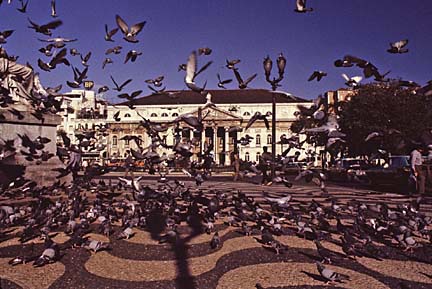
Rossio Square: This is the heart of Lisbon, an ideal meeting place for friends, full of restaurants and cafŽs. A beautiful Parisian fountain in the square's center supports a statue of Portuguese King Peter IV, the first emperor of Brazil. After 300 years of being a Portuguese colony, Brazil declared its independence in 1822, cutting off a lucrative supply of gold, sugar and coffee, and further pushing Portugal into economic decline.
The grand building on the north end is the National Theater, home to cultural performances. Rossio has been under heavy reconstruction in recent years and was virtually closed to the public, but it has re-emerged as a shining, spotless square.
Baixa: Lisbon's business district extends from Rossio to the waterfront, an area just nine blocks long and four blocks wide. This area was rebuilt in the mid-18th century after Lisbon was devastated by the great earthquake of 1755; the quake and subsequent fire leveled most of the city and killed 15,000 to 60,000 residents.
Following reconstruction, the ground floors of buildings in this part of town were occupied by shops, with offices on the next two floors and apartments on the upper two floors, making for a vibrant, self-contained neighborhood.
Three main streets running parallel through the middle of this shopping zone are Gold (Rua do Ouro), Silver (Rua da Prata) and the pedestrian center lane, Rua Augusta. This grid of retail bliss is reminiscent of an old-fashioned, mini-Manhattan.
At the end of Rua Augusta, walk through the arch into the largest square in town, the Praca do Comercio, surrounded on three sides by elegant , late 18th century government buildings. This square, with its uniform arcades, glorious Arco da Victoria triumphal arch and impressive equestrian statue representing King Joseph I, is the signature sight of Lisbon.
A splendid vista of the Tagus River borders the square's south side. Walk toward the river to enjoy a fine panorama of the statue and arch framed by the long arcades. Hop on one of the 100-year-old trolleys here for a city tour, available from May through October.
Alfama, the oldest section of Lisbon, is dense, and streets are narrow. Locals treat these lanes like outdoor living rooms, gravitating outside to chat with neighbors, do their laundry, linger in markets, play cards and gossip.
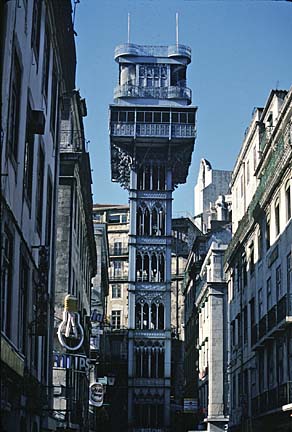
Barrio Alto and Chiado: You can scale this hill on the west edge of downtown several different ways. In the middle of the shopping area you will see a metal tower, the famous Santa Justa Elevator, built in 1902. It costs about $1 for a ride. Or, pick one of two funiculars on the north and south ends of the Baixa district. Travel free from the Baixa to the Chiado district by using the escalators in the Baixa-Chiado Metro station.
Walk to nearby Restauradores Square to ride the Elevador da Gloria, the busiest funicular in Lisbon and the most accessible for tourists because it's next door to the main tourist information office in Pal‡cio Foz. Good restaurants lie just beyond the funicular station along Rua da Gloria. This ancient rail line, which opened in 1885, will deliver you to Sao Pedro da Alcantara, a terrace with a view across the Baixa district and a sky-high cafe with prices to match.
A walkway leads from the top of the elevator to the Largo do Carmo and into Barrio Alto. By day this district is a local working-class place with inexpensive small restaurants, and many shops; but late at night it becomes an entertainment center pulsating with nightclubs and bars. This is the place to come for fado, the plaintive, mournful music of Portugal, poured out in sad ballads until the wee hours.
Nearby is the Church of Saint Rocco with one of the country's most magnificent Baroque interiors, featuring a ceiling mural, many statues and an outstanding altar. The detailed Chapel of St. John the Baptist is an eye-popping extravaganza of marble, gold, silver and precious stones.
Your remaining walk could take an hour to half a day, depending on your interests. Three options are a quick, garden or main walk. It's quickest to walk over to the picturesque old street, Rua do Seculo, walk south a few blocks, then turn east on Calcada do Combro leading into the Chiado district and the main shopping street of Rua Garret. From here, it is just a few blocks downhill back into the Baixa.
The main walk continues from the funicular area to the ruins of Igreja do Carmo (Carmelite Church), a memorial to the 1755 earthquake which hit on a Sunday morning, killing all worshippers at Mass. This shattered shell of a Gothic church is roofless, with walls held together by a few pointed arches. It has been turned into an open-air garden and archaeological museum, with scattered stone fragments of buildings and statues from the past 2,000 years.
The Carmelite Church is in the heart of Barrio Alto, which extends west seven blocks and north to south for five blocks. On its southern edge, this district changes name and becomes the Chiado, with fancier shops.
It may seem quiet here during the day, but at night it fills with thrill seekers. Return after 10 p.m. to sample this other side. When you've seen enough of the Barrio Alto and Chiado, walk downhill along Rua Miseracordia, which becomes the steep street, Rua do Alecrim, leading down toward the river. En route, you'll pass the Chiado Museum, also called the National Museum of Contemporary Art, housing Portuguese works from 1850 through today.
Art lovers will want to continue walking or take a taxi another mile along the waterfront to the National Museum of Ancient Art, also known as the Janelas Verdes Museum after the street it is located on in the Lapa district.
Return to town along the waterfront through the Santos dock area, which has been transformed into an upscale row of cafes, restaurants and nightclubs, with a picturesque marina. This could be a great place to end your day, enjoying dinner with a nautical view.
For those who wish to sample Lisbon's best nightlife, return to the Barrio Alto. The most typical night out is a visit to a fado club (see listings), either with dinner or a late show for drinks. .
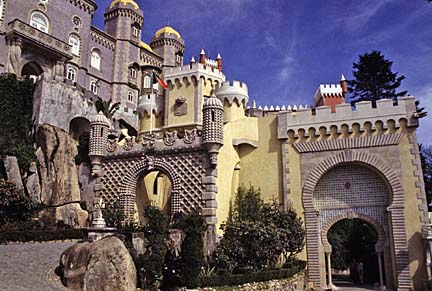
Sintra's Pena Palace, built on the site of an older monastery in the 1840s, is reminiscent of fairy-tale castles, with multicolored, spiral motifs.
Alfama and Belem
You can reach the oldest part of Lisbon, Alfama, by bus 37 or tram 12 from Praca da Figueira, near Rossio Square, or better, by tram 28 from Rua da Conceicao downtown. If the tram (electrico) is crowded, take a short ride in the opposite direction to the end of the line, then turn around to get a seat all the way to the hilltop city. The trams are a big part of Lisbon's identity, comparable to the cable cars of San Francisco, and have been running for 100 years.
Get out in the Miradouro Santa Luzia or Miradouro Portas do Sol, each with a lovely view and centrally located. Take a short walk uphill to begin your exploration.
St. George Castle (Castelo de Sao Jorge): The oldest surviving monument in Lisbon is a good place to start your Old Town walk. The oldest visible castle walls were built by the Arabs in the 8th century, but the site was also home to 5th century Visigoth invaders, and before them, the Romans who built the first fort here. St. George Castle is a romantic ruin with ancient stone walls and ramparts overlooking the city and with lush landscaping that has transformed this fortress into one of the nicest parks in town.
Alfama: After enjoying the castle, exit the gate leading to Rua da Santa Luiza and continue down the quaint lane lined with ancient homes and tiny shops. This is the Castelo district extending several blocks around the castle and leading to Alfama, beginning at the small square of Largo das Portas do Sol, housing a Museum of Decorative Arts.
Many of Alfama's "streets" are actually steep, narrow staircases, such as Beco Santa Helena, extending from Portas do Sol and continuing as Beco da Cardosa and other names to the bottom of the hill at the main street of Rua de San Pedro. You could exit here and catch a tram or walk a half-mile back to the town center, but if you have the time and energy, continue navigating this special neighborhood.
Alfama is the oldest section of Lisbon. Today it is a poor neighborhood, with some apartments lacking running water. Despite its many winding alleys, you cannot get very lost in this small district. As long as you generally head downhill you will easily get out at the bottom.
For those in good condition, Alfama is heaven to explore, best seen during the day when the streets are lively and conditions safe. Locals, who generally welcome tourists, treat these lanes like outdoor living rooms. On Tuesdays or Saturdays, visit Lisbon's main flea market in Camp de Santa Clara.
Belem museums and monuments: Take a short trip along the waterfront district of Belem to enjoy its most spectacular sights, the Jeronimos Monastery and Belem Tower, both UNESCO World Heritage Sites. Belem is a zone of museums and monuments, including the city's most popular attraction, the Coach Museum and the modern Monument to the Discoveries.
Belem is too far to walk from downtown, so take tram 15 from Praca da Figueira or Praca do Comercio for a 40-minute ride in a vintage trolley that brings you to Jeronimos.
Rossio Square is the heart of Lisbon, full of restaurants and cafes.
Jeronimos Monastery: This monumental church and monastery were built in 1502 by King Manuel. It was built in homage to St. Jerome by the wealthy Religious Order of Christ, a continuation of the medieval Knights Templar.
Walking into the church is a goose-bump experience brought on by the lofty interior space, supported by tall columns that soar heavenward and spread like trees in stone ribs at the top, forming a delicate, tracery pattern on the ceiling. The many Gothic arches are lined with twisted stone carved to look like sailor's ropes. Tombs inside include those of Vasco da Gama, King Manuel and other royals.
The church was built so solidly that it survived the great earthquake of 1755, even though the adjacent monastery was destroyed. It was rebuilt in the original style.
A block from the Jeronimos complex is Lisbon's most popular attraction, the Coach Museum, considered the world's greatest collection, with dozens of horse-drawn carriages dating to the 16th century.
The Popular Art Museum nearby is filled with folk art and crafts, including costumes, furnishing, textiles and jewelry showcasing Portugal's diversity. Also along the waterfront are the two most famous Belem monuments: The Tower of Belem and the Memorial to the Discoveries. To understand Portugal's history, you need to appreciate its spectacular maritime discoveries. Vasco da Gama was the first to sail around Africa and discover the ocean route to Asia. Pedro Cabral discovered Brazil in 1500, which Portugal claimed as their largest colony, and Portuguese navigators were the first to sail to China, in 1542. After the Portuguese discoveries, other European countries joined in the hunt for colonies. This was the start of the modern era and of global trade and communications.
The Tower of Belem, built between 1515 and 1520, was a fortress to protect Lisbon's harbor. It was originally in the middle of the river, but the river narrowed over time so the fortress is now on the shore. Climb to the tower's upper levels for a panoramic view.
The other waterfront landmark is the Memorial to the Discoveries, built in 1960 to honor Prince Henry the Navigator, who is depicted on the stone prow along with other important Portuguese voyagers, including Da Gama, Cabral, Diaz and Magellan. Henry funded a school for navigators in the late 15th century that helped the nation gain control of the seas.
When you are done looking around, take a tram back to town.
Parque das Nacoes: The newest major attraction is on the site of the Expo '98 world's fair along the Tagus River, featuring Europe's largest aquarium, Lisbon Oceanarium, and a three-mile park along the water's edge. Shoppers will enjoy the huge Vasco da Gama mall, with 164 shops and 30 restaurants, and a 380-foot-high tower offering views across the region. It's on the opposite side of town from Belem at the end of the new Red metro line at the Oriente Station, a 20-minute ride from central Lisbon, near Lisbon International Airport.
Take a day trip to Sintra and browse the shops around the main square fronting the palace. The town is noted for ceramics, baskets and carvings.
Major museum and day-trip out of town
Gulbenkian Foundation Museum: Lisbon's most wonderful museum was endowed by Calouste Gulbenkian, a billionaire who donated his collection of several thousand artworks to create this treasure house, located in the Parque de Santa Gertrudes, and accessible by metro. This is one of the world's finest private museums, with paintings, sculpture and jewelry dating from ancient Egypt through the mid-20th century. There is a strong Impressionist section and many Old Masters works, including examples of Rembrandt's best work. Gulbenkian was Armenian, and his Islamic section is especially strong, with ancient ceramics, fabrics, carpets and illuminated pages from the Koran.
Gulbenkian was also an expert on Chinese art, collecting many porcelains, and French decorative artist Rene Lalique was his friend, so dozens of Art Nouveau necklaces, combs and other items by this innovative genius are on display.
Day trip to Sintra, Cascais and Estoril: Lisbon is blessed with many nearby attractions. The most popular day-trip is to the royal palaces of Queluz and Sintra, easily reached via a 36-minute train ride, or a four-hour packaged bus tour offered by Carristur.
The metal tower of the Santa Justa Elevator, built in 1902, towers over Barrio Alto shopping area.
Queluz Palace: Often considered the Portuguese Versailles, this palace is a 10-minute walk from the Queluz-Belas. It was built in the 18th century as a summer residence, designed in elaborate Baroque and Rococo styles. Formal French-style gardens add another pleasant dimension. After strolling through the gardens, return to the train station to continue to Sintra.
Sintra: This small town has two palaces and village ambiance. It's set on rolling green hills dotted with mansions. The town is divided in two parts: a new section where the train station and business district is located, and the old town with the Royal Palace, accessible after an easy 15-minute walk along a scenic road. This pleasant stroll takes you past the City Hall, designed in a neo-Manueline style with fortified turrets and colorful walls.
Over the centuries many palaces were built by noble families attracted to Sintra by the cool summer weather and proximity to the royal court. The village center was designated by UNESCO as a World Heritage site in 1999.
The main attraction is the Royal Palace, one of the oldest intact buildings in Portugal, used as summer residence by the kings for 600 years. A second, whimsical palace further up the steep hill a mile away is Pena Palace. There are wonderful views in all directions from this hilltop fantasy fortress. A taxi can take you back to the train station for your return.
Cascais and Estoril: From Sintra, take a public bus about 10 miles to the coast to visit two lovely coastal resort towns. Cascais is a quaint fishing village and Estoril, one mile away, is a popular resort town and home of Europe's largest casino.
A coastal train can bring you back into Lisbon in 30 minutes, where you can enjoy dinner and one of Barrio Alto's late-night fado clubs -- a perfect way to end your stay.
Cascais is a quaint fishing village that caters mostly to the tourist trade despite its history as a refuge for Europe's nobility in past centuries.
Dennis Callan is the president of the Hawaii Geographic Society and produces the "World Traveler" TV series airing 6 to 7 p.m. Mondays on 'Olelo, channel 52. He leads frequent tours through Europe, Canada and the United States, and writes "Three Days in ..." the first Sunday of each month explaining how to get the most out of three days in the world's great places. This is his 38th article in a series, available at www.tourvideos.com.
If you go ...
Here are a few places to stay and dine while in Lisbon. For phoning, use the prefix 011-351-21:
HOTELS
» Hotel Avenida Palace, 123 Rua 1 Dezembro. Call 346-0151, fax 342-22884.
» Aparthotel VIP Eden, 18 Praca dos Restauradores. Call 321-6600, fax 347-0925.
» Hotel Tivoli Lisboa, 185 Ave. da Liberdade. Call 353-0181, fax 319-8900.
» Hotel Britania, 17 Rua Rodrigues Sampaio. Call 315-5016, fax 315-5021.
» Hotel Lisboa Plaza, 7 Ave. da Liberdade. Call 346-3922, fax 347-1630.
» Lisboa Regency Chiado, Armazens do Chiado. Call 325-6100, fax 325-6161.RESTAURANTS
» O Brinco da Gloria, 23 Rua da Gloria. Call 213-468-635.
» O Cantinho do Bem Estar, Rua do Norte 46. Call 213 464 265.
» El Ultimo Tango, Rua Diario de Noticias 62. Call 213 420 341.
» Casa do Alentejo, Praca de Santo Antao 58. Call 213 469 231.
» Tavares, Rua da Misericorda 35. Call 213 421 112.
» Casa do Leao, Castelo de Sao Jorge, Alfama. Call 218 861 410.
» Cervejaria da Trindade, 20 Rua Nova da Trindade; www.cervejariatrindade.pt.
» Lagosta Vermelha, 153 Rua dos Correeiros.
» Marisqueira Popular, 209 Rua dos Correeiros.
» Ena Pai, 180 Rua dos Correeiros.
» Cervejaria Portugália (beer hall) 117, Avenida Almirante Reis.FADO CLUBS
In Barrio Alto
» Adega do Ribatejo: Rua Diario de Noticias 23. Call 346-8343.
» Adega Machado: Rua do Norte, 91. Call 322-4640.
» CafŽ Luso (Restaurante Típico): Travessa da Queimada, 10. Call 342-2281(2), e-mail cafeluso@oninet.pt.
» Timpanas: Rua Gilberto Rola, 24. Call 390-6655.
» Taverna do Embuçado: Beco dos Curtumes, 10. Call 886-5088 or 886-5078, e-mail embucado@tavernadoembucado.com or visit www.tavernadoembucado.com.
» Grand'tasca: Rua Manuel Bernardes, 10 ABC. Call 397-7456, fax 395-2072.
» Sr. Vinho: Rua do Meio -- Lapa, 18. Call 397-2681, e-mail restsrvinho@mail.telepac.pt or visit www.retsrvinho.com.
» Adega do Ribatejo: Rua Diario de Noticias, 23.
» CafŽ Luso: Travessa da Queimada, 10.In Alfama
» O Beco Restaurante Tipico: Rua de Sao Miguel 87. Call 887-4914.
» Parreirinha de Alfama: Beco do Espirito Santo 1. Call 886-8209.
» Taverna do Embucado: Beco dos Cortumes 10. Call 886-5088.
» Voz do Operario: Open Saturdays only at Rua Voz do Operario 13. Call 886-2155.WEB SITES
» www.atl-turismolisboa.pt
» www.strawberry-world-lisbon.com
» www.carris.pt
» www.thingstodo-lisbon.com
» www.metrolisboa.pt
» www.discoverportugal2day.com
» lisboa.kpnqwest.pt