[ SUNDAY TRAVEL ]
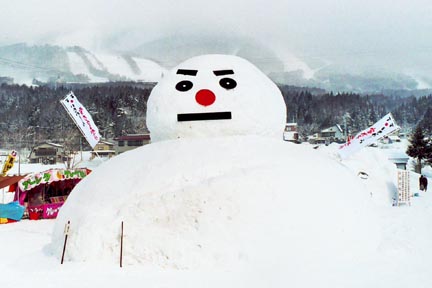
One large snowman loomed en route to Mount Bandai.
Winter wonderland
Japan's majestic Tohoku region is
worth the arduous trip for the chance
to relax in hot springs and revel
in "snow monsters"
It was one of the best showers I had ever taken. Steaming hot water rained down on my aching body. It felt good to stretch out and scrub off all that road wear. I had been on a plane for nearly 10 hours, waited at the airport for another two, then caught two trains for a combined three hours. The clock said 8 p.m., but my body knew better. I hit the lights and crawled into bed.
There's no simple, direct way to get to the Tohoku region of Japan. And its remoteness is what makes the area so distinct and appealing.
This northern region, comprising six prefectures, is about three hours northeast of Tokyo. Mountainous, wild and ruggedly magnificent, Tohoku, which means "North East," is a sprawling region of natural beauty, a landscape littered with majestic volcanoes and windswept beaches.
Compared to the bustling, crowded capital city of Tokyo, Tohoku is comfortably spacious, with just enough shops, ski resorts, onsens (hot-spring baths), and restaurants to keep it interesting. The region is home to a mere 7.8 percent of Japan's population. Yet it makes up nearly a third of the land area of Honshu.
I had already been-there-done-that in Tokyo, browsing funky shops in Harajuku and sampling tasty ramen in Hamamatsu-cho. I saw the Imperial Palace, walked around Ueno Zoo and toured a few temples. And while the big-city allure of Tokyo is riveting, downright intoxicating at times, I wanted to see Japan in its quiet grandeur. Something less skyscraper and more thatched-roofed.
I didn't see that my first night in Tohoku, strolling around Koriyama City, with its tall office buildings, convenience stores and Pachinko parlors. The city, with about 330,000 people, is one of the biggest in Fukushima-ken.
But as soon as my traveling group left the city the next morning, my plans to see the subtler side of Japan started to take shape.
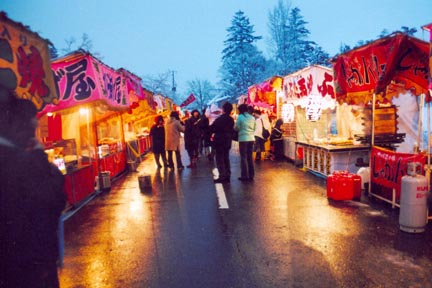
The annual snow festival in Yonezawa featured taiko drummers and spectacular ice sculptures -- and delicious local foods cooked and served from roadside stands.
Step back into time
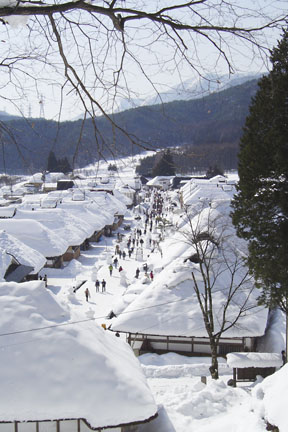
After bouncing along winding roads lined with snow-laced trees, we arrived at Ouchi-juku, an old post town in Fukushima-ken. The village clings to a single road once used by Aizu clan lords who were traveling to and from Edo (now Tokyo). The road climbs through a wooded gorge, threaded by a river still used by villagers.Ouchi-Juku has remained virtually unchanged since the Edo Period (1603-1868), with its dozens of thatched-roof homes and stores that sell pickled vegetables, handwoven baskets, dried tofu and more.
There are about 200 people who live in Ouchi-Juku and retain an old-world lifestyle that has become a tourist attraction -- and its main industry. In 1981, the village was designated a national architectural preservation site.
We arrived on the first day of its annual weeklong snow festival, which lures thousands of tourists from around the world. The street is lined with snowmen, snow lanterns and igloos bigger than my hotel room.
Hungry, we wandered into the restaurant Komeya, and were instantly warmed by the char fish frying over an open-pit hibachi near the entrance. This fish, cooked on skewers until crisp, is one of the village's specialties. Its flaky white meat is enhanced by the salty skin. It complements another prefecture favorite, shingoro, a flavored sticky rice packed on the top of a stick and cooked over a grill. The rice is typically flavored with a sesame seed sauce or miso paste.
Ouchi-Juku's signature item, however, is its soba, or buckwheat noodles. The noodles are chilled and topped with grated daikon. The soba is not eaten with a chopstick; instead, patrons are handed a single stalk of naganegi, a kind of hearty Welsh green onion, as a utensil. The combination of naganegi and soba is amazingly good, despite its simplicity.
Which holds true for the entire area.
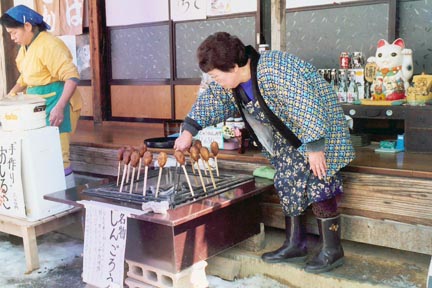
One local favorite in Tohoku is shingoro, a stick of flavored sticky rice cooked over a grill.
A taste of Tohoku
It took two days for me to realize this wasn't the Japan I remembered from my last trip, in 2001. Sure, there were still colorful vending machines standing in the most rural of villages. But in Tohoku I could hear the wind move through trees, the quiet hum of indoor heating. People walked slower, talked slower. It was hard to believe that the chaotic version of Japan was just a three-hour train ride away.Fukushima-ken is Japan's third largest prefecture, with a shape that resembles Australia. More than 2 million people live in this thriving agricultural and fishing area. And the freshwater springs in the area have made some small towns authorities on sake and ramen.
Kitakata, for example, could be the ramen capital of the world. With a population of just 37,000, the city boasts an unprecedented 131 ramen shops. Each one declares its uniqueness, whether in broth taste, creative ingredients or noodle texture.
It didn't matter that I couldn't read the menu at Ominato Ajihei, our first stop on the ramen-shop tour. I just said something like "shoyu ramen, onegaishimasu," and was presented a steaming bowl of curly noodles in a dark soup. The ramen was tasty and affordable; a large bowl was just 600 yen (or about $7).
Kitakata also boasts nearly a dozen sake breweries, offering tours and tastings of their signature rice wines. The Yamatogawa Sake Brewery, for example, invites travelers on tours of its old factory located in the heart of Kitakata. You can walk through rows of the massive wooden barrels used to make sake and learn about the process of producing this coveted rice brew.
In neighboring Aizu-Wakamatsu, the Suehiro Sake Brewer opens its doors to tourists, with guided tours and a tasting bar. Its sake has long been one of the most popular in Fukushima-ken, selling a million bottles each year, making it the third largest brewery in the Tohoku region.
Tadashi Fujisawa, our guide, who used to work for the brewery, said the area's underground water springs -- which have been surfacing for the past 145 years -- and cool temperatures make a perfect combination for producing sake.
This brewery still produces sake the old-fashioned way -- with women mashing rice with their feet. "Used to be only virgins could do this," Fujisawa said. "Now, you never know."
Walking around Kitakata is a stroll through time. The town is built of more than 2,600 traditional kura, or storehouses, once used for storage. Today, they have become homes and shops, offices and museums.
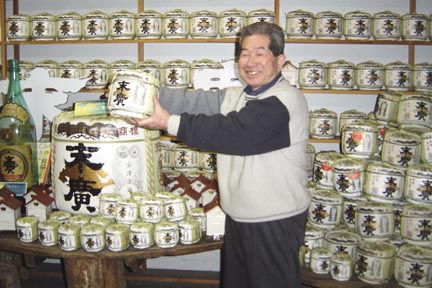
Tadashi Fujisawa, tour guide and former employee of the Suehiro Sake Brewer in Aizu-Wakamatsu, takes curious travelers on a brewery tour that ends at a sake-tasting bar. The spring water in this area, he says, is ideal for sake.
Getting naked
I woke up early to an angry, howling wind. It was snowing furiously, and I sat in my Japanese-style hotel room watching lightning burst through a thick layer of gray clouds, listening to what my roommate called "monsters shouting." The wind was kicking up snow in every direction, swirling it around in a mean tempest. I wondered if snowshoeing on Mount Bandai later that morning was still a good idea.But the thought of soaking in an onsen was convincing enough. The temperature had sunk to 20 degrees, and I couldn't wait to shed my winter layers and drown my skin in some nutrient-rich spring water.
As we made our way out of Aizu-Wakamatsu, I caught my breath. Looming in the distance was Mount Bandai, a 5,967-foot volcano, famous for its skiing and onsens. That morning it appeared as a faint ghost presiding over the land, distant and bleak, yet still imposing. Despite its reputation for heavy snow, the mountain remains a little-known resort, with fairly uncrowded ski lifts and bathhouses.
That night we checked into a hotel near a hot spring that offered both Western- and Japanese-style lodgings. After ditching my suitcase and changing into a comfortable yukata, I ventured into the dining area, looking for food. And I definitely found more than soba and sashimi.
For three hours we were entertained by two geisha, equally witty and flirtatious, who sang, danced and played lewd games with the restaurant patrons. It has become a dying trade, with no more than 8,000 geisha left in Japan. Today's geisha are not as old-fashioned as they may seem. Their conversational skills are utterly contemporary and their attitude remarkably modern.
There are no restrictions on their marital status, said one geisha named Katsuno; many are unmarried mothers.
Katsuno sipped her glass of beer with a gracefulness worthy of fine wine. Her pink eyeshadow and dark red lipstick contrasted with her stark white face. Her dream is to find a man who will marry her but let her keep her night job. "But that probably won't happen," she said in Japanese.
I snuck out of dinner to head to the onsen with my translator, a veteran bather and eager guide. "You OK with getting naked?" she asked me in the elevator. "American women tend to feel uncomfortable."
Not from what I've seen at the gym, I thought. Anyway, it wasn't an issue to me whether I would be getting naked in front of a dozen Japanese strangers. If that's what it took to slide into an onsen, then I'd do it.
There are more than 2,000 onsen throughout Japan. And I wanted to get into at least one.
The water here flows from Mount Bandai, rich in nutrients and sulfur, which the Japanese believe are healthy for your body, skin and soul.
Immediately, I understood the hype. After scrubbing down my limbs, aching again from the bus ride, I slipped into the soothingly hot water and let my tension melt away. Women entered and left, a procession of naked bodies oddly comfortable being exposed. I sank into the steam and drifted to another place.
Winter lures thousands of visitors to Ouchi-Juku for its annual snow festival.
Snow monsters at large
In July 1888, Mount Bandai erupted and destroyed hundreds of homes and killed nearly 1,900 people. Two mountainside onsens packed with people were wiped out. And at the same time, the eruption changed the landscape, creating a plateau and damming local rivers to form more than 300 lakes and ponds.Bandai-Asahi National Park lures about 3 million visitors each year. Many come to hike the lush and colorful region, especially during the crisp autumn months. In the winter, though, the region's heavy snowfall makes Mount Bandai an ideal stop for skiing and snowboarding.
We decided to snowshoe around the area, despite the persistent wind. For about $15, educated guides will walk you through the stunning landscape that, even in February, is spectacular.
I had seen snow before, but not like this. Chicago winters are bitter and unforgiving, its snow icy and wet. This stuff seemed weightless and extra fine, with a sort of purity about it. Then another traveler told me this wasn't the best snow in the area. "Zao-san," he said. "You gotta see it to believe it."
So we got on another bus and headed toward Mount Zao in Yamagata-ken, about 40 minutes from the prefecture's bullet train station. Winter attracts thousands of visitors to this Alpine-style village, to weave down its powdery courses or view the juhyo, naturally formed snow sculptures along the mountain slopes.
I had heard about the juhyo, or snow monsters, thinking it was just an advertising gimmick to lure winter travelers. Snow monsters definitely sounded cooler than, say, deformed mounds of snow, which is what I had expected.
But as soon as I got off the last cable car at the top of Mount Zao, I realized the legend of juhyo was more than a clever tourism strategy.
Hundreds of these wind-blown snow sculptures littered the mountainside. In every shape and size. Humid and cold winds move toward Japan from Siberia, becoming heavy with freezing vapor before hitting the Japanese coast and rising high above the Asahi Mountain. Giant conifers along the slopes of Mount Zao stand in their way. The snowy winds coat these trees, layer upon layer, until their shapes become obscured.
It was so cold that the top my fingers felt numb under two pairs of gloves. The biting winds whipped around us, and I lasted about five minutes outside. But seeing the juyho firsthand was worth the painful cold. Some loomed toward me, with four legs and sharp teeth. Others seemed tame. Some were fat, lumpy monsters; others thin, sophisticated creatures.
And like many other mountain resorts, Zao offers an array of onsen, its main draw the azure waters of a trio of outdoor pools. Against a background of forests, each of these pools can hold up to 200 people at once.
This is a Japan not found in guidebooks or on travel Web sites. And something that Japan hopes will change.
Last year, the government of Japan launched an awareness campaign in America, hoping to boost its annual influx of international visitors. Americans make up a sizable chunk of the country's 5 million visitors from abroad. (By contrast, 16 million Japanese travel to other countries every year.) But despite its unmistakable beauty and fascinating culture, Japan ranks just 33rd in countries most visited.
The northern regions of Japan offer rich experiences that travelers read about but rarely see.
For me, it was snow festivals. I had seen photos of amazing ice sculptures so detailed, so meticulously crafted they didn't seem real. When I arrived at the annual snow festival in Yonezawa in Yamagata-ken, I couldn't believe my eyes. Hundreds of sculptures lined the village. Ships, dragons, castles. Snow and ice were transformed into slick, transparent artwork.
The people of Yonezawa put on a spectacular festival, with taiko drumming and traditional dancing. It was obvious how much this festival means to the modest city. "This is how we welcome winter," said a tour guide and retired English teacher, who had lived in Yonezawa her entire life. "We look forward to it."
And I look forward to returning. But next time I'll go when it's warmer.
Catherine E. Toth is a Honolulu-based freelance writer.
If you go...
WHERE TO STAY
Tohoku may be off the beaten path for many American travelers to Japan, but the region boasts upscale resorts and full-service hotels. Many of the hotels in this northern region lie along the path of hot springs, offering guests a chance to dip into the country's famed baths, or onsens. The Higashiyama Grand Hotel in Fukushima-ken, for example, offers an indoor and open-air onsen with basic accommodations ranging from $100 to $145 a night. Call the hotel at 0242-27-3599 or check out www.hgh.jp.
WHERE ELSE TO STAY
Frugal travelers -- or ones who want a more cultural experience -- may opt to stay at a ryokan, or traditional Japanese inn, complete with full-course meals and tatami rooms. Some ryokan can be very expensive, but some, especially in Tohoku, can be cheaper than hotels. These minshuku are small, family-operated inns and cost around 10,000 yen (about $90) a night per person.
WHEN TO GO
The Tohoku region is beautiful year-round, with festivals and events for every season. Summer lures travelers to its beaches for surfing and kayaking. Autumn offers a romantic display of colorful leaves and cool temperatures. Winter brings powdery snow to the region' s famed slopes. And spring is full of cherry blossoms.
GETTING AROUND
The drive from Tokyo to Tohoku is about three hours. But travelers also can utilize Japan's efficient train system. The JR Tohoku Shinkansen provides convenient links between Tokyo and major Tohoku cities such as Fukushima and Sendai. Travelers can purchase a JR East Pass and tour through the Tohoku region with ease. A five-day pass costs about $200 for adults, $150 for those 12 to 25 and $100 for children 6 to 11. Passes can be purchased at Narita Airport. Call the JR East Infoline at 03-3423-0111.
WHAT TO SEE
Tsuruga-jo Castle in Aizu-Wakamatsu is one of the best-known historic castles in the Tohoku region. During the Edo Period, it was home to the head of the Aizu clan. The castle is surrounded by cherry blossom, or sakura, trees, which makes it one of the most popular tourists attractions in March and April. Cost of admission is about $5. Call 0242-27-4005.Mount Zao in Yamagata-ken features the amazing snow monsters, or juhyo. The Alpine-style villages also boast some of the best skiing and snowboarding in northern Japan. Call the Zao Onsen Tourism Association at 023-694-9328.
WHAT TO EAT
Each town has its own seasonal specialties from pears to fish. But some towns, like Kitakata, have more unusual offerings. With more than 130 ramen shops in the small town, it takes pride in its wide variety of noodles. Fukushima-ken boasts an assortment of miso, or soybean paste. Mitsuta-ya is a great stop, with some of the best miso-flavored shingoro around. The restaurant also has a gift shop that sells its famous miso paste. Call 0242-27-1345.