[ 3 DAYS IN... ]
DENNIS CALLAN / SPECIAL TO THE STAR-BULLETIN
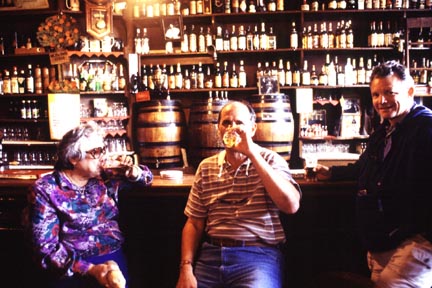
The pub is the heart of social life in Dublin.
Irish Home-coming
On the third anniversary of "Three
Days in ..." Dennis Callan revisits his
ancestral homeland of Dublin, which
he first visited as a 5-year-old
In your eagerness to see the famous beauties of Ireland's remote rural charm, don't skip Dublin, for it is one of Europe's great cities. There is an irony in focusing on the big city, because the true beauty of this land is undeniably its lush countryside. However, this convivial capital is truly a fascinating place full of warm people, lovely architecture, excellent museums, great pubs, restaurants and endless entertainment, as well as natural attractions. Any visit should include a few days in Dublin plus a week to travel through the incredible countryside.
Dublin is easy to visit in a few days because all the sights are clustered in the urban center, just a mile wide and slightly longer from north to south. You could walk that span in a few hours, but to properly explore the nooks and crannies, you should spend two or three days in this small capital city of more than 1 million people, a third of the nation's population. The city is divided into north and south by the River Liffey, with most of the interesting sights on the south side.
Day 1
South of the River Liffey, Trinity College, Bank of Ireland, shopping on Grafton StreetDay 2
Medieval Dublin, Guinness Storehouse, Temple BarDay 3
North of the River Liffey, Parnell Square, Mountjoy Square, more shopping along Henry StreetIf you go...
Travel information: Hotels, restaurants, pubs, attractions, and websites.
Ireland is an extremely peaceful place with no hint of political violence, so you can feel secure traveling here. While some might be concerned about bombings, there have been no such problems in generations. Past troubles between the British and Irish nationalists were limited to Northern Ireland, which is part of a separate country, and it's been quiet and peaceful in recent years. Of course, like in any big city, always take standard precautions and watch out for crazy drivers.
Another myth is that Dublin is an old-fashioned, grimy, poor industrial city with little physical beauty. There was some truth in this years ago, but an economic miracle in the 1990s led to modernization, transforming the culture with cutting-edge arts, fashion, music and design, and glitzy new shops. Recent wealth has also gone into renovating historic buildings, with many new exhibits developed for the visitor to enjoy. Vast neighborhoods of elegant Georgian architecture and landscaped gardens have been cleaned and restored. Half of the population is under 25 years old and very well educated, making this a youthful, happening place. This Celtic Tiger is booming, yet Dublin remains a down-to-earth and friendly place with a big Irish heart.
DENNIS CALLAN / SPECIAL TO THE STAR-BULLETIN
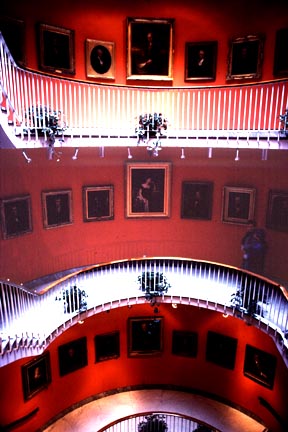
The National Gallery features a small selection from Europe's major art movements, including a large collection of Irish art.

South of the River Liffey
Begin at the center of town on the O'Connell Bridge across the River Liffey, with its grand view in all directions. To the north is the town's newer section and the main boulevard of the city, O'Connell Street, which you can save for tomorrow. Looking along the river, you can see the small pedestrian bridge called Ha'penny, just to the west, which you will be crossing later.
Most of the city's important sites are located below the River Liffey in a district roughly 10 blocks square. Continue walking for two blocks along Westmoreland Street to one of Dublin's major focal points, College Green. There is nothing green about this busy traffic intersection except for a few scrawny trees, but you might enjoy walking through the beautiful campus here.
Day trip
Probably the most attractive quick trip from Dublin is the half-hour ride to Howth, a cute fishing village with winding streets, a stunning cliff path and lovely coastal views. Take a walk along the pier and up to Howth Summit for magnificent views along Dublin Bay, which stretches 25 miles south to Dalkey, at the other end of the DART rail line. Howth also sports a 15th-century castle and the ruins of St. Mary's Abbey, complete with old graveyard. This is just a small hint of what the countryside is like and will hopefully tempt you to continue your journey far beyond Dublin to Ireland's wonderful south and west shores.If you have an extra day in Dublin, there is a lovely excursion you can take to the Wicklow Mountains, about 30 miles south of the city. Organized bus tours cover this popular full-day itinerary, or you could rent a car. One of the major highlights is Glendalough, the scenic "Valley of the Two Lakes," and the picturesque village of Enniskerry, where the tours often stop for lunch.
» Trinity College: Founded by Queen Elizabeth in 1592 as Ireland's first university, Trinity is one of the world's great schools and a leading attraction, with more than half a million visitors each year. The graceful campus spans 35 acres of historic buildings and gardens. Trinity boasts many famous graduates, including authors Oscar Wilde, Jonathan Swift, Samuel Beckett, Oliver Goldsmith and Bram Stoker. An emphasis on education has led to an economic boom in recent years, fueled by rapid increase of high-tech jobs that have drawn skilled people from around the world, reversing a historic brain-drain trend.
More than 12,000 students keep this part of town lively during the school year, but during the summer holidays, rooms in the dormitories can be rented for a reasonable fee if you would like nice, quiet, centrally located accommodations. You could enhance the experience by taking some light summer courses.
» Bank of Ireland: From the front of Trinity, head for the Bank of Ireland, a large classical building with a curved fa¨ade accented by huge pillars. Construction began in 1729 on Europe's first purpose-built parliament building, the city's grandest structure. Dublin become Europe's fifth-largest city in the 18th century. Conditions deteriorated during the 19th century, starting with the Act of Union in 1800, when England abolished the Irish Parliament, and this grand building became the Bank of Ireland. Some of the interior is original, so it is worth looking inside and asking to see the wood-paneled House of Lords, with its huge Waterford chandelier, 18th-century tapestries and coffered ceiling.
» Shopping: Continue to the beginning of Dublin's main pedestrian promenade, Grafton Street, which extends south six shop- and restaurant-lined blocks. Music fills the air thanks to street buskers who appreciate any coins you might toss their way.
Grafton Street is the center of a fine shopping neighborhood. This retail zone is about a quarter-mile square, bounded by South Great George's Street on the west and Dawson Street to the east. To find everything under one elegant roof, visit Brown Thomas at 92 Grafton, Dublin's most exclusive department store.
After stopping for lunch -- perhaps at the famous Bewley's Oriental Cafe on Grafton (there since 1841) -- it is time for choices. Significant attractions bound all four edges of this shopping district. To the north: Temple Bar. West: Dublin Castle and medieval streets. South: St. Stephen's Green and Georgian mansions. East: art and history museums.
» Museums: Walk east from Grafton two blocks along Molesworth Street, past several mid-18th-century high-gabled Huguenot houses, antique shops and art galleries. This will bring you to the Merrion Square neighborhood, site of three excellent museums and the national parliament at Leinster House. Originally built as a private mansion in 1745 for the wealthy Duke of Leinster, it was taken over by the government in 1922 after Ireland achieved independence from Great Britain. Just appreciate this grand building from the outside, enjoying its classic Georgian design.
Flanking the right side of parliament is the National Museum, which makes an appropriate starting point for an afternoon of culture. Here you can trace the evolution of Irish society from the earliest human remains up through the 20th century. The world's largest collection of Celtic treasure, with fine objects in gold, silver and precious stones, is housed here.
DENNIS CALLAN / SPECIAL TO THE STAR-BULLETIN
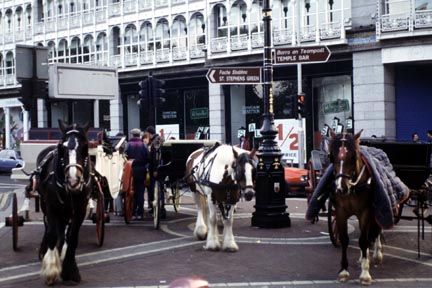
Horse carts offer travelers a tour of Dublin's main pedestrian promenade, Grafton Street.
Early Celt life is vividly illustrated by a wide variety of tools, weapons, boats, burials and ceremonial objects dating to the Stone, Bronze and Iron Ages, and the Viking period. The highlight is the stunning amount of elaborate gold jewelry from 2000 B.C. to 700 B.C., much of it unearthed from bogs by peat-cutters.
Next, walk to the National Gallery, which features a small, excellent selection from Europe's major art movements, including a large collection of Irish art. Start with the great masters before your senses get overloaded. The Italians are well represented by Caravaggio, Fra Angelico, Perugino, Mantegna, Titian and others, while the French School includes Poussin, Fragonard, Claude and a roomful of Impressionists. Vermeer, Jan Steen, Frans Hals and Ruisdael highlight the Dutch masters, while the Spanish painters include El Greco, Murillo, Zurburan and Goya. They did not leave out their British cousins, with Hogarth, Reynolds and Gainsborough, among others. Admission to this 150-year-old institution is free, except for special exhibits in the new Millennium Wing.
You could plunge into the Natural History Museum. This is mostly a collection of stuffed animals, like a dead zoo, displayed in the old-fashioned style of the mid-19th century. This should only take 30 minutes, unless you have a particular interest in the subject. Government Buildings next door comprise an imposing complex of huge neoclassical structures housing finance, law and the Prime Ministry offices open to public tours on Saturdays. Mansion House on Dawson Street is another elegant government building, housing the Lord Mayor.
Longer holiday
Dublin is a rewarding place to spend several days, but this is just the beginning of the true Irish adventure. You must get out to the countryside to experience the real Ireland. It can easily be done on your own or as part of an organized tour, with various advantages both ways.The organized bus tour takes care of everything and visits all the main sights, with some free time for roaming on your own without worrying about driving on the wrong side of the road or finding accommodations each night. This is a standard formula that works well, especially because the distances are not so vast that you are sitting in the bus all day.
On the other hand, it can be very rewarding to explore the country on your own. Rent a car and stay in bed and breakfasts along the way, and you will have a fabulous time at relatively little expense. An amazing network of B&B owners provide all the comforts of home, with friendly hostesses who can help arrange your next night's lodgings and dispense travel advice. These services, along with Ireland's scenic beauties, charming villages and friendly natives, combine to make one of the world's greatest travel adventures.
» Georgian Style: After this cultural immersion, the late afternoon will make a fine time for a fresh-air stroll through the gardens and Georgian streets of southeastern Dublin. Depending on your interest, this walk could extend for a mile or two, starting with Merrion Square and ending up at St. Stephen's Green.
Most of this neighborhood was built up during the 18th century in what is termed the Georgian style of architecture, which relied upon the neoclassical designs popularized by Andrea Palladio in Italy. The style was named for the four kings named George, who ruled England between 1714 and 1830. This was a Golden Age for architecture that produced the splendid, harmonious designs of Bath, Edinburgh, Dublin and large parts of London.
Established in the 1760s, Merrion Square is one of the finest patches of public park in the middle of town and offers a pleasant respite from the city streets. The finest group of Georgian homes in Dublin surround it. Stroll through the garden paths, then exit along the southern boundary. The park's southeast corner presents another fine view of Georgian facades along Upper Mount Street. On the corner at No. 29 Lower Fitzwilliam Street, the house of a typical middle-class, 18th-century family is open to the public, with original furnishings and household goods on display from the basement to the attic, re-creating the atmosphere of those times.
» St. Stephen's Green: This park is a charmer, with all the elements you would hope for in the perfect urban oasis: abundant green lawns, two small ponds, scattered benches, flower beds, a fountain, ducks, geese, soaring trees, a bandstand, snack stand, memorials and lovely historic buildings all around. These 22 acres first became a private park in 1678 and were later rejuvenated by a wealthy benefactor, Sir Arthur Guinness, who had new landscaping created and opened it to the public in 1880. Several lovely hotels face the park including Dublin's most elegant, the Shelbourne, whose famous Horseshoe Bar would make a great place to wrap up this day's adventure, or, if you are here earlier, enjoy their famous afternoon tea.
DENNIS CALLAN / SPECIAL TO THE STAR-BULLETIN
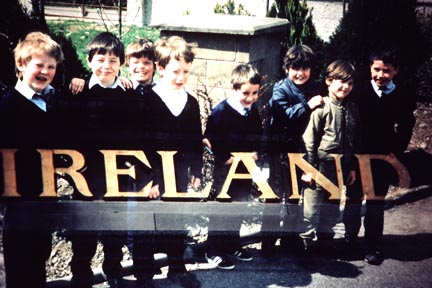
Irish schoolboys are reflected in the glass of a storefront.

Medieval Dublin and Temple Bar
» Dublin Castle: This is one of the city's main sights and is a must for those interested in history. Located south of the River Liffey in what had been Dublin's medieval walled town, the castle is a five-minute walk west from Trinity College along Dame Street. It is wise to arrive before it opens at 10 a.m. to beat the crowds. Visitors can enjoy the view from the outside for free, but it is worth paying the admission for a tour of its elegant rooms.Dublin Castle has seen many difficult times over the course of Ireland's history. It is believed a fort on this site preceded the first Viking settlement of 841. The castle was officially established in 1204 by England's King John, but the only physical remnant surviving from that time is the Record Tower. The old castle was destroyed by fire in 1684, and nearly all of the buildings standing date from the 18th century, developing into something like a walled medieval village. The castle still houses government offices and has three areas open to the public during guided tours: the State Apartments, the Chapel Royal and the Undercroft basement.
A splendid gothic revival Chapel Royal is famous for its ribbed vaulting and stucco decorations. The tour ends in the Undercroft basement, which has traces of the city's medieval wall, foundations of the Norman Powder Tower and remains of the Viking defense embankment.
After the interior visit you can walk through the gardens to enter the free Chester Beatty Library, which displays outstanding art treasures of the world, including illustrated medieval manuscripts, jade Chinese books, Arabic texts and exquisite artworks from the Far East, Asia, and Islamic and Western cultures.
DENNIS CALLAN / SPECIAL TO THE STAR-BULLETIN
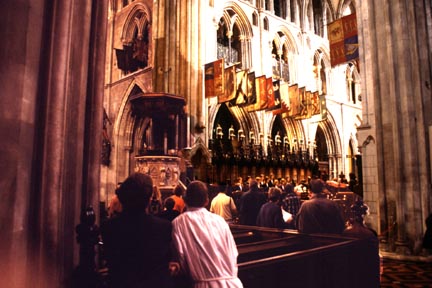
St. Patrick's Cathedral was founded in 1192 and is now the national headquarters of the Church of Ireland.
» Medieval District: The streets around the castle are some of the oldest in Dublin, with narrow cobbled lanes leading toward the river that hold additional attractions. City Hall is adjacent to the castle and is open to the public with a multimedia exhibition that traces the evolution of the city from 1170 to modern times, with an emphasis on development of the government. The building itself is worth seeing as a outstanding example of 18th-century neoclassical architecture, with a central Rotunda and soaring dome. From the top of the front steps there is an excellent view straight along Parliament Street and across the river.
A more dramatic multimedia show focusing on the early Viking settlement is presented daily two blocks away at Dublin's Viking Adventure, on Essex Street West. You walk through a reconstructed Viking street while entertained by costumed guides. Yet another multimedia show is staged two blocks west at Dublinia, where the history of medieval Dublin is presented through a multiscreen show, period artifacts and a scale model of the walled city. Visitors can also walk through streets reproduced to scale to capture medieval life, including a walk through a merchant's house and full-size wooden ship. It is located in the former Christchurch on St. Michael's Hill.
Across from Dublinia is Christ Church Cathedral, Dublin's oldest surviving building, which was constructed about 1030 by the Vikings, making this the only surviving cathedral in Ireland or Britain with a Norse foundation. The Vikings had established a major trading port on the nearby riverbank at Wood Quay. Soon after the Vikings were defeated by Irish warriors, the Normans invaded, following up on their conquest of England.
» Narrow streets: Depending on your speed and interest, walking through the narrow medieval lanes between Dublin Castle and St. Patrick's Cathedral will take an hour or two. This is the town's oldest neighborhood, filled with many fine ancient buildings, markets and churches. Beer drinkers would also enjoy a side trip to the Guinness Brewery, which tacks another hour onto the route. While this is a very rewarding stroll, if time is pressing, consider shortening or skipping this walk and jumping ahead to the Temple Bar visit.
» Liberties: Look for the steeple of St. Patrick's Cathedral, founded in 1192 and now the national headquarters of the Church of Ireland. It is located beyond the medieval walls in a section known as the Liberties because residents here enjoyed freedom from civic control. Ironically, both of these major cathedrals are Protestant, converted at the time of the Reformation. Dublin is a Catholic city that doesn't have a Catholic cathedral. Built on a site where St. Patrick reputedly baptized his flock in the fifth century, this is the nation's largest church. Its tower dates from 1370, and most of the rest was rebuilt during the 19th century in the gothic style. Its most celebrated dean was Jonathan Swift, who presided here from 1713 to 1745, while writing "Gulliver's Travels," "A Modest Proposal" and other satirical classics that mocked the English and promoted Irish freedom. Buried in the cathedral, his self-penned epitaph reads "Go, traveler, and imitate if you can this earnest and dedicated champion of liberty."
Marsh's Library, on the cathedral grounds, was founded in 1701 as the first library in Ireland, now housing 25,000 rare books. Library users were prevented from stealing volumes by being locked in cages, which still survive. The wonderful scholarly atmosphere has remained unchanged for three centuries, enhanced by ancient manuscripts, dark wood bookcases and alcoves for study.
The city's oldest pub, the Brazen Head, is on Bridge Street. Established more than 800 years ago, the tavern is now in a 1688 coaching tavern with two bars, an excellent restaurant and Irish music daily. Next, proceed three blocks east to Temple Bar, unless you want more beer or a visit to two more museums.
» Guinness and two museums: Beer lovers must continue marching another half-mile west to the Guinness Storehouse to learn all about the brewing of that wonderful dark stout and enjoy samples. The actual brewery is off limits, but this impressive showcase presents entertaining multimedia displays that tell the whole story.
The $18 admission includes a tasting high up in the Gravity Bar, with a rooftop view of the city. Guinness brews 500 million liters each year, which includes 50 percent of all beer sipped in Ireland -- 4 million pints daily for 3 million people -- and ships the rest to 150 countries. It is said the best Guinness must be consumed within a mile of the factory, so here is your chance for the fountainhead. When finished, retrace your steps east a half-mile, or continue to see the museums.
DENNIS CALLAN / SPECIAL TO THE STAR-BULLETIN
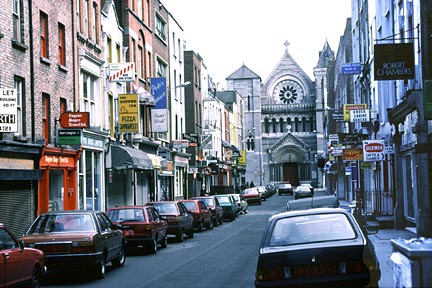
South of Grafton Street, there are shops and restaurants on Anne Street, as well as St. Stephen's Green and Georgian mansions.
» Temple Bar: One of Dublin's oldest neighborhoods has developed a split personality: By day it is a center for culture and art, while at night it becomes a party scene. You should be arriving late in the afternoon, when shops and galleries still open but before the big rush of partygoers fills the streets. You can end your day here at one of the many fine restaurants.
Variously considered the "Left Bank" or "Greenwich Village" of Dublin, this marvelous artistic zone is filled with galleries, shops and cafes. The Temple Bar Gallery and Studios was set up by artists in the early 1980s and runs a diverse program of Irish and International arts. A similar but smaller space is the Graphic Studio Gallery, which represents many of Ireland's fine artists. For high-quality souvenirs, try the Irish Celtic Craftshop on Lord Edward Street. Most of the galleries close by 5:30 p.m., so be sure to arrive in time to enjoy the arts scene.
At night, Temple Bar caters mostly to tourists who want to party into the wee hours. In fair weather you will see thousands standing or sitting on the pavement, with a pint in hand. There is a new nonsmoking law for all pubs and restaurants, so the air indoors might be better than outside.
Temple Bar is a classic tourist trap, but there are many pubs that provide an authentic local experience. Traditional music can be heard at John Gogarty's, Quays Bar, Temple Bar and Porter House. Look for the Kitchen nightclub on East Essex Street, the Clarance Bar above it and the Front Lounge on Parliament Street. Another excellent spot is the Temple Bar Music Centre, on Curved Street, open nightly and presenting a wide range of theater, music, dance and art.
The Irish Film Centre, which opened in 1993, has become one of the liveliest gathering places for film buffs. The center houses two cinemas, a film-themed bookshop, a restaurant/bar, a library and the Irish Film Archive. It also houses eight film organizations and has gallery space for photos, posters and film memorabilia. Easy to find at 6 Eustace St., the center is open daily from 10 a.m. to 11:30 p.m.

North of the River Liffey
The most interesting parts of town are south of the river, but there are many fine sights in the north end of town as well. Start in front of the General Post Office on O'Connell Street. This landmark structure still has bullet holes from the battle fought here during the Easter Rising of 1916, when a small band of Irish freedom-fighters made it their fortress. They were no match for the British army, who captured the rebel leaders and executed them. Ironically, the Irish majority was not in support of the revolution, but with these executions sentiment turned overwhelmingly against the British occupiers, and within six years Ireland gained its freedom.Walk north along O'Connell, admiring the statues amidst the broad landscaped median, en route to Parnell Square. O'Connell has lost much of its former grandeur, but there are elegant remnants, like the lovely Gresham Hotel and some fine shops. Notice the fine statue by St. Gaudens of Charles Parnell, who led the movement for Irish independence.
» Parnell Square: This irregular green park is host to several museums and the Garden of Remembrance, opened in 1966 to commemorate victims of the Irish Revolution. Literature lovers might enjoy a visit to the Dublin Writers' Museum on the square's north side. It celebrates Ireland's famous writers -- Joyce, Wilde, Shaw, Beckett, Stoker and Yeats -- displaying their manuscripts, typewriters, telephones and related artifacts.
At this point you have a few choices to make. Whiskey drinkers will be drawn to the Old Jameson Distillery at Smithfield Market, which shows how that powerful spirit is created. A generous tasting is included with admission.
Museum lovers might be attracted to the National Museum at Collins Barracks, five blocks west, to see the Decorative Arts and History collection of furniture, jewelry, folk art, silverware, ceramics, weapons, clothing and other items. The large greystone building was built in 1704 as a barracks for the British army, who used it for two centuries.
Walk one block south to the river and stroll to Four Courts, designed in the late 18th century by James Gandon, Dublin's most important architect. Nearly obliterated in 1922 during the Civil War when it was shelled by the forces of Michael Collins, the great leader of that time, it was restored a decade later and remains home to the high court of Ireland. Usually open to the public, the magnificent central hall is 64 feet wide and bustling with lawyers dressed in traditional gowns and wigs.
You have now seen all the best sights of Dublin!
Cross back over the Liffey to the south bank for a final stroll through Temple Bar, where you can find a great meal and wrap up your shopping. There should still be time this afternoon for a final big adventure: a trip out of town along the seashore on the DART commuter train, which you can catch at the Tara station four blocks east of Temple Bar.
Dennis Callan is president of the Hawaii Geographic Society and produces the "World Traveler" television series, airing 6 to 7 p.m. Mondays on 'Olelo, channel 52. He frequently leads tours through Europe, Canada and the United States, and writes "Three Days in ..." the first Sunday of each month, explaining how to get the most out of three days in the world's great places. This is his 36th article in a series also available at www.tourvideos.com.
BACK TO TOP |
If you go ...
Here are a few places to stay, see and dine while in Dublin.
Hotels
» Burlington Hotel: Upper Leeson St., call 353-1-660-5222, deluxe.
» Clarence: 6 Wellington Quay, Temple Bar, call 353-1-670-9000, U2-owned.
» Harding Hotel: Cooper Alley, call 353-1-679-6500.
» Jurys Inn: Christchurch Place, call 353-1-454-0000.
» Kilronan House: 70 Adelaide Rd., call 353-1-475-5266.Restaurants
» Bad Ass Cafˇ: 9 Crown Alley, Temple Bar call 353-1-671-2596.
» Brazenhead: 20 Lower Bridge St., call 353-1-677-9549.
» Cafe Fresh: Powers Court Townhouse Centre on the top floor, call 353-1-671-9669 for the best veggie food in Dublin.
» Cafˇ Mao, 2 Chatham St., Asian, call 353-1-670-4899.
» Eden, Meeting House Square, Temple Bar, call 353-1-670-5372.Pubs
» Temple Bar pubs: Quays Bar and Temple Bar
» Grafton Street area: Bruxelles, McDaids, John Keoghe, Davy Byrne's then Cocoon and the Bailey. You need to be dress well at the latter two.
» Along the River Liffey: Panama, Bachelor Inn, the Oval, Ha'Penny Bridge Inn, Traffic and finish in the System; located between Ha'Penny Bridge and O'Connell Bridge.Pubs with Irish music
» Cobblestone, 77b King St., Smithfield Market, call 353-1-872-1799.
» Norseman, 27 Essex St., Temple Bar, call 353-1-671-5135.
» O'Donoghue's, 15 Merrion Row, call 353-1-676-2807; the most renowned.
» Porterhouse, 16 Parliament St., call 353-1-679-8847.Attractions
» Dublin Castle: Dame St., call 353-1-677-7129. Open 10 a.m. to 5 p.m. Mondays to Fridays and 2 to 5 p.m. Sundays; $6 admission.
» Dublin City Gallery, the Hugh Lane: Charlemont House, Parnell Square North. Call 353-1-874-1903; open 9:30 a.m. to 6 p.m. Tuesdays to Thursdays, to 5 p.m. Fridays and Saturdays, and 11 a.m. to 5 p.m. Sundays. Free entry to permanent collection. Francis Bacon Studio: $10.
» Dublin Writers Museum: 18 Parnell Square North. Call 353-1-872-2077. Open 10 a.m. to 5 p.m. Mondays to Saturdays and 11 a.m. to 5 p.m. Sundays; $10 admission.
» Irish Museum of Modern Art: Royal Hospital, Kilmainham. Call 353-1-612-9900. Open 10 a.m. to 5:30 p.m. Tuesdays to Saturdays and noon to 5:30 p.m. Sundays; $5 admission.
» National Museum, Kildare Street. Call 353-1-677-7444. Open 10 a.m. to 5 p.m. Tuesdays to Saturdays and 2 to 5 p.m. Sundays. Free.
» National Gallery of Ireland, Merrion Square, West & Clare streets. Call 353-1661-5372. Open 9:30 a.m. to 5:30 p.m. Mondays to Saturdays and noon to 5:30 p.m. Free.
» Natural History Museum, Merrion Street. Call 353-1677-7444. Open 10 a.m. to 5 p.m. Tuesdays to Saturdays and 2 to 5 p.m. Sundays.
» Guinness Storehouse: St. James Gate. Call 353-1408-4800. Open 9:30 a.m. to 5 p.m. daily; $21 admission. Visit www.guinness-storehouse.com.
» The Old Jameson Distillery, Smithfield. Call 353-1-807-2355. Open 9:30 a.m. to 5:30 p.m. daily. Visit www.whiskeytours.ie.Web sites
» www.visitdublin.com
» www.dublintourist.com
» www.heritageireland.ie
» www.dublinpubscene.com
» www.temple-bar.ie
» www.smithfieldvillage.com
» www.irlgov.ie/taoiseach
» www.daytoursunplugged.ie
» www.overthetoptours.com
» www.dublinbus.ie
» www.historicalinsights.ie