[ SUNDAY TRAVEL ]
DENNIS CALLAN / SPECIAL TO THE STAR-BULLETIN
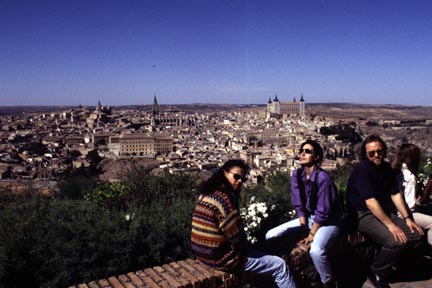
The Parador, a deluxe government-operated hotel on a hill overlooking the town of Toledo, Spain, offers the grandest view of the former Spanish capital.
Olé!, Olé!, Olé!
Historic wonders and modern
cultural delights await in the
Spanish capital of Madrid and
the surrounding towns of Toledo
and Segovia
Flamenco! Tapas! Velazquez! Olé!
The capital of Spain, Madrid is a feast of fascinating sights and remarkable side trips. Your visit could take a month, but we squeeze the main highlights into three days so you can spend the rest of your time in personal pursuits.
Four attractions put Madrid high on the list of great places to visit: the Prado Museum, the Royal Palace, Old Madrid and the modern shopping zone. Combine these with trips out of town to Toledo and Segovia, with more museums, night life and shopping, and you have a vacation to remember.
Madrid, one of Europe's youngest capitals, was established as Spain's capital in 1561 by King Phillip II, who moved the government here from Toledo.
Famous for its reputation as a late-night city, Madrid keeps some odd hours to work around, including the mother of all siestas that shuts the city down, with shops closing from 1 p.m. and reopening around 4 p.m. every afternoon. At night, prime dining for locals begins at 10 p.m., and many discos don't open until after midnight.
Explore the heart of Madrid: Plaza Mayor, Puerta del Sol, the Prado and the pedestrian paths and narrow streets surrounding the landmarks
Plaza Mayor: Begin and end the first day at Madrid's most magical place: the Plaza Mayor in the heart of town. This splendid square was built by Phillip II in 1561 when he declared Madrid as his new capital and finished in 1620 by Phillip III. Ever since, the Plaza Mayor has been one of the great gathering places of the world and remains the center of Old Madrid.
The plaza is just west of Puerta del Sol and a half-block south of the Main Street, Calle Mayor, but from the outside there are few obvious signs it exists. It could easily be missed by the passing pedestrian, so look for a short alley leading to a tall arch and step into this inner world.
This outdoor living room is always busy with a varying day-and-night personality that makes it worthwhile to revisit. Start with morning coffee at an outdoor terrace table, then return toward sunset for an aperitif -- perhaps a "fino" (sherry). The plaza, graced by majestic Spanish architecture, is peaceful around 9 a.m.
Narrow streets: Many of the city's most interesting streets and attractions are within six blocks of Plaza Mayor. One of the best strolling areas is just below the plaza in a network of narrow streets that extend south about a half-mile. Exit the southwest corner of the plaza through the Arco de Cuchilleros and descend a staircase into this ancient world. You can find some interesting activity at the indoor food market of San Miguel, one block west.
With map in hand, navigate through this wonderful neighborhood where street names reflect the original trades that occupied each block. Old traditions survive in small, specialized shops. Several restaurants have been in business for centuries along these streets, including Botin, Possada de la Villa and Meson del Segoviano, all excellent choices for lunch or dinner.
Look for the charming square, Plaza de la Villa, a block west of the food market. Here you will see the Ayuntamiento (City Hall) and the "mudejar"-style (Moorish and Christian) Lujanes Tower, Madrid's oldest building, where King Francis I of France was held prisoner in 1525. Casa de Cisneros at the back of this square is one of Madrid's first palaces, dating from the 1530s, with a distinctive Plateresque facade, carved in elaborate Renaissance details.
DENNIS CALLAN / SPECIAL TO THE STAR-BULLETIN
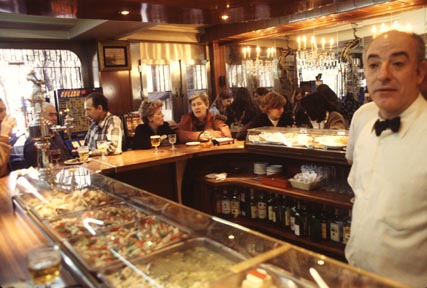
Locals often come out in the early evening in large numbers to enjoy tapas, drink sherry and chat with friends at bars around Madrid.
If you enjoy the opera, ballet or symphony, detour 300 yards north to the Royal Theater (Teatro Real) and check the box office for tickets. Performances are usually sold out well in advance, but returned tickets are often available at the box office a few days before performances, or plan ahead and order tickets by phone or Internet months in advance (www.teatro-real.com). Return to Plaza de la Villa through the same quaint, narrow lanes.
Continue along tiny Calle del Codo to Plaza del Cordon, then Plaza de la Paja, where you will see the only significant gothic church, the Bishop's Chapel (Capilla del Ospiro). If you'd like to rest in a peaceful garden, walk through the door of Anglona Palace at 13 Calle de Segovia. Continue toward Puerta de Moros, site of a former gate through the wall that once ran around the old town.
One of Madrid's most impressive churches, Basilica de San Francisco el Grande, is a few blocks west and worth visiting to see its large dome and impressive artwork, including marble statues of the apostles and a chapel painted by Goya. On Sundays the enormous Rastro flea market is held a few blocks east along Curtidores and connecting side streets of the Latina district. Antique shops are open all week.
When you tire, head back to Plaza Mayor along Calle Cava Baja, a picturesque street that evokes Old Madrid. You've probably worked up an appetite, so pick one of the neighborhood restaurants for a traditional lunch.
Puerta del Sol: After enjoying the quiet ambience behind Plaza Mayor, head to Puerta del Sol, where 10 streets and three metro lines converge in the city's busiest intersection. Kilometer zero inscribed in the pavement here is the marker from which all distances from Madrid are measured.
Heading two blocks west along Calle Arenal will bring you to the church of St. Gines. Just north of that is the Convento de las Descalzas Reales, a former convent transformed into a small Spanish art museum. The Royal Academy of Fine Arts, a block east of Sol along Calle de Alcala, is another excellent museum, with 1,500 paintings and 800 statues housed in a splendid 18th-century palace.
Pedestrian zone: Madrid's two busiest pedestrian streets, Carmen and Preciados, extend north from Puerta del Sol into a lively shopping zone. This is the town's busiest district, packed with people all day and well into the night. Hundreds of little shops are scattered throughout these blocks, anchored by two major department stores, Galerias Preciados and El Corte Ingles, which offer free maps of Madrid at their information counters.
This lively neighborhood is a huge contrast to the quiet, narrow lanes of Old Madrid, and is the best place in town for people-watching. If you feel like resting, pull up a chair at one of the sidewalk cafes and watch the world hustle by.
Gran Via: Bordering the north edge of the pedestrian zone is the Gran Via, the city's biggest commercial street, lined with movie theaters, restaurants, nightclubs and offices. Stroll north for a block or two, up one side and back down the other. If this busy boulevard appeals to you, keep going six more blocks north to Plaza de Espana, then return along the other side of the Gran Via. This is the modern heart of Madrid.
DENNIS CALLAN / SPECIAL TO THE STAR-BULLETIN
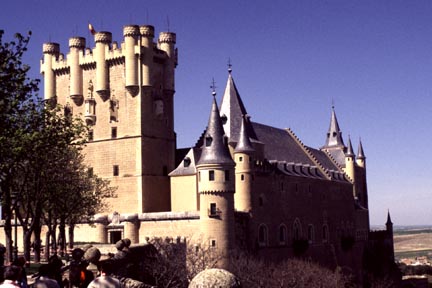
The town of Segovia is easy to explore because there is one main street that ends at the Alcazar fortress.
At the Plaza de Espana, you could go up the 32-story Madrid Tower observation deck for a downtown overview. An excellent Tourist Information Office here provides free maps and event schedules.
Beyond the plaza across the Gran Via, you will see the most beautiful baroque church in Madrid, the Church of St. Mark's, finished in 1743. Its dazzling interior of five intersecting ellipses is based on the Italian architecture of Bernini and Borromini, with a huge dome uniting the elements. A large Egyptian temple is on display two blocks north in Parque de la Montana.
The Prado: If you're ready to take on one of the world's greatest museums, this is a good time. Instead of walking a mile to get there, take a taxi, which saves time and energy. Before exiting the cab, look at the line: If it stretches a couple of hundred feet, initiate Plan B by having the driver take you to another great art museum scheduled for tomorrow, the Thyssen-Bornemisza, just two blocks away. Try to arrive at the Prado by 2 p.m., when crowds are minimal.
The Prado is noted for its amazing collection of 50 paintings by Velazquez, the greatest Spanish artist. Two of his most important masterpieces, "Las Meninas" and "The Surrender of Breda," would make a visit to Madrid worthwhile for the serious art lover.
In this 70-gallery shrine to the arts is the world's finest collection of Spanish art, with Ribera, El Greco, Zurburan and Murillo each represented by about 40 paintings.
Paseo: Early evening is prime time for a stroll. The locals come out in large numbers to have some tapas, those delectable little food tastes, drink some sherry and chat with friends. Their cherished ritual involves bar-hopping, having a bite here and another there. Many shops are open until 8 p.m. or later, and the temperature is usually quite mild.
A new pedestrian zone along Calle de las Huertas will take you from the Prado toward Plaza Mayor and Puerta del Sol, less than a half-mile away. Detour midway along the route into Plaza Santa Anna to sample some of Madrid's best tapa bars, then continue north a few blocks through Victoria, Matheu and Carrera streets for more action.
Back at Plaza Mayor you are in familiar territory and can enjoy a traditional fino aperitif at a terrace cafe. For dinner, opt for one of the cellar tavernas outside the square's southwest corner. Most visitors are ready for bed after dinner, but for locals the night is starting at about 10 p.m. Glimpse the night life in the areas around Puerta del Sol and Plaza del Dos de Mayo.
DENNIS CALLAN / SPECIAL TO THE STAR-BULLETIN
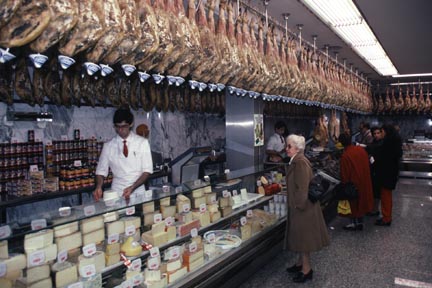
Attractions like the Ham Museum in Madrid can be found by exploring pedestrian paths and narrow streets surrounding city landmarks.
A trip to Toledo and more museums in Madrid
Toledo was the capital of Spain for many centuries, where Arabs, Jews and Christians lived together until the religious wars of the 14th and 15th centuries. With the rise of Madrid, Toledo was left behind, undisturbed for 400 years, leaving an amazing time capsule of buildings from the Middle Ages with a rich mix of Christian and Moorish architecture.
Get an early start for Toledo to beat the crowds. It takes an hour to get there by direct bus, which is quicker than a train. Making this trip on your own is easy and allows flexibility, but guided bus tours are available, as a half-day or full-day trip.
Madrid's bus station for Toledo departures is Estacion Sur de Autobuses, located four blocks south of Atocha Train Station, next to the Palos de la Frontera metro station. Direct buses leave Madrid every hour from 7 a.m., with a similar return schedule.
Toledo: The bus arrives in Toledo at the foot of a big hill where you can get on the unsightly but convenient new escalator that will carry you up to the old town of Plaza de Zocodover, one of the main squares at the town's edge. Check with Tourist Information for free maps, brochures, schedules and answers to any questions. From here, walk a few hundred yards along the main street, Calle Comercio, to begin the visit at the Cathedral.
The Cathedral: This gothic church is Toledo's most important historic site. It contains several art masterpieces from the Renaissance and Baroque periods, including 30 paintings by El Greco, who lived in Toledo for most of his life. Construction began in 1226 and continued for nearly 300 years, producing a church measuring nearly 150 yards long by 60 yards wide, with five naves and a double ambulatory -- longer and wider than the Notre Dame in Paris, built around the same period.
Behind the main altar is the most amazing artistic creation, the "Transparente," a Baroque sculptural ensemble in marble, alabaster and gilded bronze. It depicts angels, sunbursts, clouds, the Virgin and Child, a life-size Last Supper and other biblical scenes that flow from ceiling to floor, illuminated by light streaming through a large round window in the roof, concealed from direct view.
Santo Tome: Continue along the main street, now called Calle la Trinidad, in the direction of the Church of Santo Tomé. Inside, you will find the El Greco masterpiece "Burial of the Count of Orgaz." It depicts a funeral scene with the heavens above and noblemen from Toledo paying tribute to the patron, who is buried in this church.
It is the only exhibit this writer has experienced where admission is charged for just one painting, but it is worth it. Hopefully, you have beaten the crowds, because they line up by the hundreds at midday during peak season.
House of El Greco: Continue a block down San Juan de Dios to the so-called House of El Greco. He didn't live here, but it is interesting to see because the home is typical of the period, with authentic furnishings and some of his original paintings on view.
Saint Mary -- The White: Two blocks into the former Jewish quarter brings you to the town's oldest synagogue, built in the Spanish Arab style in 1180. Graceful, horseshoe-shaped arches supported by octagonal columns with intricately carved capitals make this interior look more like a mosque than a temple or church. It later became the Catholic church of Santa Maria la Blanca.
San Juan de los Reyes: The edge of town is just two blocks away, where you will find the exquisite, late-gothic Church of St. John and its famous two-story cloister. Ferdinand and Isabella founded this church and monastery to be their final resting place, but they were eventually buried in Granada.
Elaborate carved designs cover much of this large complex with intricate details in what is termed the Isabeline style, transitional from Gothic to Renaissance. The cloister is especially interesting, with its two levels surrounding the open courtyard, and carved wooden Mudejar ceilings sheltering the arcades.
DENNIS CALLAN / SPECIAL TO THE STAR-BULLETIN
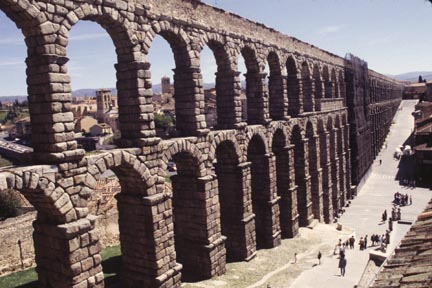
The Roman Aqueduct in Segovia was built 2,000 years ago without mortar, with 20,000 stones cut and positioned carefully.
Museum of Santa Cruz: This is the last of the major sites you'll see today, back on the other side of town where you began. Take your time getting there by wandering through the little alleys. Keep your eyes open for interior courtyards with colorful flower gardens and graceful patios. Heading eastward, you will find yourself a block from Plaza Zocodover, where you began the visit.
The museum, originally constructed in the late 15th century as a hospital for the indigent, has been transformed into 10 galleries that display a range of sculpture, paintings, tapestries and decorative arts. The architecture is even more attractive than the contents.
The view: Finally, you should consider a quick side trip by taxi before returning to Madrid on the bus. It is impossible to see Toledo as a whole while you are walking around inside it. The only way to get an overview is by driving to the Parador on a hill facing the town, enjoying the panoramic sight from this distance.
Taxis should be plentiful to take you the few miles up to the Parador, which is one of the city's series of deluxe government-operated hotels. Have lunch on the outdoor terrace while admiring the grand view of town, then walk around the grounds and garden to fully appreciate this hotel.
Madrid: The Avenue of Art: You should be able to cover the sights of Toledo and return to Madrid by midafternoon. Two wonderful art museums are on the agenda, but if you have seen enough culture already, feel free to go shopping.
Modern Art: The most important painting in the Museo Nacional Centro de Arte Reina Sofia, which opened in 1990, is Picasso's monumental anti-war canvas, "Guernica," inspired by the German bombing of that Basque town during the Spanish Civil War in 1937. This meditation on suffering makes your visit worthwhile, but there is much more to see by Picasso, Miro, Dali and most of the leading artists of the past hundred years.
Keep an eye on the clock, however, because the best museums are coming up next. Reina Sofia is open until 9 p.m., so if you are running late, you could save this for the end of the day and get to Thyssen-Bornemisza first.
Retiro Park: This is a lovely garden, a mile long and a half-mile wide, crisscrossed by dozens of paths past fountains, flower beds and ponds, sheltered by a marvelous tree canopy. At the park's midpoint, just beyond the Prado, turn left and walk to the busy traffic circle with its Fountain of Neptune in the middle, then cross the busy boulevard to the Thyssen-Bornemisza Museum.
Thyssen-Bornemisza: This is one of the world's best museums, with a much smaller collection than the Prado but including masterpieces by most of the Western world's influential artists of the 13th through 20th centuries. It is a joy to be able to experience this span of art history in a museum that is not so huge that it leaves you overwhelmed. Two hours should be sufficient time to absorb the 800 works on display. The museum closes at 7 p.m., so make every effort to get here a few hours early. If you are running out of time, save this for tomorrow.
If you can't be there, the museum has an excellent Web site that offers virtual visits with audio commentary to give you a good idea of what is there (www.museothyssen.org). There is no substitute, however, for the real thing.
Next, enjoy a short walk along the grand boulevard to the Plaza de la Cibeles to gaze upon the fountain of the ancient Earth Mother goddess of nature and agriculture, riding on her chariot. The House of the Americas on the square is a bustling cultural center where most important Spanish-American activities take place.
Cap your day with champagne at the Ritz at the Plaza de la Lealtad, followed by dinner in Old Madrid
.
Segovia and Madrid's Royal Palace
Tour options: Half the size of Toledo, with similar pedestrian lanes, ancient buildings and several landmarks, Segovia is another historic gem. It takes 80 minutes to reach Segovia by bus, the quickest way to get there, or travel by train, which takes two hours and requires a bus transfer.
The best route is to take the public bus directly there and skip the extra tours. From Madrid, take La Sepulvedana bus from its station near the Principe Pio metro station. Buses leave every half-hour; the round-trip fare is about $15.
Segovia: The bus from Madrid drops you close to the center of Segovia, from where you can view the huge Roman Aqueduct that is one of the most impressive engineering achievements of the ancient world. Three hours will be sufficient to explore the cathedral, fortress, main street, central square, Romanesque churches and other historic buildings within a half-mile site.
To absorb the aqueduct's grandeur, you need to look up at this giant structure from ground level near where the bus drops you off, then view it from above when walking up the hillside staircase. Avoid the more gentle stairs ascending from the middle of the plaza, for they do not give you that dramatic, straight-on aqueduct view.
Segovia is easy to explore because there is one main street ending at the Alcazar fortress. There, you can get off the beaten track and wander through a dozen side lanes leading past ancient churches, palaces, theaters, towers and restaurants.
The Cathedral is Segovia's most elegant building, its tower visible from a great distance. The cathedral displays a mixture of styles, with neoclassical, gothic and baroque elements side by side. It is the final major gothic church built in Spain, representing the peak of flamboyant gothic style.
In front of the cathedral is a charming main square, the Plaza Mayor, where locals gather at the popular terrace cafes. Most younger residents speak some English.
Segovia's Alcazar, or Palace Fortress, on the opposite end of town, looks like a Disney fairy tale castle, with its rounded towers, conical roof and dramatic site at the top of a cliff. The interior has elaborate carved, wooden Muslim-influenced Mudejar ceilings, original furniture, tapestries, stained glass, statues, displays of armor and cannons, and striking views through the windows and from rooftop ramparts.
Segovia's culinary specialty is roast suckling pig, which you can find in most restaurants in a variety of price ranges. The town's most famous restaurant is Meson Candido (www. mesondecandido.es), in business for 120 years serving suckling pig and other traditional dishes next to the aqueduct. This would make a memorable lunch and the perfect way to complete your visit before returning by bus to Madrid.
DENNIS CALLAN / SPECIAL TO THE STAR-BULLETIN
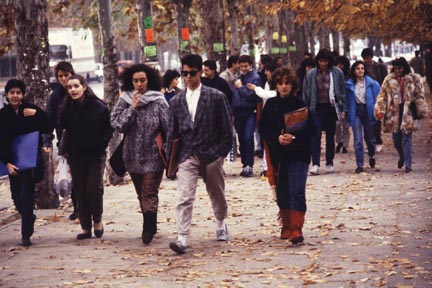
Locals stroll along one of the pedestrian paths in the University District in Madrid.
Madrid's Royal Palace: Return to Madrid by 2 or 3 p.m. so that you have time to visit the Royal Palace, which is easy to reach with a pleasant 800-yard walk from the bus station through the Campo del Moro park. Notice the lake dotted with pedal-boaters and ringed by pleasant cafes.
The Royal Palace, built for King Phillip V, grandson of France's Louis IV, has 2,800 rooms, making this Europe's largest palace. Late afternoon is a fine time to enter the site, which stays open until 6 p.m.
You can walk through some rooms on your own or sign up for an organized, two-hour group tour with a guide supplied by the palace, the only way to visit the main apartments. The visit only features a small number of rooms, but the 26 selected are among the most impressive, including the Reception Room, State Apartments, Library, Armory, Royal Chapel, Throne Room and Banquet Room, where receptions for heads of state are still held.
After the tour you can get some fresh air and refreshments at one of the outdoor cafes on the Plaza de Oriente terrace between the palace and the Royal Theater, and on nearby side streets. While here, check again for returned tickets to events at the theater.
Salamanca: The hours between 6 and 8 p.m. are prime time for strolling, so resist the urge to sit in a restaurant for dinner and take another walk. Salamanca is an upscale shopping zone about a mile northeast of the palace, just above Plaza de Cibeles. Get there in minutes by taxi.
Anyone interested in the history of mankind would enjoy visiting the National Museum of Archaeology on the second block of Calle Serrano just north of Plaza Independencia, open until 8:30 p.m. Tuesdays to Saturdays. Forty galleries are spread over three floors, and exhibits span the range of human culture from the Stone Age through the 19th century, focusing on the Roman, Muslim, Visigoth and Gothic periods.
Flamenco: After the touring and shopping is complete, have dinner at a flamenco show to enjoy the fiery music and dance of Spain. Check with your hotel desk for suggestions. It's your last night, so make the most of it.
Dennis Callan is the president of the Hawaii Geographic Society and produces the "World Traveler" TV series airing 6 to 7 p.m. Mondays on 'Olelo, channel 52. He frequently leads tours through Europe, Canada and the United States, and writes "Three Days in ..." the first Sunday of each month explaining how to get the most out of three days in the world's great places. This is his 35th article in a continuing series, which are all available on his new Web site, www.tourvideos.com.
BACK TO TOP |
If you go ...
Here are a few places to stay and dine in Madrid. If calling from the United States, add prefix 011-34.
Hotels
There are hundreds of inexpensive, family-operated hostals you can find on the Internet by searching for "hostal Madrid," or at www.madridman.com/madridhostales.html.MADRID
Hotel Paris: Calle Alcala 2. Call 91-521-6491; fax 91-531-0188.
Hotel Mora: Paseo del Prado 32. Call 91-420-1569; fax 91-420-0564.
Palace Hotel: Plaza de las Cortes 7. Call 91-360-0800; fax 91-360-8100.
Hotel Ritz: Plaza de la Lealtad, 5. Call 91-701-6767; fax 91-701-6776; www.ritzmadrid.com.
Hotel Emperador: Gran Via, 53. Call 91-547-2800; fax 91-547-2817; www.emperadorhotel.com.
Best Western Hotel Madrid: Carrets, 10. Call 91-521-6520; fax 91-531-0858; www.hotel-madrid.com.TOLEDO
Parador de Toledo: Cerro del Emperador. Call 92-522-1850; fax 92-522-5166; e-mail: Toledo@parador.es; Web site: www.parador.es.
Restaurants
FINE DINING
La Barraca, Calle de la Reina 29. Call 91-532-7154, fax 91-523-8273.
Maestro Villa, Cava de San Miguel 8. Call 91-364-2036, fax 91-366-3541.
Bazaar: Calle Libertad 21. Call 91-523-3905.
Casa Ricardo: Fernando el Católico 31. Call 91-447-6119, fax 91-447-5967.
Posada de la Villa: Cava Baja 9, since 1642. Call 91-266-1860.FLAMENCO SHOWS
Cafe de Chinitas on Calle Torija, 7. Call 91-559-5135.
Corral de la Moreria, Calle Moreria, 17. Call 91-365-8446; www.corraldelamoreria.com.
Las Tablas, Plaza de Espana, 9. Call 91-542-0520; www.lastablasmadrid.com.
Los Gabriels, Echegaray, 17. Call 91-429-6261.
Cardamomo, Echegaray, 15. Call 91-369-0757; www.cardamomo.net.CASUAL CAFES
Ducados Cafe: Plaza de Canalejas, 3. Call 91-360-0089; www.ducados-cafe.com.
Gula Gula: Gran Via, 1. Call 91-522-8764 (all you can eat for about $10).
Museo del Jamon (Ham's Museum): Gran Via, 72; Alcalá, 155; Atocha, 54, www.museodeljamon.es.
Zahara Cafe Bar: Gran Via, 31.
Casa Rua: Exit Plaza Mayor to Calle Ciudad Rodrigo.
Bar Brillante: Plaza de Atocha.TAPAS
Taberna Bilbao: Calle Costanilla, 8. Call 91-365-6125.
La Taberna de los cien vinos: CalleNuncio, 17. Call 91-365-4704.
Juana la Loca: Plaza Puerta de Moros, 4. Call 91-364-0225.
Casa Lucas: CalleCava Baja, 30. Call 91-365-0804.
El Bonanno: Plaza del Humilladero, 4. Call 91-366-6886.
Web sites
www.aboutmadrid.com
www.in-madrid.com
www.gomadrid.com
www.museoprado.es
museoreinasofia.mcu.es
www.madridvision.es
www.munimadrid.es
www.museothyssen.org
www.patrimonionacional.es
www.madridman.com
www.emtmadrid.es
www.viator.com
www.trapsa.com
www.virtualtourist.com
www.teatro-real.com
www.lasepulvedana.es
www.softguides.com
www.toledoweb.org
www.alcazardesegovia.com