[ SUNDAY TRAVEL ]
DENNIS CALLAN / SPECIAL TO THE STAR-BULLETIN
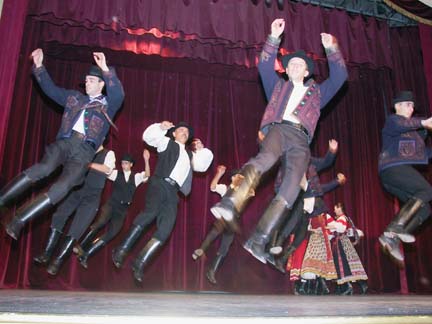
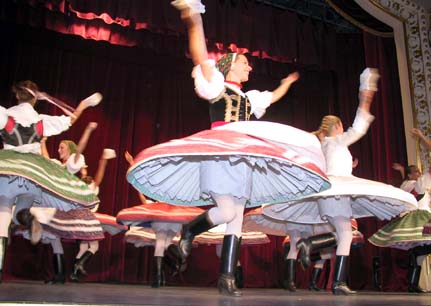
Find live gypsy music and dancing everywhere in Budapest, and don't miss the Hungarian Folk Ensemble's traditional folk-dance spectacular.
The Hungarian city enchants visitors
with its beauty, history and cultural blend
[ 3 Days In... ]
By Dennis Callan
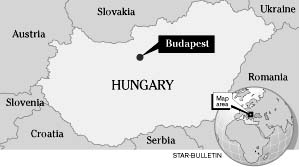
Have you heard of the Magyar people, or their nation of Magyarorszag? It's Hungary, the exotic Central European nation whose capital of Budapest will surprise you with its beauty, affordable luxury and unique history. Gypsy music fills the air, scenic vistas are everywhere, and old and new mix in a cultural blend that makes Budapest a destination to put high on your travel list. Two thousand years of invasion, liberation, reoccupation, devastation and rebirth have produced a unique culture in this city on the Danube.
Some buildings are run-down, and roads are bumpy, but it is still a city full of character.
Various architectural styles are on display, often combined in the Hungarian Eclectic that blends Classical, Gothic, Renaissance, Baroque and Art Nouveau in a single building.
Invasions by Huns in the fifth century, then Magyars, then Mongols 800 years ago, and Muslims 500 years back, have all left their stamps on the culture. The mysterious origins of today's population are reflected in the language, which is more closely related to Finnish, Estonian and Siberian than to the immediate Slavic and Germanic neighbors.
Budapest consists of Buda on the west bank of the Danube and Pest on the east. Built on a hill, Buda contains the Royal Palace and the old Castle District. Pest stands on a plain and is the site of shopping areas, the Museum of Fine Arts, the Palace of Justice, Parliament and the National Museum. No other city along Europe's longest river embraces it as much as Budapest, with nine bridges linking the two sides, and a major promenade along the river.
DENNIS CALLAN / SPECIAL TO THE STAR-BULLETIN
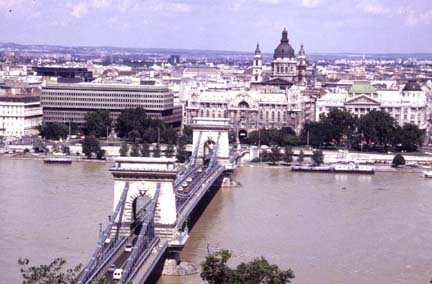
The Chain Bridge, a Budapest icon that opened in 1849, was the first permanent bridge across the Danube, providing the link that joined Buda, the older half of town, and Pest, the newer half. Several five-star hotels are along the river. Behind the bridge is a view of the city.
Day 1
Inner city walking tour of Pest and National Museum tourDay 2
Buda walking tour in the Castle District and Danube cruiseDay 3:
Inner city walk, tram ride, Museum of Fine Arts tour

Inner city walking tour of Pest and the National Museum
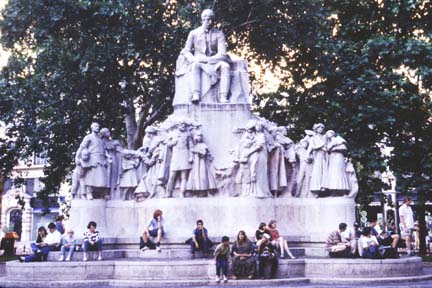
>> Vorosmarty Square: The large statue in the center of this pleasant tree-lined plaza depicts the poet, Mihaly Vorosmarty, who became a national hero with his patriotic writings in the mid-19th century, when Hungary attempted to gain independence from Austria. It says something about a nation's character to have a poet sitting in the capital's center, surrounded by marble benches that draw people to him.Hungary's most famous cafe, Gerbeaud, is on the square. Try Dobos Torta, a rich chocolate cake with chocolate-cream filling, covered with crunchy caramel. In business since 1858, Gerbeaud also has a theater offering musical productions.
Music is everywhere in Budapest, with players on street corners, gypsy orchestras in restaurants, formal productions in concert halls and opera in a grand theater.
A helpful place for tickets, maps and brochures is the information office at Deak Square. The Budapest Card -- a $22 three-day pass good for admission to the museums and public transportation, plus restaurant and tour discounts -- can be purchased here.
>> Embankment views: The town's most beautiful vista is the view from the banks of the Danube River, two blocks from Vorosmarty Square. Across the river you will see the vision of the Royal Palace atop the hill in Buda, the older half of town. To your right is the other city icon, the Chain Bridge, which opened in 1849 as the first permanent Danube crossing, providing the link that joined Buda and Pest into one city. When the weather's pleasant, the water's edge is lively with sidewalk cafes, performers, vendors, artists, locals and tourists mingling in a big show.
DENNIS CALLAN / SPECIAL TO THE STAR-BULLETIN
Vorosmarty Square, named after the poet who became a national hero with his patriotic writings in the 19th century, is the most popular place to hang out in Budapest. It is in the middle of the inner city and home to the famous old cafe, Gerbeaud.
Several of the city's five-star hotels are along the river. My favorite is the Marriott, where all rooms have a river view. Other riverside choices are the Atrium Hyatt, which houses the Las Vegas Casino, and the Inter-Continental. Four Seasons Hotel Gresham Palace will join the cluster by year's end.
Completing the super-deluxe category is the Kempinsky, four blocks inland. Its lobby is a great place to rest while listening to live classical music. There are many less-expensive hotels, but the dollar goes a long way in Hungary, so why not live it up?
The river embankment, called Belgrad Rampart, is perfect for evening strolls, when the Palace and Chain Bridge are brightly illuminated, and several nice restaurants, including Dunacorso, serve traditional cuisine at terrace tables with live gypsy music.
Music lovers should check the schedule at Vigado Concert Hall. There are outstanding classical revues most nights, usually featuring opera excerpts. Vendors on the embankment sell tickets for the Hungarian State Folk Ensemble's show of traditional folk dance at Duna Palace. While it is not a Vegas-style production, there is a string quartet accompanying 20 singing dancers in folk costumes, putting on a wonderful show.
Souvenir kiosks on the embankment offer postcards, T-shirts and dresses, or you can purchase from strolling women who sell handmade tablecloths, clothing, dolls and doilies.
>> Vaci Utca: The main pedestrian street in the heart of town leads out from Vorosmarty Square's south end. This lively promenade is lined with shops and cafes. It extends about a mile to the Central Market Hall, a huge food emporium. Walk along Vaci Utca in the morning to enjoy the serenity, then go to the food market. The food hall is one of the few places that awakens early.
DENNIS CALLAN / SPECIAL TO THE STAR-BULLETIN
Among Budapest's many musical attractions is the Hungarian State Folk Ensemble. Costumed singing dancers put on a fabulous show at Duna Palace. The city also has classical revues, and clubs and restaurants often have live gypsy music.
>> Central Market Hall: The market is full of history, color and life. The hall is huge -- covering the area of two football fields. It opened in 1896 and was refurbished 10 years ago. It is built of steel and glass, with a high ceiling, and is filled with food stalls. Chili peppers -- an essential ingredient in Hungarian cuisine -- hang everywhere. They are used in a mild form of paprika that adds rich flavors without burning. The real delight is watching locals shop for fresh produce. Upstairs, there are a couple of food counters and the Fakanal Restaurant.
Next, take a three-block walk to the National Museum.
>> Hungarian National Museum: The museum is housed in a neoclassical structure that looks like an ancient temple, with eight massive Corinthian pillars holding up a triangular pediment, depicting gods that reflect early Roman settlement. It opened in 1847 and was renovated 10 years ago. Its new permanent exhibition fills 20 galleries and covers 1,000 years. There are some flashy items, including royal jewels and crowns from the monarchs and nobles who ruled the land.
The galleries are arranged in chronological order, from the kings of the 11th century up through the collapse of communism, so start with Room 1. One section covers the 150 years of control under the Ottoman Empire during the Muslim invasion, which ended with the expulsion of the Turks in 1686.
After the Ottomans were kicked out, the Austrian Hapsburgs took over. During the 18th century, Hapsburg rule from Vienna by Maria Theresa and her son Joseph II encouraged the construction of some beautiful Baroque buildings, most of which were destroyed in later wars. By the end of the 19th century, under continued Austrian rule, Budapest became the fastest-growing city in Europe and built the first subway system on the continent.
The most dramatic half of this exhibit focuses on the 20th century, starting with the collapse of the Hapsburgs and their Austro-Hungarian Empire during World War I. Between the wars, Hungary drifted from communism to the chaos of Nazi invasion, followed by the rise and collapse of Russia. The displays are quite graphic in dealing with the Nazis and Stalin, with vintage photos and period objects, including army motorcycles, political banners, air-raid shelters and apartment interiors. This brutal domination led to disintegration of the Soviet empire and finally to independence for Hungary.
There are two more floors of exhibits covering the early medieval and Roman periods, with a Lapidarium in the basement exhibiting 200 carved stones dating back 2,000 years. This building is a beautifully restored temple of history. The lobby and monumental stairs alone are worth the entry fee.
>> Afternoon walk: This small neighborhood of the inner city only goes for about a half-mile in each direction. The buildings date mostly from the late 19th and 20th centuries.
If you are ready to eat, there is the noted Museum Kavehaz, or the Astoria Hotel, a classic old hotel that has seen better times, but remains an interesting, affordable place to stay.
Continue along Kossuth Lajos, the city's busiest street, to the Franciscan Church, built in the mid-18th century Hungarian Baroque style, with Italian influences. The street widens here to form Ferenciek Terre, the action center of the inner city, with a metro station below.
After you exit the church, you'll pass the University Library, with its brightly colored dome, then you'll pass the Karpatia Restaurant, which offers Hungarian specialties. Make reservations for dinner in the main room when the gypsy orchestra performs, for the complete magical experience.
At the end of the block is another Baroque gem, the University Church, finished in 1748 with a style influenced by the Italian genius, Borromini, borrowing his use of convex and concave surfaces on the façade. Across from the church is the Museum of Literature, which has a small park in back.
Return to Vaci Utca and browse through shops and galleries.
The pedestrian zone extends on several cross streets, lined with interesting buildings. Especially noteworthy are the Parisi Udvar arcade; the huge Municipal Council Offices, 200 yards long; and the neoclassical Pest County Hall. There are also two restaurants, Rezkakas and Szazeves Etterem, featuring outstanding Hungarian cuisine and live gypsy music.

Buda walking tour in the Castle District and Danube Cruise
Get to the Castle District on top of the hill on the Buda side of town by catching bus No. 16 from Deak Square, or by taking a walk across the Chain Bridge and riding the funicular. Another option is taxi, but always negotiate the price first.There is no castle in the district, but you will find a huge palace and charming old town.
The streets at the top of the hill are the oldest in Budapest, dating to the Middle Ages when this community was a refuge from invading Mongols. Numerous wars and fires resulted in destruction and rebirth, most recently after World War II, when horrific street battles raged for a year between the occupying Nazi and liberating Russians. The 1944-45 siege of Budapest was one of the most violent struggles in the war. It is said that only two out of 200 buildings here were still habitable after the war. The communist government invested huge sums in reconstructing this district in its original style, so what you see today looks like an 18th-century town. The entire hill and river embankments have been designated as a UNESCO World Heritage Site.
The Castle District is only one mile long and four blocks wide, with half the space taken up by the Royal Palace, and the other half consisting of narrow, cobbled streets lined with old homes. The star attraction is the Matthias Church in the town center. To find it, head for the 262-foot steeple.
>> Matthias Church and Fisherman's Bastion: Matthias Church looks like a Middle Ages Gothic structure, but most of what you see today was built in the late 19th century, with a few earlier elements incorporated. For 800 years this has been the site of the city's main church, which has been built and destroyed several times, and was turned into a mosque during the Turkish occupation. The result is an amazing combination of styles. The walls, ceiling and columns of the dazzling interior are covered in colorful geometric patterns, based on the Gothic style, with recent elements added. Observe the psychedelic mix of frescoed murals, colorful banners, carved pews, ribbed vaulting, stone pulpits, side chapels, noble tombs, baptismal fonts, coats of arms, statues, altar pieces and holy objects. Large, bright stained-glass windows throw a lot of light onto the details.
Behind the church, the famous Fisherman's Bastion lookout provides a dramatic view across the river to Pest. This Bastion looks older than it is, with its hodgepodge of Byzantine, Gothic and Romanesque kitsch thrown together in such an entertaining way that it was copied by Walt Disney. Note the huge Parliament Building across the river, with its large dome and neo-Gothic spikes.
In the small open square stands a heroic equestrian statue of St. Stephen, Hungary's first king, who is also honored at the city's largest church, St. Stephen's Basilica.
>> Old town: The rest of the district can be easily walked in an hour or two.
DENNIS CALLAN / SPECIAL TO THE STAR-BULLETIN
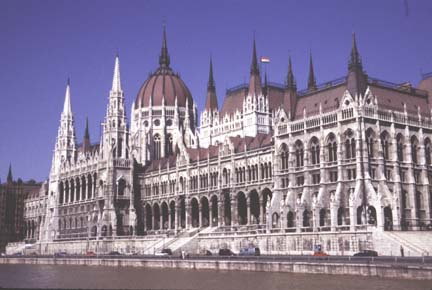
The spectacular Parliament building, which was completed in 1902, has hundreds of statues and Gothic spires adorning its exterior. Nearly 300 yards long and containing 700 rooms, it is the largest parliament structure in Europe.
One modern structure is the Hilton Hotel, located behind an 18th century Jesuit façade. The side facing Pest is a stark glass box that would clash with its surroundings if it were not hidden so well. Stop inside the lobby for a look at how Dominican monastery ruins are incorporated into a delightful courtyard that is occasionally used for concerts. You'll find excellent restaurants inside the Hilton or the Fortuna, in the same Hess Andras Square, offering gourmet meals for $10.
Across from the Hilton is the House of Hungarian Wines, a vast wine-tasting cellar. Visitors pay a modest fee for a tasting cup and can taste up to 80 wines from a barrel-vaulted basement that holds 450 different wines from 22 historical wine regions in Hungary.
As you walk in front of the Hilton, explore alleys leading to courtyards surrounded by charming old residences. The largest courtyard is at the Music History Museum, a Baroque mansion where Beethoven once stayed. Monday concerts are held at the museum. The Castle District houses several museums devoted to military history, pharmaceuticals, telephones and food, and there is a wax museum in the tunnels, recreating Hungarian legends.
For refreshments, try the oldest cafe in town, Ruszwurm, in front of Matthias Church. It's a tiny place with authentic Biedermeier decor, and it has been in business since 1827.
A series of caves runs underneath the castle hill. If you want to explore the labyrinth of tunnels and chambers, Castle Cave and Buda Castle Labyrinth have guided tours through the subterranean system, which takes nearly an hour to explore.
>> Royal Palace: Walk a few blocks to the Royal Palace. This mammoth structure seems to cover half the hill, looking down onto the Pest side of town. Some kind of palace has been here for 700 years, but due to wars, it has been leveled and rebuilt many times. During World War II it was burned to a shell, with all the furnishings stolen or destroyed. It has since been rebuilt, with the work completed in the 1980s. Archaeological excavations continue in the gardens in search of palace remains.
Two major museums inside the palace cover art and history. The National Gallery occupies four floors, filled with paintings and sculptures by Hungarian artists. There are no famous artists, but there is a vast collection of paintings and statues, representing all the main movements of Western art history, ranging from Gothic through the 20th century.
DENNIS CALLAN / SPECIAL TO THE STAR-BULLETIN
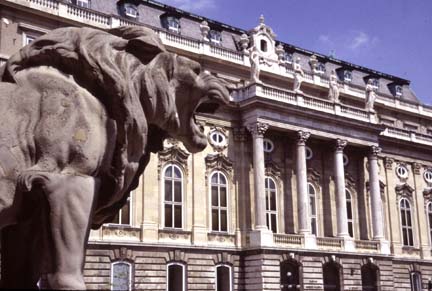
The gigantic Royal Palace, which was burned to a shell during World War II, has been rebuilt in its original grand style, with elaborate architectural motifs.
History fans will enjoy the Castle Museum in the palace. It offers a fascinating trip back to the Middle Ages, when the foundations of this structure were dug into the bedrock. By incorporating original building fragments with faithful reconstructions, museum designers have produced the feeling of being in a medieval castle. You move through a series of basement rooms with Gothic-style pointed arches and cross-vaulted ceilings, passing a tiny dungeon and a 14th century chapel, to reach galleries filled with period furniture and display cases full of artifacts.
The exterior of the Royal Palace is built in the grand style of the Hapsburgs, some of whom are buried in the lower crypt. It is reminiscent of the majestic Hofburg Palace in Vienna, from which the Hapsburgs actually ruled Budapest. Elaborate architectural motifs go up columns, across lintels, down pilasters, through triumphal gateways, and over to monumental statues in several courtyards. A heroic equestrian piece in front glorifies Prince Eugene of Savoy, who led successful battles against the Ottoman Turks. The ensemble is held together by a magnificent Renaissance-style dome that towers above.
The funicular is one block over for your ride down the hill, then it's an easy walk across the Chain Bridge to the town center. Or head for a spa.
>> Thermal baths: If you are feeling weary, try one of Budapest's great experiences -- a soak in the thermal baths and a massage at one of the famous spas. There are many public baths to choose from, but the most famous, the Gellert Spa Baths, is a mile from the Castle District and easily accessible by tram. The medicinal spring was already famous in the 13th century, and the presence of so many natural hot baths could be why the Romans founded this city. The Gellert is elaborately decorated with Art Nouveau furnishings, with stained glass windows, mosaics and sculptures to decorate the pools and fitness rooms.
>> Boat ride: Take a boat ride on the Danube, starting from the pier in front of the Marriott. The cruise takes an hour and includes narration over headsets. You'll see the awesome Parliament, which you have spotted from the Buda hills, but this close-up view makes the entire boat ride worthwhile. The boat circles Margaret Island, and you have an option to get off for an hourlong stroll before catching the next boat back to the dock.

Inner city walk, tram ride, Museum of Fine Arts
>> St. Stephen's Basilica: A few blocks north of Vorosmarty Square you will find the nation's largest church, St. Stephen's Basilica, finished in 1905 in the neo-Renaissance style, with a dome towering 300 feet over a vast interior that can hold 8,000 people. Restoration has been going on for years, but you can look past the scaffoldings to see fine mosaics, frescoes, statues and grand, religious architecture embellished with gold trim. The prize relic of the Hungarian Catholic Church is the clenched right hand of St. Stephen, which can be inspected in its jeweled casket in a special chapel.>> Parliament: It is more than a mile to the Parliament, so walk three blocks to Deak Ter and ride the metro, or take the more scenic tram No. 2.
This spectacular building was the world's largest parliament structure when completed in 1902. Based somewhat on London's neo-Gothic Palace of Westminster, but pushed to a Bohemian extreme, the building has hundreds of statues and Gothic spires. Nearly 300 yards long and containing 700 rooms, it is still the largest parliament building in Europe. Several guided tours in English are offered.
While in the neighborhood, visit the Ethnographical Museum, which has an exhibition of Hungarian peasant life, featuring costumes, artifacts and photos. The building once served as the main courthouse.
>> Tram ride: Walk four blocks to the busy street, Nagykorut, which means Great Ring Boulevard, and hop on a tram. Remember the Hapsburg connections? Well, inspired by Vienna, Budapest built this ring road that circles the downtown area. It goes through the non-touristy heart of the city.
The old-fashioned tram is comfortable and has lots of windows for sightseeing.
Toward the end of the line, get off at the Museum of Applied Arts to look at this unusual building, designed in 1896 in the fancy style of India. Inside is a museum of decorative arts, featuring ceramics, furniture, textiles and metal work. Hop back on the tram to return along the Great Boulevard until you reach the New York Café.
You have never seen a coffee shop as elaborate as the New York Café, the only authentic cafe left from the 19th century, even though there were 500 cafes at the center of cultural life here. The New York was always the most popular and most ornate. It is so pretty that there is a fee to see the spiral columns, magical lighting, golden trim, statues, murals, iron balconies, velvets and multilevel rooms. The food is expensive, but you can have a drink and the admission fee is credited to your tab.
>> Museum of Fine Arts: You have seen most of Budapest except for the Museum of Fine Arts, followed by dinner at Gundel, Hungary's most famous restaurant. From the New York Café, take the tram to Oktogon, transfer to the metro and ride to the end of the line. This is the continent's first subway train, built in 1896 when Budapest was in its glory. You arrive at Heroes Square, gateway to the museum and the City Park.
In the middle of Heroes Square stands a monumental column celebrating the nation's millennium, topped by the Archangel Gabriel holding the Hungarian crown, which symbolizes the nation's conversion to Christianity under St. Stephen 1,000 years ago. The 100-foot column is embraced by a semi-circular colonnade, bedecked with statues representing heroic kings and princes of Hungary. The square is flanked by majestic museums.
The Museum of Fine Arts has an excellent collection of Old Masters, especially Spanish and Italian, a handful of Impressionists, a large room of Egyptian pieces, and several galleries of Greek and Roman statues. The building is impressive in the grand neoclassical style of a temple to the arts.
Perhaps the most interesting piece is a bronze sculpture by Leonardo da Vinci of a horse rearing up on its hind legs, with a rider hanging on. It is his only known surviving statue. There are other Italian works by Raphael, Correggio, Veronese and Tiepolo, and Spanish paintings by Velasquez, El Greco, Goya, Zurbaran and Murillo. On the Flemish side you will find Rembrandt, Hals, Rubens, Bruegel, Steen and Van Dyke. However, before you go upstairs to see this Old Masters' Gallery, begin with the Impressionists, with beautiful canvases by Pissarro, Renoir, Monet, Cezanne, Gauguin and Manet.
Gundel Restaurant is around the corner. If you are not ready to eat, take a walk in City Park. It has a zoo, rolling lawns, ponds, a fantasy castle, a skating rink, a chapel, museums of agriculture and transportation, baths with thermal springs, a circus and a fun fair.
There is no better way to wrap up your visit than with dinner at Gundel.
This grand restaurant has been revitalized by the new ownership of cosmetics heir Ronald Lauder and famed restaurateur George Lang, who also operates Café des Artistes in New York. Reasonably priced gourmet dining, with gypsy music, in sumptuous surroundings will complete a perfect three days and nights.
Dennis Callan is the president of the Hawaii Geographic Society and produces the "World Traveler" television series, airing at 8 p.m. Mondays on 'Olelo, channel 52. He leads frequent tours through Europe and writes "Three Days in ..." for the Star-Bulletin the first Sunday monthly, explaining how to get the most out of three days in the world's great places.
BACK TO TOP |
[ IF YOU GO ] Here are some places to stay and dine while in Budapest.
If calling from the United States, use the prefix 011-36-1.
Budapest hotels
>> Budapest Marriott Hotel
My favorite, at 1052 Bp Apáczai Cs. J.u. 4
Call 266-7000 or fax 266-5000
E-mail marriott.budapest@pronet.hu or
marriotthotels.com/budhu>> Hotel Inter-Continental
Apáczai Csere J.u. 2-14
Call 276-333 or fax 327-6357
E-mail budapest@interconti.com
intercontinental.com>> Atrium Hyatt
At V. Roosevelt tér 2
Call 266-1234 or fax 266-9101
E-mail reservation@budapest.hyatt.hu
hyatt.com>> Kempinski Hotel
At 7 Erszebet ter
Call 800-426-3135 or 429-3777, or fax 429-4777
E-mail hotel@kempinski.hu
kempinski-budapest.com>> Hilton Budapest
At Hess András tér 1-3
Call 488-6600 or fax 488-6644
E-mail hiltonhu@hungary.net
danubiusgroup.com/Hilton>> Hotel Astoria
At 1053 Bp Kossuth Lajos u. 19-21
Call 484-3200 or fax 318-6798
E-mail astoria.reservation@danubiusgroup.com
danubiusgroup.com/Astoria>> Hotel Taverna
At 1052 Bp Váci u. 20
Call 485-3100 or fax 485-3111
E-mail hotel@hoteltaverna.hu
hoteltaverna.hu
Restaurants and cafes
>> Fortuna: Hess Andras ter 4; call 355-7177.
>> Gerbeaud: Vorosmarty ter 7; call 492-9000.
>> Gundel: Allatkerti u., 2; call 121-3550.
>> Karpatia: Ferenciek tere 7-8; call 317-3596.
>> New York Café: 9 Erzsebet korut; call 322-3849.
>> Rezkakas: Veres Palne u. 3; call 318-0038.
>> Ruszwurm: Szentharomsag utca 7; call 175-5284.
>> Szazeves Etterem: Pesti Barnabas u., 2; call 318-3608.
Web sites
>> origo.hnm.hu
>> bkv.hu
>> budapestinfo.hu
>> budapestpanorama.com
>> budapestpost.com
>> budapestsun.com
>> budapestweek.com
>> budpocketguide.com
>> fsz.bme.hu/hungary/budapest/
>> gotohungary.com
>> VirtualHungary.com