Hawaii’s Back yard
Cheryl Chee Tsutsumi
Bowfin museum a reminder
of sacrifice that helped secure
victory in WWIIWhile other boys drew cars and airplanes in elementary school, Charles Hinman drew submarines. That fascination never waned, and today Hinman has his dream job, running the Education and Outreach programs of the USS Bowfin Submarine Museum & Park. The park's mission is to restore and preserve the World War II submarine USS Bowfin, which was designated a National Historic Landmark in 1986.
"A common expression among submariners is 'Any vessel can sink; only a submarine can surface,'" says Hinman. "Bowfin is in the best condition of any surviving U.S. submarine from World War II (there are only 15 still in existence), and she is displayed in the best location in the world."
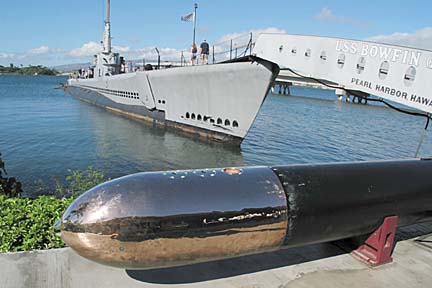
Bowfin is the centerpiece of a 5-acre park that lies adjacent to the USS Arizona Memorial Visitor Center at Pearl Harbor. It attracts 250,000 visitors annually -- about one-fifth the attendance of its famous neighbor -- but it is no less significant in the annals of WWII history.
Measuring nearly 312 feet long, the sub was launched on Dec. 7, 1942, a year to the day after Japanese warplanes bombed Pearl Harbor. Nicknamed the Pearl Harbor Avenger, she completed nine patrols and sank 44 enemy ships.
Hinman ticks off Bowfin's other notable accomplishments: "She was the first and one of only two submarines to carry an admiral on a war patrol. She evacuated civilians, rescued downed fliers, laid mines, tested top-secret sonar equipment and was one of the first subs to use acoustic torpedoes. She earned both the Presidential Unit Citation and the Navy Unit Commendation, the two highest awards any vessel can receive. And she came home with all of her crew alive."
USS BOWFIN SUBMARINE MUSEUM & PARK
At the entrance to the USS Bowfin is a MK14 torpedo commonly carried on World War II submarines.
In addition, Bowfin played the roles of three submarines in the 1987 TV series, "War and Remembrance." She also was the subject of an episode of the early-1960s TV series "The Silent Service." The 1957 movie "Hellcats of the Navy," starring Ronald Reagan, was loosely based on Bowfin's eight-sub wolf pack, whose mission near the end of the war was to eliminate the remnants of merchant shipping around the islands of Japan.
"They were to sink, as many as possible, any and all enemy vessels they encountered other than those officially designated as ships of mercy," Hinman explains. "Merchant ships include tankers, freighters, transports and any other type of vessel that constitute the sea lifeline of a maritime nation. They are primary targets of a navy waging a war against an enemy that depends on shipping to continue hostilities, such as Japan during the war in the Pacific."
BOWFIN WAS decommissioned in February 1947. Four years later, she was recommissioned for three years of service during the Korean conflict. From 1960 to 1971, she was used as a Naval Reserve training boat. She was decommissioned and removed from the Navy's ship registry in December 1971.
The Pacific Fleet Submarine Memorial Association, the USS Bowfin Submarine Museum & Park's parent organization, acquired Bowfin from the Navy in 1979. Two years later, the sub opened to the public for tours. The nonprofit memorial association receives no federal, state or local funding; all restoration, preservation and operation efforts are funded through admissions, gift shop sales and donations.
USS BOWFIN SUBMARINE MUSEUM & PARK
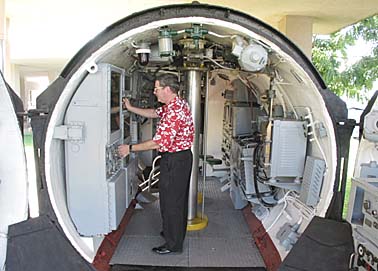
Charles Hinman is inside the USS Parche Conning Tower on display at the USS Bowfin Submarine Museum and Park.
Listening to narration on Walkman-style headsets as they explore the cramped confines of Bowfin, visitors get a clear idea of the mental and physical challenges her courageous crew of 80 faced during patrols, which usually lasted about 44 days. In the aft torpedo room, for example, four torpedoes were stored in launching tubes and four more on reloading racks in the same area where some crewmen slept.
Other highlights of the self-guided tour include the galley, officers' staterooms, radio room, engine room and maneuvering room, where orders to change speed were executed.
The 7,500-square-foot Bowfin Submarine Museum houses a 40-seat theater that screens documentary videos; a 32-foot-long, 65,000-pound Poseidon C-3 missile, which was carried on ballistic missile submarines in the 1970s; and an impressive collection of artifacts, including weapon systems, naval uniforms, original recruiting posters, battle flags and a nearly complete set of submarine war patrol reports.
Hinman describes these as "a treasure for historians. All American sub commanders were required to submit a formal report after every patrol. Of the approximately 1,700 patrols conducted in World War II, over 90 percent of which were in the Asia/Pacific theater, our archives hold nearly 1,300 -- more than 76 percent (of the total)."
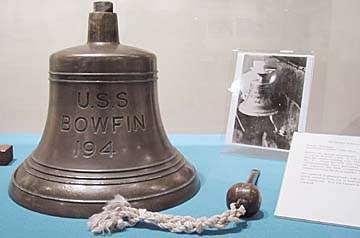
THE ACQUISITION of Bowfin's lost ship's bell is one of Hinman's favorite stories. "It had been missing for about 24 years, and was discovered at an estate sale on the mainland," he says. "A California couple who collect antiques purchased the bell and contacted a World War II submarine museum in California to ask about it."
USS BOWFIN SUBMARINE MUSEUM & PARK
The vessel's bell had been missing for about 24 years before it was discovered at an estate sale.
The staff of the USS Pampanito Museum wasn't interested in a bell inscribed with the words "USS Bowfin," but they knew who would be. "We purchased the 77-pound brass bell for $800," says Hinman, "and it arrived safe and sound in July 1996, thanks to Mario Hernandez, Fred Algar and Eric Webber, three Naval reservists who toted it back to Pearl Harbor aboard a commercial airplane."
According to Hinman, submarines accounted for 55 percent of the enemy merchant vessels sunk in the Pacific during WWII -- more than all other forces combined. Subs also destroyed about a third of the enemy's military ships.
"Everyone knows that USS Arizona represents the beginning of the war in the Pacific and the battleship Missouri its end," says Hinman, "but it could be rightfully said that Bowfin represents the winning of the war."
Address: 11 Arizona Memorial Drive, Honolulu, HI 96818 USS Bowfin Submarine Museum & Park
Hours: Open 8 a.m. to 5 p.m. daily except Thanksgiving, Christmas and New Year's Day. Last admission to the submarine is 4:30 p.m.
Admission: $8 for adults; $6 for military personnel, Hawaii residents and seniors 65 and older; and $3 for ages 4 to 12 for both submarine and the museum; $4 for adults and $2 for kids for museum only.
Restrictions: Children under 4 are not allowed on the submarine; however, they are admitted free to the museum.
Call: 423-1341
Web site: www.bowfin.org
Cheryl Chee Tsutsumi is a Honolulu-based free-lance writer
and Society of American Travel Writers award winner.