[ SUNDAY TRAVEL ]
DENNIS CALLAN
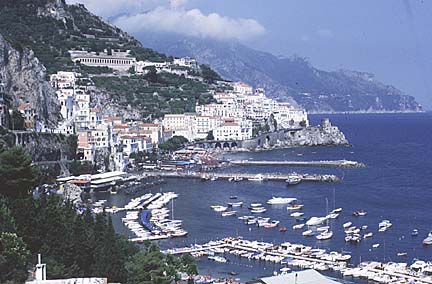
The picturesque town of Amalfi clings to a cliff that offers many dramatic views of hidden coves, little villages and majestic vistas. Below is a statue in Pompeii, which was buried under nine feet of volcanic ash in 79 A.D. Pompeii is the best-preserved ancient village in the world.
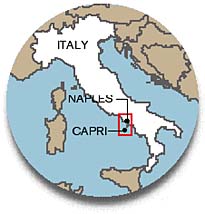
Imagine a series of picturesque villages along the shores of the Italian Mediterranean, sparkling with blue sea and sky, colorful flowers framing homes on steep hills, meandering pedestrian alleys lined with quaint shops, restaurants to die for, world-famous historic ruins and an island sheltering a magical blue sea cave. All this might sound too good to be true, but there is such a wonderland place, south of Naples along the Amalfi Coast.
Paradise awaits in Sorrento and Capri,
If you go
and on the Amalfi Coast
Sorrento makes an ideal base for exploring this spectacular area, which extends about 20 miles in each direction. You can stay in the same hotel for three nights and make day trips to surrounding sites. Sorrento is a popular resort town that offers excellent hotels, including one of the world's best, the five-star Excelsior Grand Hotel Vittoria, with an elevator running down the cliff to the water.
But if you love to ramble and don't mind changing hotels, there are some excellent hotels in Capri and Positano.
The advantage of staying three days or longer is being able to change your schedule according to the weather. One area highlight is a visit to the Blue Grotto on Capri, but it closes when the winds are blowing wrong or the tide is too high. If the grotto is closed, push the Capri visit back to your second day. If it is cloudy you might be better off visiting Pompeii, where the weather is usually clear. Otherwise, there is no bad season to visit, although it is hotter and more crowded in the summer.
Excellent public transportation via bus, boat or train will take you everywhere so you don't have to rent a car and drive along sometimes scary, steep, winding roads. One of the greatest travel bargains is the $2 public bus ride from Sorrento to Amalfi, which takes you along the most scenic drive imaginable to the beautiful villages of Positano and Amalfi.
Boats provide rapid, convenient service to the Isle of Capri, and a $2 train ride will transport you 2,000 years back to Pompeii, the world's best-preserved ancient town, once entombed by the ashes of mighty Vesuvius. Continue on the train to Naples for a quick look at Italy's third-largest city.
DENNIS CALLAN
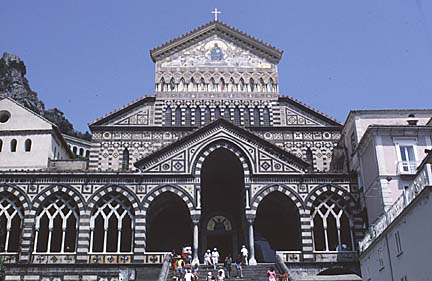
The 9th century cathedral at Piazza Duomo in Amalfi is a site well worth visiting. The town's most historic attraction was built in a combination of styles, ranging from the Byzantine to the Baroque. The Duomo stands at the top of a steep flight of steps that may discourage the timid.
The Isle of Capri
One of the world's most fabled islands is 30 minutes away from Sorrento by boat. First, you need to get down a cliff to the harbor. Take a 30-minute walk or a five-minute taxi ride. A boat trip costs $6 to $9 one way. There are several different lines to pick from, so buy a one-way ticket on whatever boat is leaving first.Note the schedules so you know when the last boats return to Sorrento. The distance is short enough that it doesn't matter if you are on a hydrofoil or a slower boat. Capri is only 4 miles long and a mile wide, three miles offshore, with two small villages, Capri and Anacapri, so you can see most of it in a day.
Arriving at Capri's Marina Grande, you must decide whether to take the funicular up to the village, take a boat tour to the Blue Grotto, catch the bus into town, walk uphill or hire a taxi to give you a tour of the island. I recommend you find a nice taxi driver and put yourself in his hands. When you get off the boat, there is a group of local drivers waiting. Don't worry about being overcharged; these gentlemen are there to help you. It is part of a long tradition of hospitality on Capri.
Among the many drivers, we were lucky to find Franco Gargiulo, who took us on a wonderful tour we will never forget. Try and reach him at 081-837-5322. He, his wife and daughter own the 10-room Hotel Nautilus, which would make a lovely place to spend the night.
A private driver will take you to the Blue Grotto, give you an overview of the island with a panoramic tour, drop you off for a visit to the town of Anacapri, and take you back to the main village of Capri, where you can explore and later take the funicular down to Marina Grande for your departure.
However you choose to get there, don't miss these sights:
>> Blue Grotto: It is best to see this magical place in the morning when the lighting and weather are at their best. Purchase the ticket at Marina Grande, and a boat will take you halfway around Capri to the grotto, where you transfer to a little skiff. The boatsman will row you into this famous sea cave. You will be amazed by the glowing blue water, shining with a mysterious light that comes from below. The visit is about two minutes, but time seems suspended here. Your sailor will extend the experience for an extra tip, and you could even jump in for a quick swim. You could also get to the grotto on your own by public bus and then hire an oarsman. A few hardy souls even jump into the water and swim into the cave. The boat tour will return you to Marina Grande, where you can take the funicular up the steep hillside to Capri Village, which has most of the island's shops, restaurants and hotels.>> Capri Village: Start in the Piazza Umberto at the top of the funicular line. The island's main center of action, known as the Piazzetta, is surrounded by cafes and offers stunning views. Medieval alleys branch out from this central point.There are two lovely walking routes through town, along lanes lined with fancy shops that end in wonderful lookouts. Escape the crowds with a walk along Via V. Emanuele and Via Matteotti to the Garden of Augustus, which gives a dramatic view looking straight down the cliff toward Marina Piccola, and to the huge signature rocks of Capri, the Faraglioni. The garden is named Augustus in tribute to the Roman emperor who made the island one of his summer homes. But it was his successor, Tiberius, who moved in for 10 years, during which he reputedly presided over a nonstop orgy.The second walking route takes you along Via Camerelle, past more shops, to the most deluxe hotel on Capri, the five-star Quisisana. Continue walking along Via Tragara through a residential zone of splendid villas for another half-mile, finally reaching the Tragara Terrace with a different view of the Faraglioni and back toward the Gardens of Augustus. For the ambitious there is a steep path down to the swimming area and two restaurants with a close-up view of the Faraglioni.
A longer hike will take you along Via Tiberio, up a hill to the ancient ruins of the Villa Jovis palace of Emperor Tiberius, the largest preserved archaeological site on the island. The spectacular setting shows why Tiberius chose this spot.
>> Anacapri: The island's other town can be reached by bus from Capri in a 15-minute ride along a winding hillside road with more scenic views. Bus fare is $1.50 one way, or $7 for an all-day pass. Anacapri is a much simpler village with a few shops, several small hotels, a pleasant pedestrian zone and easy access to the $6 cable-car ride up Mount Solaro, the island's highest point, at 1,932 feet.Two sites in Anacapri are worth a visit: the Church of San Michele, with a vast ceramic floor mural depicting the Garden of Eden, populated by a whimsical variety of animals; and Villa San Michele, a museum with Roman artifacts found on Capri, just a five-minute walk from the main square, Piazza della Vittoria.Buses leave Anacapri hourly for Marina Grande for the boat back to Sorrento, where you can catch the sunset from the Belvedere terrace, followed by dinner in a fine restaurant like L'Antica Trattoria.
DENNIS CALLAN
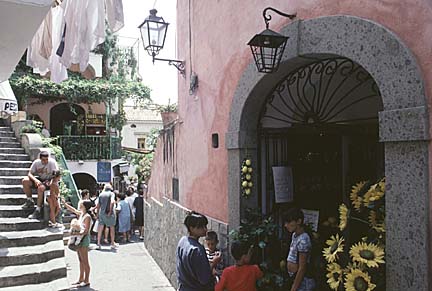
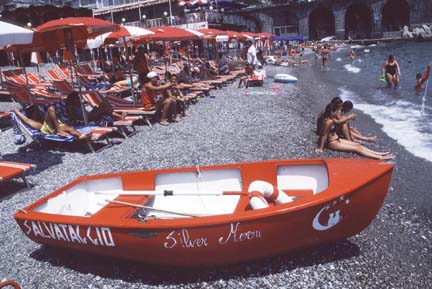
The walk through Positano's narrow pedestrian lanes to the beach provides some of the most enjoyable moments during a trip to this part of Italy.
Sorrento and the Amalfi Coast
Sorrento has a pleasant pedestrian zone and a pretty shore, lined with swimming alcoves and a small boat marina. Start with breakfast, followed by an orientation stroll around town before taking off for a bus ride along the coast.The center of Sorrento is Piazza Tasso, a typical Italian square with a couple of statues, a few cafes and a busy intersection. Plunge into the pedestrian zone, which extends five blocks along Via S. Cesareo, with side lanes and shops geared mostly to locals, featuring bakeries, boutiques, shoe stores, notions and souvenir shops. One specialty to look for is limoncello, a sweet-sour liqueur fermented from the lemons that cover the landscape. Sip a free sample as you watch it flow through an elaborate tubing system found in several micro-distilleries here.
Halfway along Via S. Cesareo, you will come upon an open loggia that was built in the 15th century as a place for the locals to gather. They have been using this terrace ever since. Called Sedile Dominova, this corner building, with graceful columns and arches and colorful frescoes, is usually filled with the senior set playing cards. Walk in and say "buon giorno, come sta." Don't expect them to speak much English, but their friendliness needs no translation. Younger Italians and most shop clerks do, however, speak some English.
The cloister of the church of San Francesco is a landmark. Evening concerts are staged here. Corso Italia, the main street just west of Piazza Tasso, is always an interesting place to stroll.
>> Amalfi Coast: Midmorning is a fine time to begin your excursion by public bus. Buses run every 30 minutes. Buy tickets for about $2. Bolder individuals could rent a car or moped in Sorrento, but it takes a lot of concentration to navigate the curvy streets. A 30-minute bus ride will take you to Positano, and it's 45 more minutes to Amalfi. Sit on the right side of the bus so you can look straight down to the sea as the bus careens around the curves. It doesn't get much better than this vista of sea, sky, cliffs and hills that unfold. You'll pass hidden beaches, isolated homes, colorful splashes of blazing flowers and, finally, the pot of gold that is Positano.>> Positano: The bus stop is on the main road, high above the coastline, so you'll have to walk about a mile downhill, following the curves of Viale Positea through the village to reach the shore. Pause at various terraces to soak in the vista, or perhaps sit at a cafe with a view. Some cars and mopeds buzz along this little winding road until you reach the narrow route reserved for pedestrians. You could take a bus, but that would take away the pleasure of this walk.The lower section of the pedestrian alley is ideal for shoppers in search of Mediterranean outfits, beach accessories, straw hats, arts and crafts, and souvenirs. Near the water, the path widens to form a town square that kids use for soccer games, presided over by the church of Santa Maria Assunta. A remarkable Web site (www.positanonline.it) gives a virtual tour of the village.
There is a five-star hotel in Positano, Le Sirenuse, that is often listed among the world's top 10 places to stay because of its breathtaking hillside location and perfect service. Have a look, or stay for a meal on the terraces overlooking the village. The other top hotel is the San Pietro, hosting one of Europe's top restaurants. There are a dozen lovely alternatives in less expensive hotels, as well.
DENNIS CALLAN
Positano is the gem of the Amalfi Coast. The village clinging to the hills is one of the most scenic in the world.
At the bottom of the hill, the path follows along the beach past several busy cafes, including the most popular restaurant in town, Chez Black, a venerable institution with a French name and Italian cuisine. You might recharge here for the ascent, then do more shop browsing on the way up to minimize the effort.
Walk across the sandy beach to the water's edge so you can admire the view of the picturesque homes covering the hill -- which will also give you an idea of the climb you have to make to get out of here and up to the bus stop. Walk, or ride the shuttle, back to the main road and catch the bus south to Amalfi.
>> Amalfi: You reach this next village in 30 minutes, after 10 more breathtaking miles of winding roads, passing several tiny villages clinging to the vertical cliff, with heart-thumping views straight down to the water and to the steep hills above. The bus stop in Amalfi is on the shore, so you do not need to climb any steep hills.A thousand years ago, Amalfi was one of Europe's power centers, with a large navy protecting wealthy trading posts throughout the Mediterranean, and a population of 80,000, compared with today's 5,000. Amalfi was an independent republic that controlled the peninsula, rivaling Pisa, Venice and Genoa, but this came to an end when Arab, Norman and Italian rivals grew more powerful. Finally, a massive 14th-century earthquake struck, pushing most of the town into the sea. Since then, Amalfi has been a sleepy little village with a charm that lures visitors, like the sirens of Homer's "Odyssey," who sang their fatally enchanting song from treacherous rocks near here.After leaving the beach, walk into the village on Via Genova through an archway into Piazza Duomo, the square with the town's most historic attraction, the ninth-century cathedral. Built in a combination of styles ranging from the Byzantine to the Baroque, the Duomo stands at the top of a steep flight of steps that may discourage the timid. Notice the bronze doors cast in Constantinople around 1066 and other artistic treasures inside, then walk through to the Cloister of Paradise, built in the Arab style in 1266.
This village is about five blocks deep, so continue up the main lane, admiring pastel buildings splashed with flowers. Return via a pedestrian alley that you find by climbing steps from the main street. This tiny lane tunnels through the buildings and connects with more tempting back alleys that climb the hillside.
Now it's time for the one-hour bus ride back to Sorrento, unless you have time for a bus ride up the hill to see Ravelo, another scenic little burg.
DENNIS CALLAN
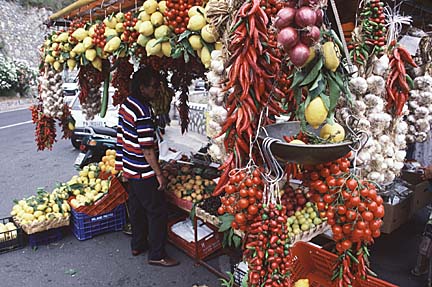
A fruit stand in Amalfi offers a bountiful selection.
Pompeii and Naples
The world's best-preserved ancient village is a 30-minute train ride from Sorrento. Get off the Circumvesuviano train at Pompeii Scavi station. Buy your $10 ticket at the site's entrance.There are usually some tour guides waiting near the gate, and you should consider hiring one for a walking tour to get more out of the visit. Talk with the guide to make sure you can understand his accent, then agree on the tour price and length. Or enjoy the site on your own, with a guidebook and map.
In 79 A.D. the mountain exploded and spit a column of fire and ash 12 miles up. In 30 minutes the rocks started landing on the town. Most of the Pompeiians grabbed what they could carry and ran.
By midnight, 18,000 had escaped while 2,000 stayed. Then a column of boulders and ash fell, and Vesuvius sent flows of lava down the mountain to finish off the city, killing all who remained. Nine feet of ash debris sealed them off until the 18th century, when excavations began.
A few of the streets and buildings are so well preserved that it seems they were abandoned recently, instead of 2,000 years ago. As you stroll through a grand villa, with columns rising around a courtyard and statues on pedestals, you might expect to come upon the owner in a toga, pouring wine for his visitors.
Allow three or four hours for the visit, then continue your journey to Naples.
>> Naples: It takes 40 minutes to travel from Pompeii to Naples on the Circumvesuviano train, which takes you into the main train station. Walk two miles through the most interesting part of town, and visit the National Archaeological Museum's collection of ancient Italian art, much of it recovered from Pompeii.Spread over four floors and nearly 80 rooms, the museum could keep you busy all afternoon. Be sure to admire the masterpieces: the Farnese Bull, a large marble ensemble from 200 B.C. Rome, and other pieces of that collection, including the Farnese Hercules, the Battle of Alexander mosaic, the bust of Seneca and other bronzes, the Pompeii frescoes that show vivid realism with brilliant use of color (1,500 years before the technique was rediscovered in the Renaissance) and the scale model of Pompeii made in cork.>> National Archaeological Museum: Highlights include hundreds of ancient Greek and Roman statues in marble and bronze, gladiator weapons, gold and glass works, coins, ceramics, Egyptian arts, temple furnishings and artifacts from Herculaneum.
DENNIS CALLAN
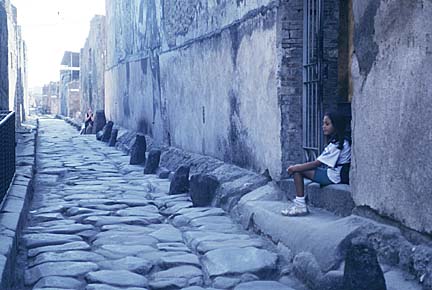
A little girl rests her feet in a Pompeii doorway. Included among the city's remains are plaster molds of some of the individuals killed during the 79 A.D. eruption of Mount Vesuvius.
>> Walking tour: Take a taxi to Piazza Plebiscito, which is surrounded by Naples' major buildings. Admire the curving façade of the church of San Francisco di Paola, with sweeping arcades and a neo-Classical façade that combines elements from the Pantheon and St. Peters in Rome to create a grand public space. Have refreshments at the Café Gambrinus, and glance across to the Royal Palace, where noble rooms are open to the public. One of the town's nicest shopping streets, Via Chiaia, is around the corner.Cross the Piazza Trieste e Trento, passing the old opera house, Teatro San Carlo, to enter one of Naples' most delightful spaces, the Galleria Umberto I, a shopping mall built in the late 19th century. Another block will take you to the façade of Castel Nuovo, a medieval fortress with Renaissance embellishments.Return to the Galleria to begin your walk up Via Toledo through the heart of old Naples. Glance at the crowded Spanish Quarter, but do not venture inside because of the high crime rate. You are safe continuing along Via Toledo, mingling with the local crowd, as you make your way to Spaccanapoli, one of the oldest parts of town, full of charm and character, with churches, antique shops, markets, pizza (invented in Naples), cafes and shrines.
An outstanding sight is the church of Gesu Nuovo, with its façade of diamond-shaped stones and Baroque interior. This quiet street is a place to mingle and relax, so this will be an ideal place to complete your three-day tour. When you have walked enough, hail a taxi to go to the train station for the 70-minute ride back to Sorrento.
BACK TO TOP |
If you go
When visiting the Amalfi Coast, here are some places to stay and eat:HOTELS
Sorrento>> Excelsior Grand Hocall: At Vittoria Piazza Tasso, 34; call 39-081-807-1044, fax 39-081-877-1206; www.exvitt.it or call toll-free 800-325-8541
>> Bellevue Syrene: At Piazza della Vittoria, 5; call 39-081-878-1024, fax 39-081-878-3963; www.bellevuesyrene.it
>> Continental: At Piazza della Vittoria, 4; call 39-081-807-2608, fax 39-081-878-2255; www.continentalsorrento.com
>> Eden: At Via Correale, 25; call 39-081-878-1909, fax 39-081-807-2016; www.hocalledensorrento.com
>> Europa Palace: At Via Correale, 34/36; call 39-081-878-1501, fax 081-878-1855; www.europapalace.com
>> Michelangelo: At Corso Italia, 275; call 39-081-878-4844, fax -39-081-878-1816; www.michelangelohocall.it
Capri
>> Hocall Quisisana, Via Camerelle 2; call 081-837-0788, fax 39-081-837-6080; www.quisi.com
>> Hocall La Palma, Via V. Emanuele, 39; call 39-081-837-0133, fax 081-837-6966; www.lapalma-capri.com
>> La Residenza, Via F. Serena, 22; call 081-837-0833, fax 081-837-7564; www.hocalllaresidenza.com
>> Hocall Nautilus: Via Marina Piccola 98; call 39-081-837-5322, fax 39-081-837 9366; www.caprionline.com/nautilus
Positano
>> Palazzo Murat, Via dei Mulini, 23; call 089-875-177.
>> San Pietro, Via Laurito, 2; call 089-875-455 for five-star accommodations 1.5 miles from town.
>> Le Sirenuse, Via C. Colombo, 30; call 089-875-001; five-star deluxe accommodations in town; www.sirenuse.it
RESTAURANTS
Sorrento>> Ristorante Pizzeria Aurora, Piazza Tasso, Sorrento; call 081-878-1248.
>> Ristorante "da Cataldo," via Marina Grande, 202; call 081-878-2170.
>> L'Antica Trattoria, Via P.R. Giuliani, 33; call 081-807-1082.
>> Ristorante Caruso, Piazza Tasso; call 081-878-1216.
>> Sorrento Inn, Via Fuoro 19; call 081-877-3123.
>> Ristorante S. Antonino, Via S.M. delle Grazie, 6; call 081-877-1200.
Positano
>> Chez Black, 19 Via del Brigantino; call 089-875036.
>> San Pietro, Via Laurito; call 39-089-875-455.
>> La Sponda, Le Sirenuse; call 39-089-875-066.
>> Al Palazzo, Palazzo Murat; call 39-089-875-177.
Capri
>> Al Grottino, Via Longano, 27; call 081-837-0584.
>> Buca di Bacco, Via Longano, 25; call 081-837-0723.
>> Ristorante La Pigna, Via Lo Palazzo; call 081-837-0280.
>> La Colombia, Grand Hocall Quisisana, Via Camerelle, 2; call 081-837-0788.
>> La Terraza, Via Camerelle, 85; call 081-837-6650.
WEB SITES
>> www.alilaurogruson.it
Dennis Callan is the president of the Hawaii Geographic Society and produces the "World Traveler" television series airing at 8 p.m. Mondays on 'Olelo, channel 52. He leads tours through Europe and writes "Three Days in ..." the first Sunday of each month explaining how to get the most out of three days in the world's great places.