
Squish factor:
Testing energy bars
By Dana Williams
in Death Valley
Star-BulletinDEATH VALLEY NATIONAL PARK, Calif. -- So you're planning a hiking adventure in the Big Island's Kau Desert, a bike trip to Nanakuli or maybe an afternoon at Waimea Canyon.
For quick, portable, easy nutrition, you're thinking about bringing along one of the many energy bars on the market.
But which ones will still be intact after a few hours in the sun?
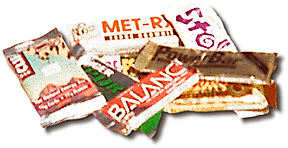
To find out, the Star-Bulletin sent a bag of energy bags to one of the hottest places in the Western Hemisphere.
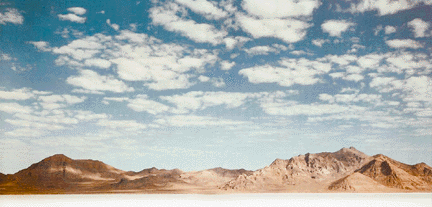
In Death Valley, where the temperatures were around 100 degrees in late September, we tested eight bars during a six-hour hike across the lowest point in the valley floor.
The bars were:
Power Bar, "Athletic Energy Food," chocolate, 2.3 ounces
The squish factor
The bars were purchased at stores in Hawaii, packed into a plastic shopping bag, stuffed into a suitcase and flown to Las Vegas. From there, they were shoved into the trunk of a rental car for the drive to Death Valley.After spending a day in the rental car, the bars were transferred to the pocket of an old Army rucksack and carried across the Badwater salt flats, 282 feet below sea level.
The durability of the bars was measured using the Squish Test. The tester held a bar in her left hand and squished it between her thumb and forefinger. Bars with a high squish factor were presumed to be melted. They were then opened, examined, and in some cases, consumed.
All the bars were solid and had adequate squish resistance before the hike started.
The hike
After carrying the rucksack over the salt floor of the valley for 1-1/2 hours, the tester removed the bars and performed the squish test. The time was 12:30 p.m. The air temperature was in the high 90s.
After 4-1/4 hours:
After 6 hours:
The bar appeared to have been transformed into a gluelike sealant. The tester, failing to dislodge the substance from its wrapper, placed the bar in her mouth and used her lower teeth to scrape a sample from the plastic coating. After expending more effort than should be necessary to consume an energy bar, the frustrated tester shoved most of the messy bar and its plastic coating back into the rucksack.
Sand dunes, scenic canyons and miles of salt flats are some of the attractions at Death Valley National Park on the California-Nevada border.
The park is about a two-and-a-half-hour drive from Las Vegas, and for the outdoors enthusiast, it provides a welcome relief from the noise and lights of the casinos.
Temperatures at low elevations are moderate in the fall, winter and spring, but brutally hot in the summer months.
The National Park Service says daytime air temperatures of 120 degrees are common, and ground temperatures can get even higher.
Hikers should remember to bring broad-brimmed hats, plenty of water and sunscreen.
Children and adults will enjoy playing in the sand dunes. The dunes, some of which are 120 feet high, stretch for about 2 miles. The National Park Service recommends hiking in the early morning or late afternoon for dramatic light, but the dunes are fun any time of day.
The park has plenty of day hiking areas, from Badwater salt flat, 282 feet below sea level, to Telescope Peak trail, which climbs to 11,049 feet.
Above the 10,000-foot level on Telescope Peak, hikers can find ancient bristlecone pines. The trees, which live for more than 4,000 years, are believed to be the oldest living things on earth.
At the north end of the park, visitors with four-wheel drive vehicles can travel to the Racetrack, where huge boulders move mysteriously over a dry lake bed.
Skies in the park are generally clear, and with no nearby city lights at night, the stars are incredibly bright.
Camping is available throughout the park, and prices range from free in some primitive sites to $16 a night during peak season, in the late fall, winter and early spring.
Hotel and resort lodging is also available.
Death Valley
National ParkFrom Las Vegas: Highway 95 runs parallel to the park, with connecting highways at Beatty (head west on state Route 374), and Lathrop Wells (take state Route 373 to Death Valley Junction, then go west on California Highway 190).
From Los Angeles: Interstate 15 passes south of the park, with a connection at Baker, Calif. (turn north and take state Route 127 to Death Valley Junction, then go west on California Highway 190).
Write: Death Valley National Park, P.O. Box 579, Death Valley, CA 92328
Call: 1-(760)-786-2331
Visit: http://www.nps.gov/deva/
Click for online
calendars and events.

