
Christmas Time
on their side
They've broken the law,
By Burl Burlingame
but Christmas without families
breaks their spirit
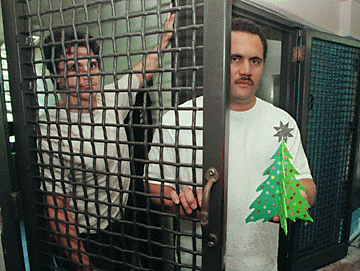
Star-BulletinSOME time today, in a hard, narrow wedge of a cell on the fourth level of Halawa Correctional Facility, prisoners Roy Toney and Steven Loya will celebrate Christmas.
Pulling metal footlockers out from under the bottom bunk, Loya will pull out a package of Keebler cookies that he's been hoarding. Toney will pull out a tiny Christmas tree. The tree is made of cardboard cut out with dental floss. Relatives wrote letters on green construction paper, which Toney stuck to the cardboard with a glue made of rice, poi and toothpaste. Decorations are bits of colored paper torn from magazine ads. The star is made of shiny foil from cigarette packages.
Other prisoners will stop by to marvel at Toney's tree, which he handles with the reverence reserved for the Holy Grail. Loya will open the precious package of cookies, and they'll eat them, every one, chewing slowly so each will last longer.
It's Christmas, and everyone celebrates the best they can.
In prison, Christmas is considered a holiday like any other. Relatives may visit, but they often don't. Prisoners may queue up to use the single phone in each cell block. There are no special meals. There are no presents from relatives. There are no decorations allowed in the cells. Entertainers perform for the inmates during the week -- Loyal Garner and Simplisity played this week, and sometimes, church-group carolers -- but they're there primarily to keep the prisoners' minds off their loneliness."It hurts," said Loya. Normally a chatty fellow with lots of energy, he's subdued, as if a shadow has fallen across his personality. "It hurts more than usual. I know my children are out there suffering, and I can't help them.
"It's frustrating. I just want Christmas over and done with."
"This is our hardest time of year, the holiday season," said health-care administrator Chris Keliipio. "The inmates get depressed because they're without their families, and we'll have three or four on suicide watch.
"The community doesn't understand that non-involvement with families and family activities is part of prison."
In many ways, it's the hardest part -- particularly during holidays that stress family togetherness.
"Christmas has to be a day like any other holiday," said Halawa warden Eric Penarosa. "It's an extra visitation day during the week.
"There are understandable tensions. We have problems with suicidal and angry inmates. This is the time of year when they sit around and think about what they've lost. They get morose. I don't blame them. But that's what incarceration is about."An inmate died in restraints this week while behaving bizarrely. He simply stopped breathing. It's not known yet whether it was a medical condition or if he just willed himself to die during the holidays.
"It's tense for staff," said Penarosa. "At times like these, it's easy to let your guard down because you're sympathizing with the inmates. But you shouldn't."
"It affects us too," said guard Francisco Barbosa. "Every guard has a chance to spend time here on Christmas. We understand that Christmas is a problem, and we take it into consideration, make it as easy as possible for the inmates."
He predicted that Christmas Eve would be "real quiet. No one wants to screw up a chance for a visit."
Penarosa noted that the prison gets "lots of help from volunteers and entertainers to help get the inmates' minds off their situation."
"We will try to do a special meal, but it won't be steak and lobster. We have no control over the menu, which is planned way ahead. And we'll put extra effort into the mail room, making sure that letters and cards get to the inmates as soon as possible," said Penarosa.
"One real source of tension is when an inmate is expecting a family visit, but the family is busy and doesn't show. The inmate sits in his cell, showered and shaved and abandoned, and he gets upset. It gets tough for his cellmate!"
We paid a visit to the facility this week to talk to guards and prisoners.
Inside, the feeling is both angular and disorienting -- masses of squat cinder block, sewn together with steel bars and bowstring-taut suspension-bridge cable, no square corners, no shadows, everything open to view, the echoing crunch of electric doorbolts slamming home. Their window to the world is television, the electronic gateway that specializes in poor impulse control. There are no open doors, ever.
Our guide was Lt. Francis Hun, who appears to be made of brick and steel himself.
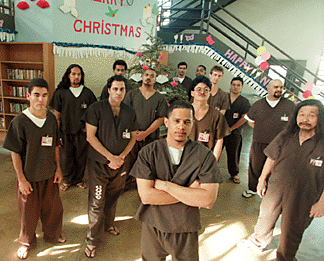
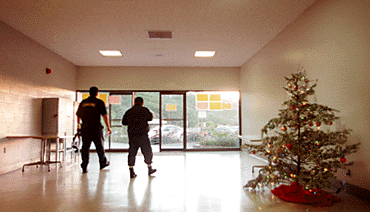
Each cell block has a Christmas tree, nothing fancy, "but you can smell the pine," said Penarosa. There are a few electric lights and glass ornaments. The ornaments are regularly counted. Prisoners make the rest of the decorations, using folded toilet tissue, Post-It notes, silver foil from cigarette packages, shreds of waxed milk cartons. They write their names on the decorations; magical thinking, perhaps, or just a way of asserting a trace of individuality.
The cells themselves are bare. "They can't decorate their cells," said case manager Dovie Borges. "It's unauthorized behavior, and it's misconduct."
Christmas decorations in the administrative spaces are seen by only one inmate, the fellow assigned to clean up.
Brisk, friendly Borges, who tracks something like 150 inmates, said the year has been relatively quiet so far, thanks partly to transfers of hardcore inmates to mainland prisons. "The bigger the population is, the more conflicts that arise," said Borges.The relief lasted approximately two weeks, until overcrowded neighbor island prisons shifted their excess to Halawa. It's still not unusual to see three inmates in a cell built for two, with a mattress on the concrete floor.
Borges' speciality is new-prisoner RAD, or reception, assessment and diagnosis. Newly sentenced prisoners wear blue uniforms, "general population" inmates wear brown. Some wear both -- there aren't enough uniforms to go around. No one wears shoes unless they have a medical condition.
Larry "Blackie" Ortiz has been in brown for most of his adult life, and has 15 more to go. He has never been visited in prison, by anybody. How's he doing this Christmas?
"Not good," Ortiz said slowly. "I don't have anything going. If it weren't for the kindness of the entertainers, I don't know what I'd do. I wonder ... how can a country that's so rich, treat its humanity so bad?"
"Ortiz is a guy who has mellowed out over the years," observed Hun. "He used to be full of anger and would take on anybody. But he realized that was self-destructive."
"I'm not happy about Christmas -- why should I be?" said Darrell Ortiz, who is spending his third Christmas in Halawa. "I have a hard longing for my home up on North Shore. My family comes on holidays, like Christmas, but gifts are not allowed. It's my family I miss the most, but I also miss the ocean -- body-surfing and boogie-boarding -- and as time goes by I accept that certain things cannot be changed, except within myself. The longer I'm away from home and family, the more I appreciate them."
Halawa prisoners aren't allowed out into public, so their efforts at community aid are centered around the repair of bicycles. "They're rebuilt by volunteer inmates, on their own time. We get the parts from venders and the police department. It's sort of our version of Toys for Tots."In the past, "Christmas packages" of snacks could be purchased from the prison shop. Not his year, though.
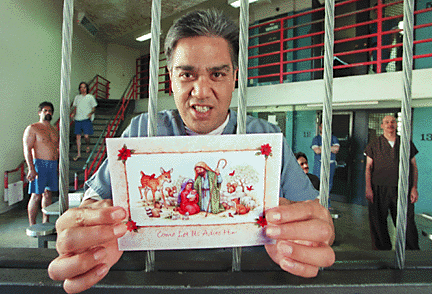
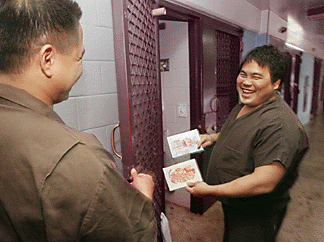
So he'd have one, Mark Kaleleiki bought a Christmas card from the prison store. "Pretty, yeah?" he said proudly, holding it out for inspection. "I'm away from loved ones, but I got a card for Christmas." Kaleleiki has the distracted air and goofy grin of someone who has been prescribed happy pills.
Although Bill Manning blames his incarceration on alcohol, it is his second time in prison. "I had 14 years between, sober," he said. "Then, in jail. I've had two Christmasses in here already but I should be home next year. You should never take anything for granted. Not your family, not your job. I'm half Hawaiian, so the concept of ohana is important. And I was raised close to the ocean. I miss the feel of it. I miss fish.
"The only good thing about prison is the terrible food. I came in here weighing 350 and I lost 200 pounds. I think the mystery meat is made out of kangaroo or something."
Mike Castro has the wary air of someone who has been struck by surprise too often; he's on the lookout for the next blow. Like many prisoners, his arms are heavily tattooed. "It's a form of self-mutilation," observes Hun. "Our guys generally aren't very happy with themselves."
Castro has spent 13 Christmasses behind bars, using the time to disassemble himself, building what he hopes is a law-abiding personality.
He also began to draw, reaffirming a long-dormant talent in graphic arts. The walls of the Halawa administrative wing are decorated with Castro's intricate sketches, scattered bits of color under baleful florescent lighting. Once a day, he will add a line or two to each sketch. He has time, after all.
Many of his drawings have a stark, spiritual quality. Does he miss Christmas?
"I used to," Castro shrugs. "I used to get sad. I look back on it now and see all the people that helped me, instead of those that hurt me. What I miss is being a human being, a real person. In a way, prison has been positive for me. You walk out a better or worse person -- it's up to you."
The prisoners seemed quiet and reflective. Maybe it's the time of year.
"They have time to think, because, basically, they've been cut off from everything else," said Hun.
"Here I sit like an idiot doing time, when all the things I took for granted are gone for me," said Loya. "The smiles on my kids faces. Helping them put toys together. Kissing my wife. Eating what I want, when I want it. Watching TV all by myself!"
When he closes his eyes, Roland Hoopai can see his kids' faces as they open Christmas presents. He hangs on to the memory. The last time he saw such a scene was 14 years ago. "I've lost all contact with my family," he said. "Their lives are too busy, I guess. My brothers and sisters are busy too.
"My birthday is Dec. 31, so this was always my time of year as a kid, special times. Christmas, New Year's and birthday. Now I just hold on to whatever humanity I have left. We need to be more decent human beings, but it's hard. Prison is hard. Sometimes you cannot unlearn behavior," he said, shaking his head. "Some young men I see coming in here ... they're lost to society."
Pam DeGuzman, a perky clerk-
steno, wondered if the prison staff becomes, by default, the prisoners' extended family. "We're here every day, here on the inside, and no one on the outside knows what it's like. After a while, we understand the prisoners' feelings maybe better than their families do, because we're here too."
Even so, said nursing supervisor Barbara Kaiser, "I wouldn't want to be here for Christmas."
"But most of us are," said Hun. "Guards and prisoners, together."
The cliche about Christmas is that the joy comes from giving, not getting. Think about that today as you get whatever you asked for.
"I appreciate everything, every single thing," whispered Castro the artist. "The best thing in the world would be just to stand in the sunlight once more. I miss it, I miss it."
Inmate Roland Hoopai was thinking about the emotional fragility of prison life when he wrote this poem last month: Poetry
in prison
The fear I have in Love
As endless as the stars above
So vulnerable and open
I lay my heart to view
for all the world to see
You may take it in your hands
And show me what I need
But please give it back to me
for if you throw it to the ground
My heart will surely break
Click for online
calendars and events.

