
Shriners helps save
By Helen Altonn
Philippine boy’s foot
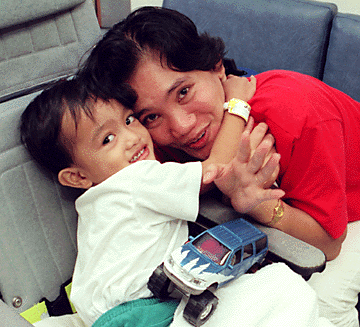
Star-BulletinThe little boy clutched a toy truck, a "Pilots for Kids" cap, wings and other gifts from Northwest Airlines pilots who took Christmas to children at Shriners Hospital.
But the greatest gift Juvenick Flores, 2-1/2, will take home to the Philippines is a normal left foot.
A baseball-sized growth was removed by Dr. Kent Reinker, Shriners' chief of staff, who said Juvenick is "doing great."
He expects the child to be walking all over the hospital next week. "He'll be terrorizing the place."
Aloha Medical Mission doctors saw Juvenick last year during a mission to Ilocos Norte. Doctors there were going to amputate his foot because of a deformity.
Medical mission doctors thought the boy's foot could be saved and arranged for surgery at Shriners Hospital, which paid all expenses.
Juvenick and his mother, Alma, arrived about a month ago and the surgery was performed after a series of tests to determine what the growth was.
A condition known as hemangioma, a tumor of the blood vessels, had caused the "big purple ball," Reinker said.
A major question was whether a malignant tumor was involved, he said. However, it was benign, so it wasn't a problem for removal, he said.
"These are nothing other than birth marks," Reinker said. "They're rather common." Mostly, they're little things that go away with time, but they can be very large and difficult, he said.
There are good Filipino surgeons who could have removed the growth but they don't have the diagnostic equipment or surgical facilities that are available here, he said.
Shriners Hospital sponsors a doctor in Cebu and Hawaii doctors go there every year to see patients and advise "on things risky like this," Reinker said.
If Juvenick had a cancerous tumor, amputation would have been the only option for Ilocos Norte doctors, he said.
"The standard treatment here is to save the foot."
Reinker said Shriners is tempted to keep every kid until after Christmas because of big baskets of gifts. But he expects Juvenick to be released next week.
Alma Flores said they will probably spend Christmas with her cousin, Cirvalina Longboy, in Salt Lake. Her husband is in the Philippines caring for their other two children, a 4-year-old boy and a girl, 1 year and 4 months.
Tears filled her eyes as she discussed her family at home and played with Juvenick, happy and sleepy after the Northwest pilots' Christmas party Tuesday.
"When he first came, he was so shy," said Duke Gonzales, the hospital's director of community relations. "He has opened up. It has been a beneficial experience in many ways."
Eye doctor sees to it
By Helen Altonn
that medical mission
is a success
Star-BulletinOphthalmologist Jorge G. Camara, who has been on nearly every Aloha Medical Mission since it began in 1983, held back from the most recent one to the Philippines.
As much as he wanted to go, he said he stayed home to see how Philippine ophthalmologists whom he has trained would perform without him.
"For the first time in the mission, the ophthalmologists were Philippine ophthalmologists," he said. "We have made them educationally self-sufficient. That is what the goal of these missions should be."
The ophthalmology team, led by Dr. Rafael Rodriguez, did all the eye surgery -- 101 operations of a total 200 procedures during the five-day mission, Camara said.
The group included four Philippine ophthalmologists who have trained with Camara, two who have been accepted for the training program and one applicant.
Although they are certified ophthalmologists, they haven't been exposed to the modern equipment and techniques available here, Camara said. There is no program in the Philippines in reconstructive surgery, which is his sub-specialty, he said.
"I will be on the next mission, but I wanted to see if truly this training would benefit the country as a whole," Camara said.
The Philippine ophthalmologists, who spend six months to a year in training with him, will be training others in their country, he said. "They pledge to devote themselves to doing charity work for the rest of their careers."
Camara said he went to the Philippines about three weeks before the mission began to set things up for his trainees. He arranged with companies to supply needed equipment, which was sent from the city to the province of Pangasinan, he said.
"The delightful thing was, without my being there, the eye team performed as if I was there," he said. "In a sense, I made myself dispensable. That was the most exciting part of the mission for me."
The team saw more than 600 eye patients and everything went smoothly, he said.
"I'm as happy as if I'd been there myself," he said.
Noting the parable, "It is far more valuable to teach people how to fish than to give them fish," he said, "That was the whole idea behind this concept.
"I'm so happy that I've been privileged to do this, that God gave me this opportunity."
Camara said the mission took 76 medical people -- the largest team in its history -- to Pangasinan, a five-hour drive north of Manila. The area was devastated in October by two typhoons, with more than 100 killed and 90,000 left homeless.
The volunteers treated about 15,000 patients in five days.
Camara has been on at least a dozen missions. "You work extremely hard, doing the best you can to service as many people as you can see," he said. "You leave, and still hundreds of people are left behind, but you go away knowing you made a difference in someone's life."
The group included 42 physicians, 18 nurses, three pharmacists and lay volunteers. Specialists included ophthalmologists, plastic surgeons, general surgeons, obstetricians, dermatologists and anesthesiologists.
Dr. Ramon Sy, Aloha Medical Mission president, led the 45th mission. It was called the Centennial Medical Mission in recognition of the Philippines' celebration of 100 years of independence from Spanish rule.
The mission has sent volunteers to seven countries, including China, Vietnam, Vanuatu, Bangladesh, Laos and Cambodia.
The volunteers, who pay their own travel and lodging expenses, have treated more than 200,000 patients and performed more than 8,000 surgeries, Camara said.
They've donated millions of dollars worth of medicines and equipment to Southeast Asia countries.
The last mission sent about $500,000 worth of medical supplies and equipment to the Philippines, provided by local hospitals and groups. Camara also helps his trainees acquire equipment they need to go home and practice the skills they learn here.
"All of this is donated to the people so the work can continue long after we're gone," he said.
