
Neighbor islands
feel worse pinch
at gas pump
Prices off Oahu are up to
By Rob Perez
60 cents higher per gallon
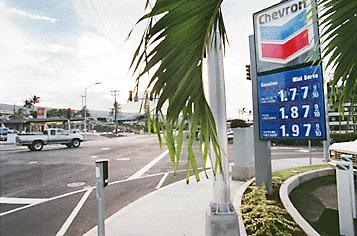
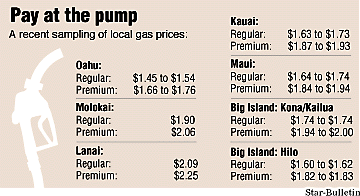
Star-BulletinOn the Kona side of the Big Island, motorists pay about $1.75 a gallon for regular unleaded gas.
That's 20 to 30 cents more than what drivers on Oahu typically are charged.
Yet the wholesale cost to Kona dealers is only about 3 to 4 cents more than what Oahu dealers pay, once differences in taxes are factored in, according to dealers and former industry officials.
Why, then, such a big difference in pump prices?
In a word, competition. Or lack thereof.
The neighbor islands individually have far fewer gas stations than Oahu, which results in less competitive pricing pressures at the retail level. That results in higher prices, especially in tourist-oriented areas like Kona.
So while Oahu motorists complain about Hawaii having the nation's highest pump prices, they can consider themselves fortunate in one sense. On the neighbor islands, prices are roughly 10 to 35 cents more per gallon for the same type of gas.
In extreme cases, such as on Lanai where regular unleaded sells for more than $2 a gallon, the difference can top 60 cents.
"The (neighbor island) consumer feels like they're absolutely being raped, absolutely being exploited," said Paul Mann, a Big Island restaurateur who used to run a gas station on the mainland. "But they don't know who to blame."
The state blames Hawaii's major gas suppliers, accusing them of conspiring to artificially inflate wholesale prices throughout the island chain. In October, the state filed a $500 million-plus antitrust lawsuit against the companies, which vigorously denied the allegations. The lawsuit is pending.
Hawaii's high prices have drawn increasing attention the past year and a half, particularly as the cost of crude oil -- the main ingredient for making gasoline -- has plunged.
That plunge has triggered steep declines in retail gas prices on the mainland. In one Ohio market, regular unleaded fell last week to 68 cents a gallon. But the drops locally have not been nearly as dramatic, adding fuel to accusations of price gouging.While dealers on Oahu have been portrayed as victims of the alleged overcharging, struggling with slim profit margins, the picture is murkier on the neighbor islands.
Dealers there acknowledge that they have much higher margins. But they also say their costs are higher -- a contention Mann and other critics dispute, except for the added cost of transporting the gas from Oahu.
Neighbor island dealers also claim their profit levels have been shrinking.
"It's getting harder and harder (to run a station), and you're making less and less," said Paul Hanada, who operates two Shell outlets on Maui. "The market is becoming more like Oahu's."
Despite the increased difficulties, current and former industry people agree that, when compared with Honolulu dealers, neighbor island ones are far from the poor house.
"They're doing exceptionally well," said Birch Akina, a retired Chevron Corp. employee who spent more than 20 years as a retail representative, working with local dealers.
Consider the differences Kona and Oahu dealers face in purchasing gas.
On Oahu, they are charged a wholesale price of roughly 90 cents a gallon for regular unleaded. In Kona, the comparable price is around $1.01, reflecting the cost of shipping the gas from Oahu to Hilo and then trucking it several hours to the Kona side of the Big Island.
Dealers on both islands, like their counterparts throughout the state, pay the same federal and state taxes -- about 35 cents a gallon. They also pay the same 4 percent general excise tax.
What they pay in county gasoline taxes, however, differs significantly. Oahu dealers are charged 16.5 cents a gallon. On the Big Island, the tax is only 8.8 cents.
Once that tax difference is accounted for, the Kona dealer effectively pays about 3 to 4 cents more than the Oahu dealer for regular unleaded gas. The tax-adjusted difference is similar for Maui and Kauai.
Yet pump prices on the neighbor islands top Oahu prices by considerably more than that 3-to-4-cent differential, resulting in much higher gross profit margins.
Margins are determined by subtracting the cost of acquiring the gas from the retail price. The difference is what the dealer uses, along with gross profits from other products and services, to cover the cost of running the station. What's left is profit.
The high margins on the neighbor islands help explain why stations there sell for as much as four times the value of comparable Oahu stations, said Frank Young, an Oahu Chevron dealer and chairman of the state's Petroleum Advisory Council.
Several neighbor island dealers said stations there need higher margins because costs for such things as rent, labor and electricity are higher.
In Kona, for example, minimum starting pay is about $7.50 an hour -- at least $1 higher than what many Oahu stations pay -- because the dealers must compete for labor with nearby resort hotels, they said.
But Mann, who has owned a restaurant near Kona for the past 13 years and ran a mainland gas station for seven, said business costs in Kona are no greater overall than those on Oahu.
He said neighbor island dealers are just as guilty as the oil companies of overcharging.
"When there's a 30-cent difference (between Kona and Oahu prices), something's really wrong," Mann said.
Spokesmen for Chevron Corp., which operates one of Hawaii's two refineries and has the largest chunk of the retail gas market, and Tesoro Hawaii, which operates the other refinery, declined comment, citing the pending litigation.
Hanada, the Maui dealer, said comparing prices from different markets is unfair.
"There are a lot of factors that affect the price of gasoline," he said. "The decision lies with the dealer on how competitive he wants to be in the marketplace or how competitive he can afford to be ... But there's nothing wrong with somebody making money."
Hanada said dealers charge whatever the market will bear, not necessarily what their costs are. That's no different than what retailers do when they price grocery products, he said.
Hanada noted that Maui dealers have become much more competitive in pricing during the past year and a half.
At one of his stations, the regular unleaded self-service price has dropped about 23 cents a gallon, to $1.64, since early last year, even though his wholesale price declined only 8 to 10 cents, according to Hanada.
But the regular unleaded price of $1.85 a gallon at his "Gas and Go" pumps, which draw the majority of customers, hasn't changed. That meant Hanada was making much higher margins with that gas but much lower ones with self-service.
While gas sales generate the majority of his income, Hanada said he gets higher profit margins by selling such things as cigarettes. A pack can be sold at a 30 percent to 40 percent mark-up, he said, compared with the 8 percent return he currently gets on self-serve regular unleaded.
Indeed, gas prices when adjusted for inflation haven't gone up much compared with other consumer products, neighbor island dealers said.
"People are constantly picking on the price of gasoline but don't say anything about the price of bread, milk, cereal," said Duke McBeath, who operates two Hilo service stations. "If you checked other items, gas is still a bargain."
McBeath's stations recently were selling regular unleaded for about $1.62 a gallon.
One critical factor in pricing gasoline is volume. The more volume a station does the more flexibility the dealer has spreading the station's operating costs over many gallons.
If a station sells only 50,000 gallons a month (the state average is roughly 100,000), the dealer needs higher margins than the average station to generate the same amount of revenue.
That's one reason places like Lanai have such expensive gas, dealers said.
But even when neighbor island stations sell significantly more gas than Oahu ones, their prices generally still are much higher.
"It all depends I suppose on what they can get away with," said Akina, the retired Chevron employee.
Dealers say the bottom line is competition. And the competition is much stiffer on Oahu, where prices at some stations have fallen below $1.50 a gallon for the first time in several years.
Said one Kona dealer: "They're kind of crazy over there in Honolulu. I don't know how those dealers stay in business."
