
Keeping Japanese
immigrant
history alive
Kiyoshi Okubo, 93, operates
By Rod Thompson
Hilo's Hawaii Shima Japanese
Immigrant Museum with
wisdom and humor
Star-BulletinHILO -- If retired Japanese-language newspaperman Kiyoshi Okubo had tried to immigrate from Japan to Hawaii just three months later in 1924, he would have been blocked by a new U.S. law.
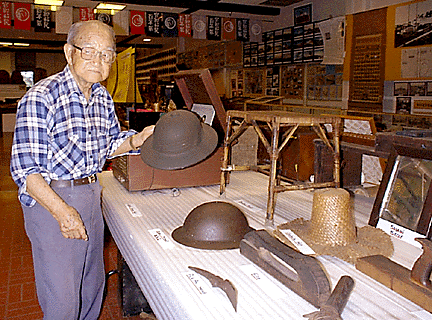
Japanese exclusion is one of the events Okubo, 93, highlights when he discusses the Hawaii Shima (Island) Japanese Immigrant Museum he operates in Hilo's Kaikoo Mall.
The museum moved in September from a house across the street where it had been sheltered for decades. The old building had decayed to the point that it was starting to collapse, said Okubo's friend, Tom Okuyama.
Okubo feels Japanese exclusion must be viewed with another event in 1924: the publication in the New York Times of a statement by 29 prominent university presidents nationwide condemning the law.
Okubo couldn't become a citizen until the law was changed after World War II. His wife and son already enjoyed American citizenship. He was naturalized in 1955 with the personal motto "One flag, one family."
Now he playfully suggests he's living by a new motto: "Mo' makule, mo' pupule." (The older I get, the crazier I get.)
Despite the joke, Okuyama says Okubo's mind is sound. "He's a journalist by trade. He doesn't write too many notes. He can remember everything."
He also kept in touch with Japanese classmates from the 1920s as they reached positions of power. "That's why he can go and tell the consul general what he wants. He knows all the prime ministers," Okuyama said.
Born in Niigata in 1905, Okubo was a student in Tokyo at the time of the great 1923 earthquake.
Prospects weren't good in the damaged city, so on April 9, 1924, at the invitation of a brother, he came to Hawaii. Then 19-1/2, he was also just six months away from Japanese army draft age.
He became a student at Iolani School, a Japanese-language teacher in Kona and, in 1932, Hilo branch manager of the Honolulu-based Hawaii Hochi. From 1936 onward he also managed a Japanese-language radio program.
When the attack on Pearl Harbor took place, Japanese in Hilo thought it was a U.S. government drill, Okubo said. But he listened to a radio report on it from Los Angeles and knew Japanese in America were being interned.
He put on a suit and tie and waited at home for police to arrest him. They came at midnight.
After 39 days of internment at Kilauea Military Camp, he was released. Fred Makino, the Irish-Japanese publisher of the Hawaii Hochi, needed him.
And the U.S. Army needed Makino. Seventy percent of the Japanese in Hawaii couldn't understand English, Okubo says. The only way for the Army to communicate its frequent directives was through Japanese-language newspapers.
Authorities ordered people of Japanese ancestry to destroy Japanese cultural items.
Okubo sold 1-1/2 tons of books for $14 to a paper mill for pulp. His personal collections after the war and donations from others form the basis of his museum.
In 1963, Okubo learned that Hilo dentist Harry Urasaki served at war's end as a translator for Japanese war leader Hideki Tojo. Urasaki still had the blood-stained uniform Tojo was wearing when he tried to commit suicide.
With Urasaki's permission, Okubo traveled to Japan to return the uniform to the Tojo family. In return, the family gave him a short piece of calligraphy written in Tojo's own hand before he was executed.
Okubo shows it and explains that it says, "Now I will return to the Buddha."
Okubo began his own newspaper, the Hilo Times, in 1955 and closed it in 1991. Three months ago he offered to donate his printing press, one of only two of its kind in the world, to a printing museum in Tokyo.
Most of the items in his museum are old newspapers, 78-rpm records and photographs.
Some are unusual, such as the armlike sewing stand for making basting stitches.
There also is a wooden object about a foot high which has two small rollers, apparently for squeezing something.
"Nobody seems to know what it is," says museum volunteer Kiyoko Okuyama. "Maybe in the olden days they used it for drying lau hala (after it was soaked)."
Why does Okubo collect these things?
"Because other people won't do it," he said. "I'm not a smart guy, only I did it."
